
U.S. hotels began 2026 steadily, with flat occupancy and slightly higher ADR for January. As of February, HVS expects modest RevPAR growth in 2026 and stronger gains in 2027 and 2028. Cap rates are trending downward as more distressed assets sell, while transaction activity is slowly gaining momentum, supported by lower interest rates.
Industry Insights
We have written thousands of articles about all aspects of hospitality, including valuations, investing, lending, operations, asset management, and much more.
HVS U.S. Market Pulse: February 2026
U.S. hotels began 2026 steadily, with flat occupancy and slightly higher ADR for January. As of February, HVS expects modest RevPAR growth in 2026 and stronger gains in 2027 and 2028. Cap rates are trending downward as more distressed assets sell, while transaction activity is slowly gaining momentum, supported by lower interest rates.
Minneapolis–St. Paul Hotel Recovery Remains Tepid
The hotel sector in Minneapolis–St. Paul continues to evolve and recover from pre- and post-pandemic oversupply and demand changes. Leisure and event-driven travel have returned with renewed energy, but not yet at the scale needed to fully offset the region’s corporate travel losses.
HVS Global Perspectives: Our 2025 Outlooks
Our views around the world reflect early optimism for 2025, with the anticipation of stronger transaction activity and modestly improving hotel metrics in most regions.
Minneapolis-St. Paul Hotel Market Moves Toward a New Normal
Hard hit by a multitude of factors during the pandemic, the Twin Cities hotel market has experienced significant fluctuations in supply, demand, and operating performance. Signs of resilience are evident in the year-to-date trends, as the hotel market adjusts to supply changes and a different demand mix.
Look What You Made Me Do To The U.S. Economy (Taylor's Version)
Taylor Swift’s Eras Tour has had an estimated $4.6 billion impact on the US economy. This seems absurd at first, but HVS analysis reveals that Swift’s tour is an immense outlier from other concert tours in attracting attendees from out of town. More than 3.7 million people travelled more than 100 miles from home to see Swift perform.
Hotel Operators Get Creative To Enhance Guest Revenue Capture
As HVS associates travel nationwide and experience new hotels, or newly renovated and revitalized properties, we are seeing many owners creating innovative ways to generate revenue. This article lists just a few ways we’ve recently come across.
The Minneapolis-St. Paul MSA: A Lagging Recovery
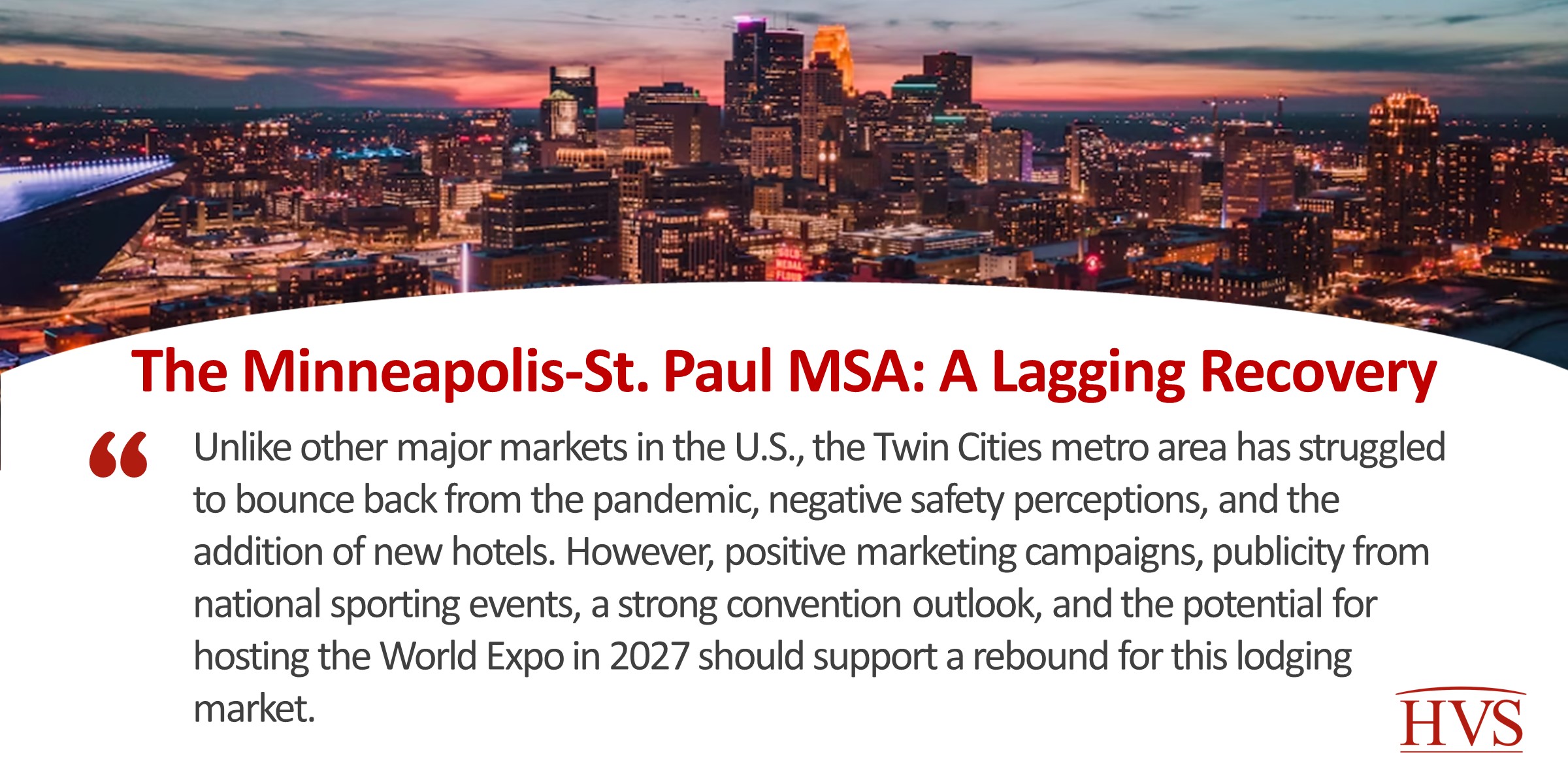
Unlike other major markets in the U.S., the Twin Cities metro area has struggled to bounce back from the pandemic, negative safety perceptions, and the addition of new hotels. However, positive marketing campaigns, publicity from national sporting events, a strong convention outlook, and the potential for hosting the World Expo in 2027 should support a rebound for this lodging market.
Tampa Bay Lodging Market: A High-Impact Destination
The greater Tampa Bay lodging market is thriving, as evidenced by rising RevPAR levels, the entrance and subsequent absorption of significant new guestroom inventory, several high-profile transactions, and numerous exciting development projects in the market’s pipeline.
Hotel Market Recovery – Minneapolis-St. Paul
Reeling from the impact of new supply, seasonality, civil unrest, and a global pandemic, Minneapolis-St. Paul hotels faced a staggering RevPAR drop in 2020, worse than most cities in the United States. While the greater metro-area hotel market has begun to bounce back, it is at a much a slower pace than the national rebound. What has the recovery looked like thus far? When will the market return to pre-pandemic levels?
HVS Market Pulse - Minneapolis-St. Paul
The Twin Cities hotel market has suffered a greater loss than that of the nation given the combined impact of the COVID-19 pandemic and civil unrest. Many hotels suspended operations between April and June, with little activity taking place in urban cores. How far has the market fallen, and what will the next few years look like?
Industry Insights
We have written thousands of articles about all aspects of hospitality, including valuations, investing, lending, operations, asset management, and much more.
The hotel sector in Minneapolis–St. Paul continues to evolve and recover from pre- and post-pandemic oversupply and demand changes. Leisure and event-driven travel have returned with renewed energy, but not yet at the scale needed to fully offset the region’s corporate travel losses.
Our views around the world reflect early optimism for 2025, with the anticipation of stronger transaction activity and modestly improving hotel metrics in most regions.
Hard hit by a multitude of factors during the pandemic, the Twin Cities hotel market has experienced significant fluctuations in supply, demand, and operating performance. Signs of resilience are evident in the year-to-date trends, as the hotel market adjusts to supply changes and a different demand mix.
Taylor Swift’s Eras Tour has had an estimated $4.6 billion impact on the US economy. This seems absurd at first, but HVS analysis reveals that Swift’s tour is an immense outlier from other concert tours in attracting attendees from out of town. More than 3.7 million people travelled more than 100 miles from home to see Swift perform.
As HVS associates travel nationwide and experience new hotels, or newly renovated and revitalized properties, we are seeing many owners creating innovative ways to generate revenue. This article lists just a few ways we’ve recently come across.
Unlike other major markets in the U.S., the Twin Cities metro area has struggled to bounce back from the pandemic, negative safety perceptions, and the addition of new hotels. However, positive marketing campaigns, publicity from national sporting events, a strong convention outlook, and the potential for hosting the World Expo in 2027 should support a rebound for this lodging market.
The greater Tampa Bay lodging market is thriving, as evidenced by rising RevPAR levels, the entrance and subsequent absorption of significant new guestroom inventory, several high-profile transactions, and numerous exciting development projects in the market’s pipeline.
Reeling from the impact of new supply, seasonality, civil unrest, and a global pandemic, Minneapolis-St. Paul hotels faced a staggering RevPAR drop in 2020, worse than most cities in the United States. While the greater metro-area hotel market has begun to bounce back, it is at a much a slower pace than the national rebound. What has the recovery looked like thus far? When will the market return to pre-pandemic levels?
The Twin Cities hotel market has suffered a greater loss than that of the nation given the combined impact of the COVID-19 pandemic and civil unrest. Many hotels suspended operations between April and June, with little activity taking place in urban cores. How far has the market fallen, and what will the next few years look like?
Robust demand in urban centers continues to drive Canadian hotel values despite high interest rate environment.