
Introduction
Kos is one of the most established resort destinations in the Dodecanese and among the most important island hotel markets in Greece. The island benefits from strong international recognition, extensive seasonal air connectivity, well-developed resort infrastructure and long-standing relationships with European tour operators. These characteristics have allowed Kos to attract significant volumes of leisure demand and to remain relevant through multiple tourism cycles.
While Kos remains strongly associated with sun-and-sea tourism and high-volume resort demand, its hotel market is gradually evolving. The next phase of development is increasingly shaped by the island’s ability to extract greater value from its established demand base through product upgrading, stronger positioning and improved operating performance, and, in selected cases, repositioning of existing assets and new capital entering the market.
This article examines the key demand, supply and investment signals shaping the evolution of Kos. It covers the island’s destination profile, tourism demand, hotel supply and recent development activity, and assesses hotel performance for the upper-upscale and luxury resort segment. This approach offers a clearer view of how a mature Dodecanese resort market is moving from scale-driven growth towards more quality-led, revenue-focused hospitality development.
While Kos remains strongly associated with sun-and-sea tourism and high-volume resort demand, its hotel market is gradually evolving. The next phase of development is increasingly shaped by the island’s ability to extract greater value from its established demand base through product upgrading, stronger positioning and improved operating performance, and, in selected cases, repositioning of existing assets and new capital entering the market.
This article examines the key demand, supply and investment signals shaping the evolution of Kos. It covers the island’s destination profile, tourism demand, hotel supply and recent development activity, and assesses hotel performance for the upper-upscale and luxury resort segment. This approach offers a clearer view of how a mature Dodecanese resort market is moving from scale-driven growth towards more quality-led, revenue-focused hospitality development.
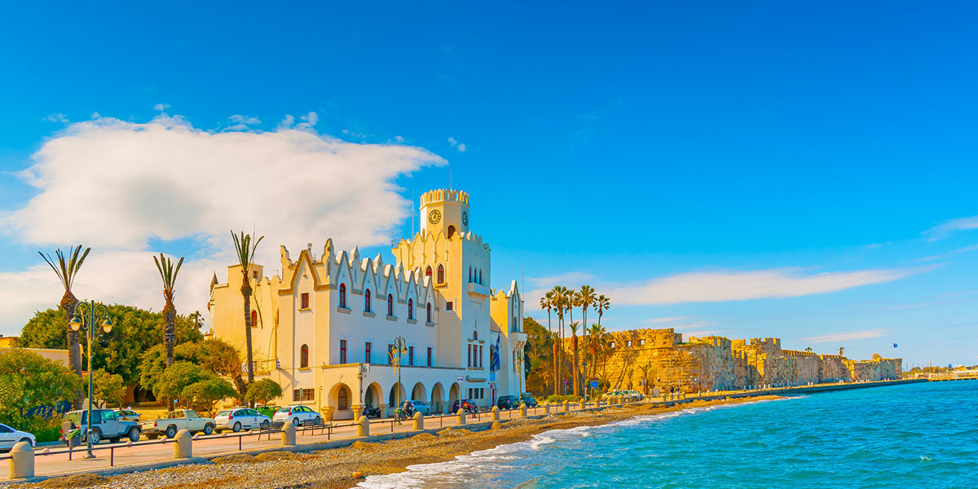
Kos Town waterfront and Castle of Neratzia
Source: Shutterstock
The accommodation offer is spread across a series of established coastal resort areas, including Psalidi, Tigaki, Marmari, Kardamena and Kefalos. These support a broad accommodation mix, ranging from family-oriented and all-inclusive resorts to higher-rated beachfront properties and adults-oriented leisure concepts. Kos Town provides the main urban, commercial and cultural anchor, offering accommodation, retail, food and beverage, nightlife and access to the historic harbourfront. This structure allows Kos to serve a wide range of international leisure demand while maintaining a clear resort identity. Compared with more diversified destinations, its strength lies in the clarity and efficiency of its tourism product: a straightforward, accessible and well-organised resort experience.
Beyond its core sun-and-sea appeal, Kos benefits from elements that add depth to its beach positioning. Its association with Hippocrates, the Asclepieion, the Castle of Neratzia and other archaeological sites give the island historical depth, while cycling routes, marina infrastructure, coastal villages, gastronomy and proximity to nearby islands and the Turkish coast broaden the visitor experience. These features do not change the island’s core resort character, but they allow hotels to differentiate through wellness, active leisure, nautical tourism and more experience-led hospitality.
The future opportunity for Kos is less about redefining the island as a luxury destination than about improving the value extracted from its existing resort model. Given its established demand base and concentration of resort properties, value creation is likely to come from the upgrading of existing assets, stronger upper-tier positioning, improved operating efficiency and more differentiated guest experiences. The island’s competitive advantage lies in combining operationally efficient resort demand with better-positioned, higher-quality accommodation products. In this context, Kos’ evolution should be viewed as a quality-led refinement of a mature resort market rather than a complete repositioning of the destination.
Destination Overview
Kos occupies a distinct position within the Dodecanese hotel market. While smaller in scale than Rhodes, the island has developed into a highly efficient and well-established resort destination, supported by a compact geography, an accessible coastline, strong seasonal air access and a hospitality product closely aligned with international leisure demand. Its tourism model is shaped by beach-led holidays, resort stays and package travel, making it one of the most recognisable sun-and-sea destinations in the South Aegean.The accommodation offer is spread across a series of established coastal resort areas, including Psalidi, Tigaki, Marmari, Kardamena and Kefalos. These support a broad accommodation mix, ranging from family-oriented and all-inclusive resorts to higher-rated beachfront properties and adults-oriented leisure concepts. Kos Town provides the main urban, commercial and cultural anchor, offering accommodation, retail, food and beverage, nightlife and access to the historic harbourfront. This structure allows Kos to serve a wide range of international leisure demand while maintaining a clear resort identity. Compared with more diversified destinations, its strength lies in the clarity and efficiency of its tourism product: a straightforward, accessible and well-organised resort experience.
Beyond its core sun-and-sea appeal, Kos benefits from elements that add depth to its beach positioning. Its association with Hippocrates, the Asclepieion, the Castle of Neratzia and other archaeological sites give the island historical depth, while cycling routes, marina infrastructure, coastal villages, gastronomy and proximity to nearby islands and the Turkish coast broaden the visitor experience. These features do not change the island’s core resort character, but they allow hotels to differentiate through wellness, active leisure, nautical tourism and more experience-led hospitality.
The future opportunity for Kos is less about redefining the island as a luxury destination than about improving the value extracted from its existing resort model. Given its established demand base and concentration of resort properties, value creation is likely to come from the upgrading of existing assets, stronger upper-tier positioning, improved operating efficiency and more differentiated guest experiences. The island’s competitive advantage lies in combining operationally efficient resort demand with better-positioned, higher-quality accommodation products. In this context, Kos’ evolution should be viewed as a quality-led refinement of a mature resort market rather than a complete repositioning of the destination.
Tourism Demand
Kos benefits from a sizeable and well-established tourism demand base, supported by its mature resort identity, strong international accessibility and long-standing presence in European leisure markets. In 2025, the island recorded approximately 1.4 million hotel arrivals and 8.8 million hotel bednights, confirming its position as one of the most important resort destinations in the South Aegean. Over the 2019–25 period, hotel arrivals and bednights increased at compound annual growth rates of 1.0% and 0.5%, respectively, indicating that accommodated demand remained broadly resilient despite the disruption caused by the pandemic.
Source: ELSTAT processed by HVS
International demand remains the primary driver of the island’s tourism market. Kos has historically benefited from strong recognition across key European source markets, extensive tour-operator relationships and direct seasonal air connectivity. These factors have supported the island’s ability to attract substantial volumes of leisure travellers and have reinforced its position as a mature and well-established resort destination in the Dodecanese.
Air connectivity remains central to Kos’ competitive position. In 2025, Kos International Airport handled approximately 1.6 million passengers, having increased at a compound annual growth rate of 3.5% over the 2019–25 period. This underlines the importance of direct seasonal flights from key European source markets and supports the island’s ability to sustain high-volume resort demand during the main tourism season.
Sea access also forms part of Kos’ broader tourism ecosystem. In 2025, seaport passenger traffic reached approximately 389,000 passengers, increasing at a compound annual growth rate of 3.4% over the 2019–25 period. While air travel remains the main gateway for international leisure demand, maritime connectivity supports ferry movements, island-hopping flows and wider regional mobility within the Dodecanese.
Kos’ demand profile is defined by scale, international leisure orientation and strong accessibility. The island has already demonstrated its ability to attract and accommodate significant tourism volumes. The key opportunity going forward lies less in volume growth alone and more in converting this established demand base into higher-value performance through product upgrading, stronger upper-tier positioning and more efficient resort operations.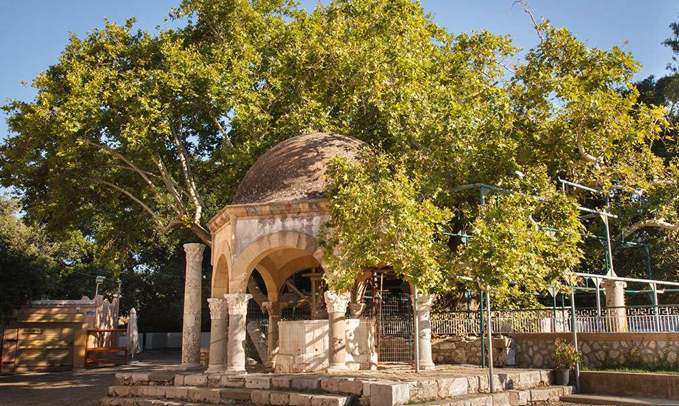
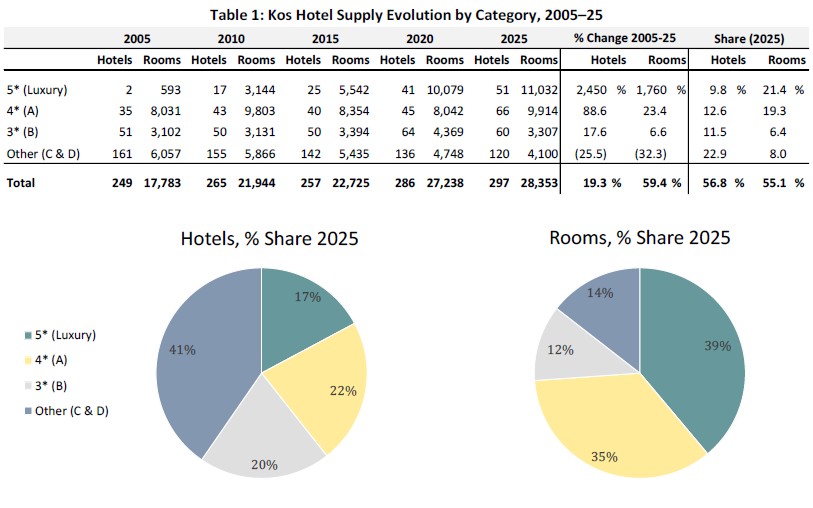
The evolution of hotel supply in Kos points to a clear quality-led development cycle. While total hotel supply increased moderately over the reviewed period, growth was heavily concentrated in the five-star segment. Five-star hotels increased from only two properties and approximately 600 rooms in 2005 to 51 properties and around 11,000 rooms in 2025. This represents a substantial expansion of the luxury segment and indicates that the island’s hotel development has increasingly been driven by the upgrading, expansion and repositioning of larger resort assets rather than by the addition of smaller lower-category properties. In 2025, five-star and four-star hotels accounted for approximately 40% of total hotel units, but represented around 74% of total room supply. This highlights the strong room-weighted concentration of the upper categories and confirms that Kos’ accommodation base is structurally dominated by larger upscale and luxury resort assets. The five-star segment alone accounted for approximately 17% of total hotels and 39% of total rooms, underlining the increasing importance of luxury accommodation within the island’s hotel structure.
The scale differential between categories is also notable. In 2025, five-star hotels averaged approximately 216 rooms per property, while four-star hotels averaged around 150 rooms per property. By comparison, three-star hotels averaged approximately 55 rooms, while two-star and one-star hotels combined averaged around 34 rooms per property. This confirms that the island’s upper-tier segments are primarily composed of larger resort-style assets, while the lower categories remain more fragmented and small-scale. Lower-category hotels continue to represent a significant share of hotel units, with two-star and one-star properties together accounting for approximately 40% of total hotels in 2025. However, their contribution in terms of room supply is much more limited, with two-star and one-star properties together representing only around 14% of total rooms. This reflects the smaller scale of these properties and suggests that Kos’ supply base has been moving towards larger and more professionally operated resort assets.
 Source: Hellenic Chamber of Hotels
Air connectivity remains central to Kos’ competitive position. In 2025, Kos International Airport handled approximately 1.6 million passengers, having increased at a compound annual growth rate of 3.5% over the 2019–25 period. This underlines the importance of direct seasonal flights from key European source markets and supports the island’s ability to sustain high-volume resort demand during the main tourism season.
Sea access also forms part of Kos’ broader tourism ecosystem. In 2025, seaport passenger traffic reached approximately 389,000 passengers, increasing at a compound annual growth rate of 3.4% over the 2019–25 period. While air travel remains the main gateway for international leisure demand, maritime connectivity supports ferry movements, island-hopping flows and wider regional mobility within the Dodecanese.
Kos’ demand profile is defined by scale, international leisure orientation and strong accessibility. The island has already demonstrated its ability to attract and accommodate significant tourism volumes. The key opportunity going forward lies less in volume growth alone and more in converting this established demand base into higher-value performance through product upgrading, stronger upper-tier positioning and more efficient resort operations.
The Tree of Hippocrates, one of Kos’ most recognisable cultural landmarks
Source: Shutterstock
Hotel Supply
Kos has a sizeable and well-established hotel market, with a total supply of 297 hotels and approximately 28,300 rooms in 2025. Over the 2005–25 period, the number of hotels increased by 19.3%, while total room supply expanded by 59.4%. This indicates that the island’s accommodation base has grown not only in terms of hotel units, but more importantly in terms of scale, with the market gradually shifting towards larger resort properties.The evolution of hotel supply in Kos points to a clear quality-led development cycle. While total hotel supply increased moderately over the reviewed period, growth was heavily concentrated in the five-star segment. Five-star hotels increased from only two properties and approximately 600 rooms in 2005 to 51 properties and around 11,000 rooms in 2025. This represents a substantial expansion of the luxury segment and indicates that the island’s hotel development has increasingly been driven by the upgrading, expansion and repositioning of larger resort assets rather than by the addition of smaller lower-category properties. In 2025, five-star and four-star hotels accounted for approximately 40% of total hotel units, but represented around 74% of total room supply. This highlights the strong room-weighted concentration of the upper categories and confirms that Kos’ accommodation base is structurally dominated by larger upscale and luxury resort assets. The five-star segment alone accounted for approximately 17% of total hotels and 39% of total rooms, underlining the increasing importance of luxury accommodation within the island’s hotel structure.
The scale differential between categories is also notable. In 2025, five-star hotels averaged approximately 216 rooms per property, while four-star hotels averaged around 150 rooms per property. By comparison, three-star hotels averaged approximately 55 rooms, while two-star and one-star hotels combined averaged around 34 rooms per property. This confirms that the island’s upper-tier segments are primarily composed of larger resort-style assets, while the lower categories remain more fragmented and small-scale. Lower-category hotels continue to represent a significant share of hotel units, with two-star and one-star properties together accounting for approximately 40% of total hotels in 2025. However, their contribution in terms of room supply is much more limited, with two-star and one-star properties together representing only around 14% of total rooms. This reflects the smaller scale of these properties and suggests that Kos’ supply base has been moving towards larger and more professionally operated resort assets.
From an investment perspective, Kos’ supply structure is increasingly aligned with the characteristics of a mature and operationally efficient resort market. The strong concentration of rooms in the five- and four-star categories provides a platform for further product upgrading, asset management and upper-tier repositioning, particularly among larger resort properties with the scale required to support improved operating performance.
Overall, the evolution of hotel supply in Kos reflects a gradual shift from volume-led accommodation growth towards a more quality-oriented resort market. While the island’s value-creation story is less visibly driven by international luxury branding, the strong expansion of five-star room supply and the dominance of upper-tier resort assets indicate that Kos is increasingly focused on extracting greater value from its established leisure demand base through scale, product quality and operational efficiency.
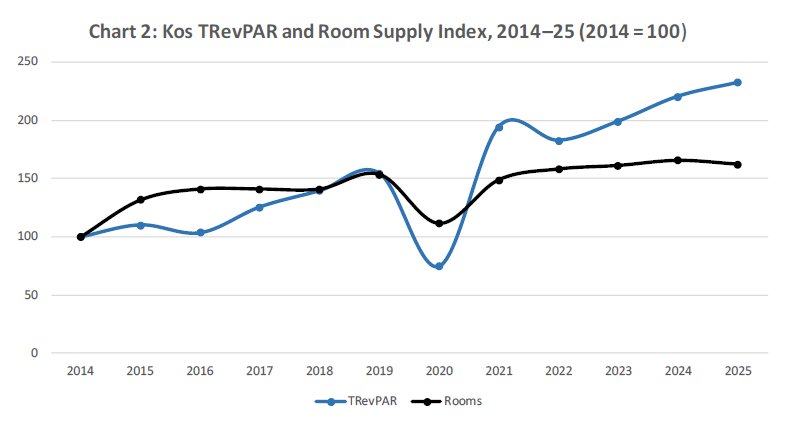
Room supply within the sample increased steadily over the reviewed period, with the room supply index rising from 100 in 2014 to 162 in 2025. This reflects the gradual expansion of the analysed four- and five-star hotel sample, supported by the addition and development of larger upper-tier resort properties. Following the disruption of 2020, the sample recovered quickly, with room supply increasing from an index level of 112 in 2020 to 147 in 2021 and reaching 162 by 2025.
TRevPAR followed a more dynamic pattern. The index increased from 100 in 2014 to 154 in 2019, before declining sharply to 75 in 2020 as a result of the pandemic-related disruption. The recovery was strong, with TRevPAR rising to 194 in 2021 and remaining well above pre-pandemic levels thereafter. By 2025, the TRevPAR index reached 232, representing the highest level over the reviewed period.
The comparison between TRevPAR and room supply indicates that Kos’ upper-tier hotel market has been able not only to absorb additional sampled room capacity, but also to improve revenue performance at a faster pace than supply growth. While the room supply index increased to 162 in 2025, TRevPAR reached 232, suggesting that the island’s four- and five-star hotel market has strengthened its ability to generate higher revenue per available room.
Overall, the performance trend supports the view that Kos’ hotel market is moving towards a more quality-led and revenue-focused operating model. The strong increase in TRevPAR, particularly after 2020, suggests that the island’s upper-tier resort segment has benefited from resilient leisure demand, improved pricing power and the gradual upgrading of the accommodation product. This reinforces Kos’ value-creation potential, which appears to be driven less by visible international luxury branding and more by resort scale, operational efficiency and product enhancement within the four- and five-star segments.
Source: HVS Research
Overall, the evolution of hotel supply in Kos reflects a gradual shift from volume-led accommodation growth towards a more quality-oriented resort market. While the island’s value-creation story is less visibly driven by international luxury branding, the strong expansion of five-star room supply and the dominance of upper-tier resort assets indicate that Kos is increasingly focused on extracting greater value from its established leisure demand base through scale, product quality and operational efficiency.
Hotel Performance
To assess hotel performance in Kos, an index analysis was prepared for TRevPAR and room supply, with 2014 set as the base year. The analysis is based on a sample of 42 four- and five-star hotels, with room supply reflecting the total number of rooms within this sample rather than the island’s total hotel room stock. The analysis provides an indicative view of how the revenue-generating capacity of Kos’ upper-tier hotel market evolved in relation to the expansion of its sampled room supply over the 2014–25 period.Room supply within the sample increased steadily over the reviewed period, with the room supply index rising from 100 in 2014 to 162 in 2025. This reflects the gradual expansion of the analysed four- and five-star hotel sample, supported by the addition and development of larger upper-tier resort properties. Following the disruption of 2020, the sample recovered quickly, with room supply increasing from an index level of 112 in 2020 to 147 in 2021 and reaching 162 by 2025.
TRevPAR followed a more dynamic pattern. The index increased from 100 in 2014 to 154 in 2019, before declining sharply to 75 in 2020 as a result of the pandemic-related disruption. The recovery was strong, with TRevPAR rising to 194 in 2021 and remaining well above pre-pandemic levels thereafter. By 2025, the TRevPAR index reached 232, representing the highest level over the reviewed period.
The comparison between TRevPAR and room supply indicates that Kos’ upper-tier hotel market has been able not only to absorb additional sampled room capacity, but also to improve revenue performance at a faster pace than supply growth. While the room supply index increased to 162 in 2025, TRevPAR reached 232, suggesting that the island’s four- and five-star hotel market has strengthened its ability to generate higher revenue per available room.
Overall, the performance trend supports the view that Kos’ hotel market is moving towards a more quality-led and revenue-focused operating model. The strong increase in TRevPAR, particularly after 2020, suggests that the island’s upper-tier resort segment has benefited from resilient leisure demand, improved pricing power and the gradual upgrading of the accommodation product. This reinforces Kos’ value-creation potential, which appears to be driven less by visible international luxury branding and more by resort scale, operational efficiency and product enhancement within the four- and five-star segments.
Source: HVS Research
Recent Openings, Repositioning Projects & Management Changes
Recent hotel activity in Kos points to the continued upgrading of the island’s resort product, with investment focused on new five-star openings, refreshed all-inclusive resorts, upgraded guest facilities and larger-scale pipeline developments. Kos’ value-creation story is closely linked to the improvement of established resort assets, the expansion of upper-tier accommodation and the strengthening of operationally efficient leisure products. This is reflected in recent ownership changes at two of the island’s long-established family-owned resort groups. The five Kipriotis hotels in Psalidi (1,522 rooms) have passed to H.I.G. Capital, and a renovation of the 709-room Kipriotis Village Resort is being planned. In Kardamena, the Paterakis family’s Porto Bello Royal (five-star, 418 rooms) and Porto Bello Beach (four-star, 326 rooms) were acquired by Brook Lane Capital. Both transactions show established resort assets moving from founder-led ownership to institutional capital, with repositioning and upgrading likely to follow.Mosay All Suite Hotel – New Five-Star (2025)
Mosay All Suite Hotel opened in Kos in 2025 as a new five-star, beachfront all-suite hotel in the Lambi area. The property comprises 127 suites and is positioned around a blend of Mediterranean and Eastern influences, with a private beach, six pools, spa and fitness facilities. Its opening adds a more design-led and experience-oriented product to the island’s accommodation base, supporting Kos’ gradual move towards higher-quality and more differentiated resort concepts.
ARATO by E-GEO – New Adults-Only Hotel, Opened July 2026
ARATO by E-GEO is a new five-star, adults-only hotel in Lambi, close to the beach and Kos Town. It opened in early July 2026 and was officially inaugurated on 25 July 2026. The property offers a contemporary, suite-led product, with selected rooms featuring private or swim-up pools, as well as spa and wellness facilities. Its opening supports the growth of more intimate, adults-oriented accommodation concepts on Kos, complementing the island’s established base of large-scale resorts.
Grecotel LUX ME Kos – Reimagined Resort, Reopened April 2026
Grecotel LUX ME Kos reopened on 25 April 2026 following a major renovation of the property. The works included fully redesigned family suites with private pools, a new collection of guestrooms and a new lagoon pool complex centred on “Papaya Island” with a lazy river, set within the resort’s 100,000 m² grounds in Psalidi. The project highlights continued investment in high-quality all-inclusive resort products on Kos and supports the island’s positioning in the upper-tier family and leisure segment. The relaunch is particularly relevant for Kos because it reflects the upgrading of an existing large resort into a more premium, experience-led product, rather than the addition of new room supply.
KOIA All-Suite Wellbeing Resort – Expansion (2026)
KOIA All-Suite Wellbeing Resort is a five-star, adults-only (16+) property located on the hillside above Agios Fokas, approximately seven kilometres from Kos Town. In 2026, the resort completed an expansion comprising 27 additional sea-view rooms, 19 of which feature private pools, and a two-bedroom villa, bringing total inventory to approximately 79 keys (from 51 previously), according to property management. The resort’s wellness-led positioning, anchored in the Hippocratic heritage of the island, is representative of a small but growing segment of boutique, high-rated product on Kos, which has historically been dominated by large-scale, family-oriented and all-inclusive resorts.
Casa Coa – Five-Star Pipeline Project (Marmari, Pyli)
Casa Coa is among the most significant pipeline projects on Kos. Developed by Casa Coa S.A., the proposed five-star resort is planned to comprise approximately 410 rooms and 1,200 beds on a privately owned site of approximately 10.9 hectares at Limnara, Marmari. Originally licensed in 2023 as a smaller four-star hotel, the scheme was subsequently enlarged and upgraded, with environmental terms approved in early 2026 following pre-approval of the building permit. At the time of writing, no construction start, operator or opening date has been announced. If delivered, the project would be one of the largest single additions to the island’s upper-tier supply.
Recent activity in Kos confirms that the island’s hotel market is increasingly focused on quality-led resort upgrading rather than purely quantitative supply growth. New openings such as Mosay All Suite Hotel and ARATO by E-GEO, together with the renovation of Grecotel LUX ME Kos and the expansion of KOIA All-Suite Wellbeing Resort, point to a gradual strengthening of the island’s upper-tier and experience-led accommodation offer. At the same time, pipeline projects such as Casa Coa indicate continued interest in larger-scale five-star resort development.
Conclusion
Kos remains one of the most established resort markets in the Dodecanese, supported by strong international recognition, sizeable accommodated demand, seasonal air connectivity and well-developed resort infrastructure. Unlike larger and more diversified islands, however, its next phase is less about broadening its appeal and more about extracting greater value from a compact, resort-concentrated product that already operates efficiently.
The structure of supply is central to this. Upper-tier hotels account for a disproportionately high share of total room stock, much of it in large four- and five-star resorts, many of them all-inclusive and independently owned and operated. As a result, the island’s hotel performance depends less on new market entrants and more on how existing assets are managed, renovated and repositioned.
Recent activity reflects this. Rather than a wave of international luxury flags, Kos has seen established resorts upgraded, upper-tier capacity expanded and new concepts introduced around wellness, adults-oriented stays and design-led suites. The island is refining its product from within, adding quality without diluting the large-scale leisure identity that underpins its demand.
The TRevPAR and room supply index analysis supports this reading. Kos has recovered strongly from the pandemic-related disruption, and the growth in total revenue per available room indicates that hotels are capturing more spend per guest, not simply filling more rooms. This is particularly relevant in a market where on-site food and beverage, spa and leisure facilities are central to the resort offer.
The main lever for Kos is operational. With demand largely proven, the opportunity lies in asset management: renovating ageing resort stock, refining the all-inclusive model, controlling costs amid rising energy and labour expenses, and growing ancillary revenue. Owners and operators who invest selectively in product and systems are best placed to turn the island’s demand into stronger profitability.
Kos is set to remain a high-volume resort destination. Its evolution is best understood as a gradual, asset-by-asset upgrade of a mature resort base, in which value is created through better-run and better-positioned hotels rather than a change in the island’s core identity.
The structure of supply is central to this. Upper-tier hotels account for a disproportionately high share of total room stock, much of it in large four- and five-star resorts, many of them all-inclusive and independently owned and operated. As a result, the island’s hotel performance depends less on new market entrants and more on how existing assets are managed, renovated and repositioned.
Recent activity reflects this. Rather than a wave of international luxury flags, Kos has seen established resorts upgraded, upper-tier capacity expanded and new concepts introduced around wellness, adults-oriented stays and design-led suites. The island is refining its product from within, adding quality without diluting the large-scale leisure identity that underpins its demand.
The TRevPAR and room supply index analysis supports this reading. Kos has recovered strongly from the pandemic-related disruption, and the growth in total revenue per available room indicates that hotels are capturing more spend per guest, not simply filling more rooms. This is particularly relevant in a market where on-site food and beverage, spa and leisure facilities are central to the resort offer.
The main lever for Kos is operational. With demand largely proven, the opportunity lies in asset management: renovating ageing resort stock, refining the all-inclusive model, controlling costs amid rising energy and labour expenses, and growing ancillary revenue. Owners and operators who invest selectively in product and systems are best placed to turn the island’s demand into stronger profitability.
Kos is set to remain a high-volume resort destination. Its evolution is best understood as a gradual, asset-by-asset upgrade of a mature resort base, in which value is created through better-run and better-positioned hotels rather than a change in the island’s core identity.