
Introduction
Rhodes is one of the most established resort destinations in the Dodecanese and among the most important hotel markets in Greece. The island benefits from strong international recognition, extensive seasonal air connectivity, developed resort infrastructure, and long-standing relationships with European tour operators. These characteristics have enabled Rhodes to attract significant volumes of leisure demand and maintain its relevance through multiple tourism cycles.
While Rhodes remains a high-volume resort destination, its hotel market is gradually evolving. The next phase of development is increasingly shaped by the island’s ability to extract greater value from its established demand base through product upgrading, stronger positioning, improved operating performance and, in selected cases, brand affiliation and repositioning activity.
This report examines the key demand, supply, performance and investment signals shaping the evolution of Rhodes. The island is analysed in terms of destination profile, tourism demand, hotel supply, hotel performance and recent development activity. This approach allows for a clearer view of how one of Greece’s most mature island resort markets is transitioning from scale-driven growth towards more quality-led and revenue-focused hospitality development.
While Rhodes remains a high-volume resort destination, its hotel market is gradually evolving. The next phase of development is increasingly shaped by the island’s ability to extract greater value from its established demand base through product upgrading, stronger positioning, improved operating performance and, in selected cases, brand affiliation and repositioning activity.
This report examines the key demand, supply, performance and investment signals shaping the evolution of Rhodes. The island is analysed in terms of destination profile, tourism demand, hotel supply, hotel performance and recent development activity. This approach allows for a clearer view of how one of Greece’s most mature island resort markets is transitioning from scale-driven growth towards more quality-led and revenue-focused hospitality development.
Rhodes Old Town and the island’s historic harbourfront
Source: Shutterstock
Destination Overview
Rhodes has long been one of Greece’s most recognisable island destinations, combining cultural heritage, strong international accessibility and the scale of a major Mediterranean resort market. Its appeal extends beyond the conventional sun-and-sea proposition, anchored by Rhodes Old Town, one of the best-preserved medieval settlements in Europe, and Lindos, whose acropolis and coastal setting remain among the island’s most recognisable landmarks. Together with its extensive coastline and established resort areas, this combination of heritage, landscape and resort infrastructure gives Rhodes a broader tourism platform than many purely beach-led destinations, appealing to a wide range of leisure travellers.
Over the past decades, Rhodes has developed around a powerful combination of volume, connectivity and resort infrastructure. Its established position among international source markets, together with its extensive hotel base and strong tour-operator links, has supported the island’s resilience through multiple market cycles and reinforced its role as one of the Eastern Mediterranean’s leading leisure destinations. The island’s resort geography is also highly diversified, with established coastal areas such as Ixia, Ialyssos, Faliraki, Kolymbia, Lindos and Kiotari each serving different leisure segments, from family-oriented and all-inclusive resorts to couples, adults-only properties and more lifestyle-led hotel concepts.
Nowadays, however, the market’s evolution appears to be entering a more nuanced phase. Rhodes is not moving away from its large-scale resort identity, and all-inclusive and tour-operator-driven demand remain central to its tourism model. Instead, the island is increasingly seeking to generate greater value from its established demand base. This is reflected in the gradual enhancement of the hospitality product and the emergence of more clearly positioned resort concepts, with a growing number of properties placing greater emphasis on design, wellness, food and beverage, adults-only positioning and experience-led hospitality. Rather than replacing the island’s traditional resort base, this evolution adds new layers to its accommodation offer and provides a foundation for further segmentation within the upper-upscale and resort market.
Rhodes also benefits from demand generators that support a more diversified visitor experience. Its medieval town, archaeological sites, marina-related infrastructure, coastal villages and event venues provide a basis for cultural and nautical tourism, weddings and selected meetings or incentive travel. Although these segments remain secondary to the core leisure market, they strengthen the island’s ability to broaden its appeal and support demand outside the peak summer months.
As a result, the next chapter for Rhodes is likely to be defined not simply by how much demand the island can attract, but by how effectively its hospitality sector can translate scale into higher-value performance. The island’s competitive advantage lies in the breadth of its proposition: it can accommodate high-volume leisure demand while also offering the cultural depth, coastal settings and evolving resort concepts that appeal to more experience-oriented travellers. This provides the foundation for its ongoing transition from a volume-led resort market towards a more differentiated, higher-value hospitality destination.
Tourism Demand
Rhodes benefits from one of the deepest and most established tourism demand bases among Greek island destinations. In 2025, the island recorded approximately 2.70 million hotel arrivals and 16.36 million bednights, highlighting the scale of its accommodated demand and its long-standing appeal as a major leisure destination. Over the 2019-25 period, hotel arrivals increased at a CAGR of 1.9%, while bednights grew at a lower CAGR of 1.3%, indicating that the island's tourism base has continued to expand at a measured pace, with a modest shortening in the average length of stay while overnight demand remains substantial.
 Source: ELSTAT processed by HVS
Accessibility remains crucial to Rhodes' competitive position. Airport passenger arrivals reached approximately 3.53 million in 2025, increasing at a CAGR of 4.8% over the 2019–25 period. This growth outpaced both hotel arrivals and bednights, confirming the importance of air access in supporting the island's large-scale resort model and its ability to attract substantial visitor flows during the main tourism season.
Sea access also plays an important role in Rhodes' tourism ecosystem. Seaport and cruise passenger arrivals reached approximately 914,000 in 2025, increasing at a CAGR of 6.3% over the 2019–25 period. This represents the strongest growth among the key demand and access indicators shown, suggesting that maritime connectivity, including the cruise segment, has become an increasingly important complement to the island's airport-driven demand base.
Overall, Rhodes' demand profile is defined by scale, resilience and strong accessibility. The continued growth in hotel arrivals, bednights, airport passengers and seaport and cruise traffic underlines the island's position as one of Greece's most mature and high-volume resort destinations. Going forward, the next phase of development will depend less on Rhodes' ability to attract visitors and more on how effectively its hospitality sector can convert this large demand base into higher-value performance through product differentiation, stronger positioning and more experience-led hospitality.
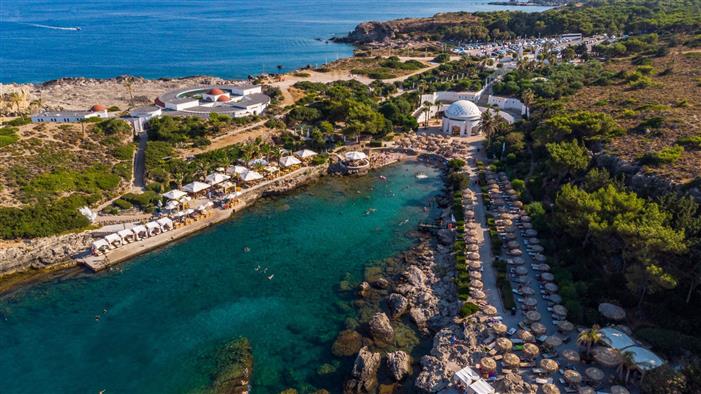
Kallithea Springs, Rhodes
Source: Shutterstock
Hotel Supply
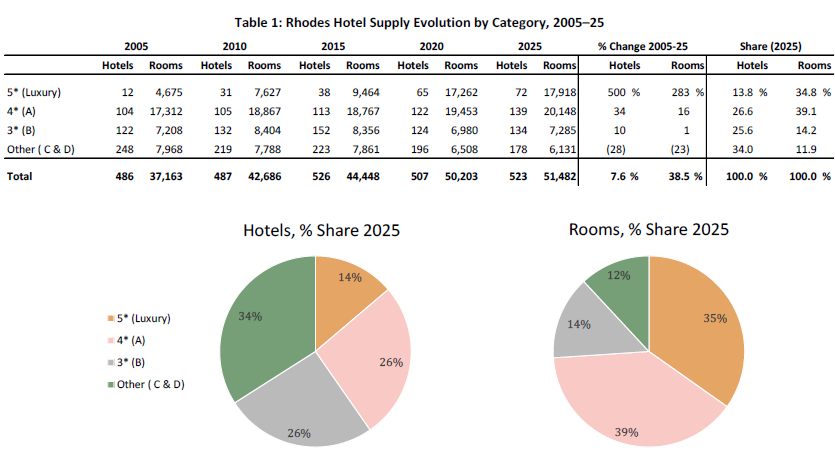
Rhodes has one of the largest and most established hotel markets in Greece, with a total supply of 523 hotels and approximately 51,500 rooms in 2025. Over the 2005–25 period, the number of hotels increased by only 7.6%, while total room supply expanded by 38.5%, indicating that growth has been driven more by larger-scale hotel units. This shift is particularly evident in the five-star segment, where the number of hotels increased from 12 to 72 and room supply grew by 283%, from approximately 4,700 rooms in 2005 to approximately 17,900 rooms in 2025. At the same time, the combined "other" category (two- and one-star hotels) contracted, with hotel rooms declining by 23%, while four-star and three-star room supply increased by a more moderate 16% and 1%, respectively. The evolution of supply suggests a gradual move away from fragmented quantitative expansion towards a more quality-led development cycle, driven by the expansion, upgrading and repositioning of larger upper-tier resort assets.
In 2025, five-star and four-star hotels accounted for approximately 40% of total hotel units, but represented almost 74% of total room supply. This highlights the strong room-weighted concentration of the upper categories and confirms that Rhodes' accommodation base is structurally dominated by larger-scale resort assets. The five-star segment alone represented approximately 14% of total hotels and 35% of total rooms, while four-star hotels formed the largest room segment at 39%, highlighting the growing importance of upper-tier accommodation in the island's hotel structure. By contrast, other hotels accounted for 34% of total units but only 12% of total rooms.
The scale differential between categories is also notable. In 2025, five-star hotels averaged approximately 249 rooms per property, compared to around 145 rooms for four-star hotels and approximately 54 rooms for three-star hotels. By contrast, hotels of lower classification averaged only around 34 rooms per property. This confirms that the upper-tier segments are primarily composed of larger resort-style assets, while the lower categories remain more fragmented and small-scale.
From an investment perspective, this supply structure suggests that Rhodes is increasingly aligned with the characteristics sought by institutional investors and international operators: large scale, proper resort infrastructure, established demand and a growing base of upper-tier assets. The concentration of rooms in the five- and four-star categories provides a platform for further brand affiliation, repositioning and asset-management-led value creation, particularly where older resort properties can be upgraded to capture higher ADR and improve profitability.
Overall, the supply evolution in Rhodes reflects a broader value-creation cycle, driven by the upgrading, repositioning and expansion of hotel assets into higher-rated categories. This transformation has strengthened the island's ability to attract higher-spending international leisure demand, support stronger pricing levels and enhance the revenue-generating capacity of its hotel market.
Hotel Performance
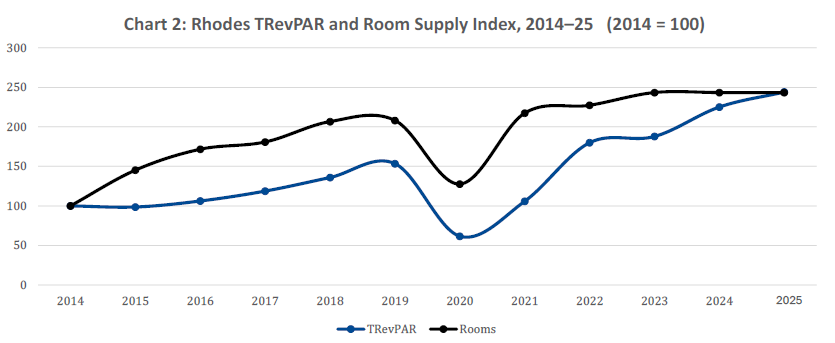
To assess hotel performance in Rhodes, an index analysis was prepared for TRevPAR and room supply, with 2014 set as the base year. The analysis is based on a sample of 67 four- and five-star hotels, with room supply reflecting the total number of rooms within this sample rather than the island’s total hotel room stock. The analysis provides an indicative view of how the revenue-generating capacity of Rhodes’ upper-tier hotel market evolved in relation to the expansion of its sampled room supply over the 2014–25 period.
Room supply within the sample increased significantly over the reviewed period, with the room supply index rising from 100 in 2014 to approximately 243 in 2025. This reflects the substantial expansion of the analysed four- and five-star hotel sample, likely driven by new openings, expansions and the addition of larger resort properties. The increase in room supply was relatively steady until 2019, followed by a temporary decline in 2020 due to pandemic-related disruption, before recovering strongly from 2021 onwards.
TRevPAR followed a more cyclical pattern. After remaining broadly stable in 2015, the index increased steadily between 2016 and 2019, reaching 153 in 2019. The pandemic had a pronounced impact on performance in 2020, when the TRevPAR index declined to 62. However, the recovery was strong, with TRevPAR rising to 180 in 2022, 188 in 2023 and 244 in 2025, exceeding pre-pandemic levels by a considerable margin.
The comparison between TRevPAR and room supply indicates that Rhodes’ upper-tier hotel market has been able to absorb a materially larger sampled accommodation base while also improving its revenue performance. Although room supply growth exceeded TRevPAR growth over the full period, the strong post-pandemic rebound in TRevPAR suggests that the island’s four- and five-star hotel market has maintained considerable demand depth and pricing resilience.
Overall, the performance trend supports the broader value-creation narrative observed in Rhodes. The island is not only expanding in terms of upper-tier room capacity, but is also demonstrating an improved ability to generate higher revenue from its higher-rated hotel stock. This is likely supported by the strengthening of the four- and five-star resort segment, product upgrading, improved market positioning and continued demand from international leisure travellers.
Recent Openings, Repositioning Projects and Management Changes
Recent openings, rebranding activity and repositioning projects in Rhodes indicate a continued shift towards higher-quality, branded and experience-led hospitality products. Since 2024, investment activity has not been limited to the addition of new rooms, but has increasingly focused on upgrading existing assets, strengthening brand affiliations and improving the revenue-generating capacity of the island’s hotel stock.
AMUS Hotel & Spa – H Hotels Collection (2024)
In early 2024, H Hotels Collection | Hatzilazarou Group acquired the historic Rhodes Bay Hotel & Spa (formerly Amathus Beach Hotel) in Ixia from UK-based L+R, subsequently rebranding the 357-key property as AMUS Hotel & Spa and integrating the former Elite Suites by Rhodes Bay into the new identity. The transaction marked the group’s first move beyond its traditional base in southern Rhodes and reflects the repositioning of an established hotel asset towards a more refined luxury resort concept, strengthening the group’s presence in the island’s upper-tier accommodation market. The acquisition forms part of a wider investment programme, which has included extensive renovations across the group’s Kiotari portfolio, such as new leisure and food and beverage offerings at Princess Andriana Resort & Spa and refurbished rooms at Princess Sun Hotel & Spa, while the group has also announced plans for a new five-star family resort in Kiotari.
Aulūs Lindos Rhodes (formerly Lindian Village), Curio Collection by Hilton – Reopening, Acquisition and Rebranding by Domes Resorts (2024–26)
Lindian Village Beach Resort Rhodes, Curio Collection by Hilton, reopened in April 2024 following its repositioning under Hilton’s Curio Collection brand. The resort’s reopening focused on privacy, wellness and a more curated luxury resort experience. In late 2025, Domes Resorts agreed to acquire the property from Zetland Capital Partners, marking the group’s entry into the market. The resort has since been rebranded as Aulūs Lindos Rhodes and repositioned as a family-oriented, ultra all-inclusive beachfront resort under Domes’ Aulūs brand, while retaining its Curio Collection by Hilton affiliation. This asset comprises 188 rooms and suites, the majority with private pools or outdoor Jacuzzis, and represents a clear example of value creation through renovation, international brand affiliation and institutional investment in the island’s luxury resort segment.
Mitsis Grand Hotel – Major Luxury Repositioning Project (2024–27)
In 2024, Mitsis Hotels announced a major redevelopment of the historic 327-room Mitsis Grand Hotel in Rhodes Town, with an investment of approximately €80–100 million. The project, led by WATG and ROAM Interior Design, is expected to reposition the property as a high-end, year-round luxury destination within a wider mixed-use scheme that includes retail space, conference facilities and wellness and entertainment venues, with the new chapter of the hotel currently expected to be unveiled in May 2027. Given the hotel’s landmark status, the redevelopment is expected to further enhance Rhodes’ urban luxury accommodation offering and support the qualitative upgrading of the island’s hotel product.
Cabú Rhodes – Adults-Only Luxury Hotel (2025)
Cabú Rhodes opened in Faliraki in June 2025 as a five-star adults-only hotel and is a member of Small Luxury Hotels of the World. The 86-room property is positioned around privacy, serenity, minimalist design and refined luxury, targeting leisure travellers seeking a more intimate and experience-led resort stay. Its opening reflects the growing demand for differentiated adults-only concepts in Rhodes and supports the island’s gradual shift towards higher-yield accommodation products.
AMOH, a Luxury Collection Resort, Rhodes – Marriott International (2026)
In April 2026, AMOH, a Luxury Collection Resort, Rhodes, opened on Kavos Beach in Pefki, near Lindos. Operated by Wavemaker Hospitality, the 197-room resort marks the debut of The Luxury Collection brand on the island and further reinforces Rhodes’ positioning within the international luxury resort landscape. Its opening highlights the increasing interest of global hotel brands and established hospitality operators in Rhodes’ upper-end accommodation market, supporting the island’s ongoing transition towards more refined, experience-led resort products.
The Landmark Rhodes Villas & Spa – Small Luxury Hotels of the World (2026)
The Landmark Rhodes Villas & Spa opened in Kolymbia in May 2026 as a five-star villa-style resort and is affiliated with Small Luxury Hotels of the World. The property offers 24 spacious private villas, each with an individual pool, contemporary Greek dining and a wellness-oriented product, focusing on privacy, personalised service and lower-density accommodation. Its opening further supports Rhodes’ shift towards high-added-value resort concepts and more exclusive hospitality products.
MGallery Rhodes – Accor’s MGallery Collection and Colossos SA (2027)
In July 2026, Accor’s MGallery Collection and Colossos SA, a family-owned hospitality company whose Rhodes portfolio includes Amada Colossos Resort and Rodos Park, announced the first MGallery hotel on the island. The adults-only beachfront resort in Kallithea is currently under construction and is scheduled to welcome its first guests in spring 2027. The 222-key property is designed as a ten-storey building with a spiral silhouette that provides sea views from every room, and will offer private-pool accommodation, a 1,100 m² spa and an extensive food and beverage programme. The project marks the arrival of the MGallery brand in Rhodes and reinforces the trend towards international brand affiliation, privacy-led product and adults-only concepts in the island’s upper-tier market.
Recent openings, acquisitions, rebrandings, repositioning projects and new developments under construction confirm that Rhodes is undergoing a clear value-creation cycle. The island is not only expanding its room supply, but also upgrading the quality, brand profile and experiential character of its hotel stock. The entry and/or expansion of international as well as Greek hospitality groups, including Hilton Hotels & Resorts, Marriott International, Accor, Small Luxury Hotels of the World, Domes Resorts, Mitsis, H Hotels Collection and Colossos SA, underline the strengthening investment appeal of Rhodes and its gradual transition from a traditional mass-leisure destination towards a more upscale, branded and revenue-driven resort market.
Conclusion
The analysis points to a market that has already achieved significant scale and is increasingly moving towards a more value-driven phase of development. Rhodes’ future performance is likely to depend not only on further demand growth, but also on the ability of its hotel sector to improve product quality, strengthen positioning and generate higher revenue from its established visitor base.
This transition is already visible across the market. The expansion of four- and five-star room supply, the strong recovery in revenue performance and the recent wave of openings, rebrandings, acquisitions and repositioning projects all indicate a clear shift towards higher-quality, branded and experience-led hospitality products. The growing involvement of both Greek and international hotel groups further reinforces Rhodes’ relevance as an investment market, particularly within the upscale and luxury resort segments.
This transition is already visible across the market. The expansion of four- and five-star room supply, the strong recovery in revenue performance and the recent wave of openings, rebrandings, acquisitions and repositioning projects all indicate a clear shift towards higher-quality, branded and experience-led hospitality products. The growing involvement of both Greek and international hotel groups further reinforces Rhodes’ relevance as an investment market, particularly within the upscale and luxury resort segments.
Going forward, Rhodes’ main opportunity lies in converting its established tourism platform into stronger value creation. While seasonality and reliance on leisure demand remain structural characteristics of the market, the island benefits from the scale, infrastructure and investment momentum required to support further upgrading. Overall, Rhodes is well positioned to continue evolving from a volume-led resort destination into a more differentiated, higher-yield and revenue-focused hospitality market.