

Three Lodging Markets Working Together
The Virginia Beach–Chesapeake–Norfolk, VA–NC Metropolitan Statistical Area is one of the largest and most diverse lodging markets in the Mid-Atlantic, stretching from Williamsburg to Chesapeake and Suffolk. This article focuses on the three primary coastal submarkets of Newport News/Hampton, Norfolk/Portsmouth, and Virginia Beach, which benefit from direct access to Hampton Roads Harbor, the Chesapeake Bay, and the Atlantic coastline. These coastal markets drive much of the region's lodging performance, supported by a diverse mix of government, military, maritime, business, and leisure demand.
Occupancy across the broader Norfolk–Virginia Beach market has remained largely stable, bracketing 62% during the last five years, just shy of the pre-pandemic peak of roughly 63%. ADR has shown a similar trend, noting only marginal year-over-year growth recently. However, ADR in 2025 is nearly 25% higher than pre-pandemic levels, with overall RevPAR performance up 20%. This pricing strength reflects the region’s diverse demand base that includes military and government activity, business and group travel, and Virginia Beach’s substantial leisure demand, allowing operators to maintain rates during periods of relatively limited occupancy growth.
A Closer Look at Performance Across Coastal Virginia
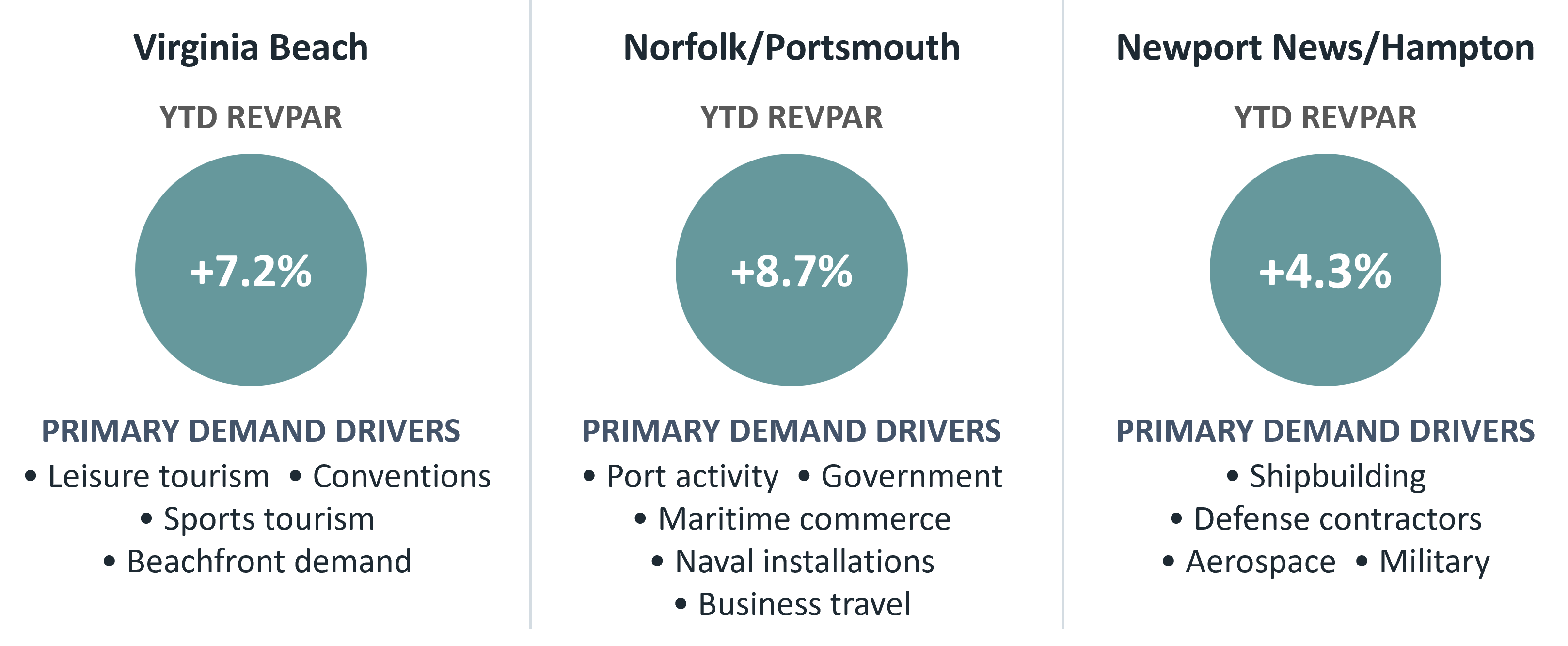
Performance trends among the three coastal submarkets have varied in recent years. Virginia Beach is the region's rate leader at almost $180 YTD through September 2026, benefiting from beachfront tourism, sports-related travel, and convention activity.
Norfolk/Portsmouth enjoys the stability provided by naval installations, maritime commerce, government activity, and business travel, posting the strongest year-over-year RevPAR growth among the three submarkets year-to-date (YTD) through September 2026. In fact, Norfolk/Portsmouth has achieved the greatest RevPAR gain since 2019 in this region, exceeding the pre-pandemic performance by nearly 23% in the latest calendar year. In comparison, Virginia Beach and Newport News/Hampton have achieved RevPAR gains of roughly 16% and 22%, respectively, since 2019.
Newport News/Hampton presents a different story. Following several years of growth, and despite a strong foundation of military, aerospace, defense contractor, and shipbuilding demand, the submarket experienced a RevPAR decline in 2025—the only coastal submarket to post a correction. However, in the YTD data through September 2026, all metrics have increased. RevPAR is up over 4%, although this is still the slowest growth of the three. The diversity of the market’s demand drivers provides balance across the region and helps to insulate it from fluctuations in any single source of demand.
The results demonstrate that even within a diverse regional lodging market, individual submarkets can perform differently, and one year does not establish a long-term trend. The broader strength of Coastal Virginia today is not that every submarket is growing but, rather, that the region's varied demand drivers provide stability despite differences in local performance.
Looking Ahead
The defining strength of the Coastal Virginia lodging market may be less about achieving significant gains in occupancy and more about the market’s ability to sustain and raise room rates across a diverse demand base. The three submarkets illustrate complementary sides of the regional lodging economy: Norfolk/Portsmouth and Newport News/Hampton benefit from a substantial base of year-round government, business, and group demand, while Virginia Beach provides a powerful leisure component capable of generating rate premiums during peak periods. The market's diverse mix of demand sources supports year-round hotel performance and reduces reliance on any single traveler source or season.
As travel patterns have matured following the pandemic and the industry enters a more established operating environment, future hotel performance will increasingly depend on the ability to capture higher-rated business, expand shoulder-season demand, and capitalize on the region’s ongoing economic and institutional investment. In this context, Coastal Virginia’s lodging market enters the coming years with a notable structural advantage: a diversified demand base that can support pricing power even when occupancy growth is more modest.
At HVS, data is only the starting point. By maintaining a local market presence and engaging directly with key industry players, we deliver real-time insight and current data tailored to each market. The outcome is analysis that reflects today’s market realities, not yesterday’s assumptions. For more information on the Coastal Virginia lodging market or guidance on hotel investment decisions aligned with your strategy and risk tolerance, contact Chelsey Leffet or Jerod Byrd, MAI, your HVS Mid-Atlantic hospitality experts.