
Market Report

Salt Lake City Hotels Prepare for a Transformative Decade

November 23, 2026
Salt Lake City is heading into one of its busiest development periods in recent years. The airport expansion is nearing completion, major changes are underway downtown, Temple Square is reopening, and plans are advancing for the Salt Palace. Further ahead, the 2034 Winter Games will be an important long-term driver.
Salt Lake City’s hotel market is entering a pivotal period shaped by expanding air access, major downtown investment, renewed visitor attractions, and preparations for the 2034 Winter Games. These catalysts point to stronger long-term demand, even as the planned Salt Palace closure creates a significant near-term challenge for convention-dependent hotels.
 

The planned projects should strengthen the city’s long-term appeal while creating temporary disruptions along the way. As a result, the outlook is favorable, although the timing will not be seamless. For hotel owners and developers, the more important question is not whether the city will attract additional visitation, but how quickly that demand will develop and which submarkets are best positioned to capture it.

Salt Lake City Hotel Metrics Illustrate Strength with Modest Growth in Recent Years
Source: CoStar
Source: CoStar
 
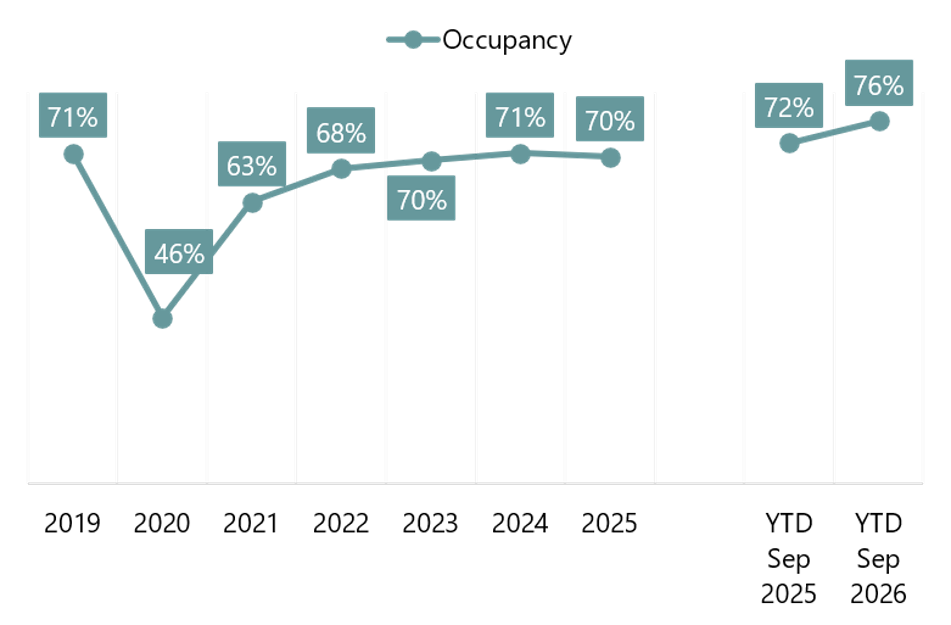
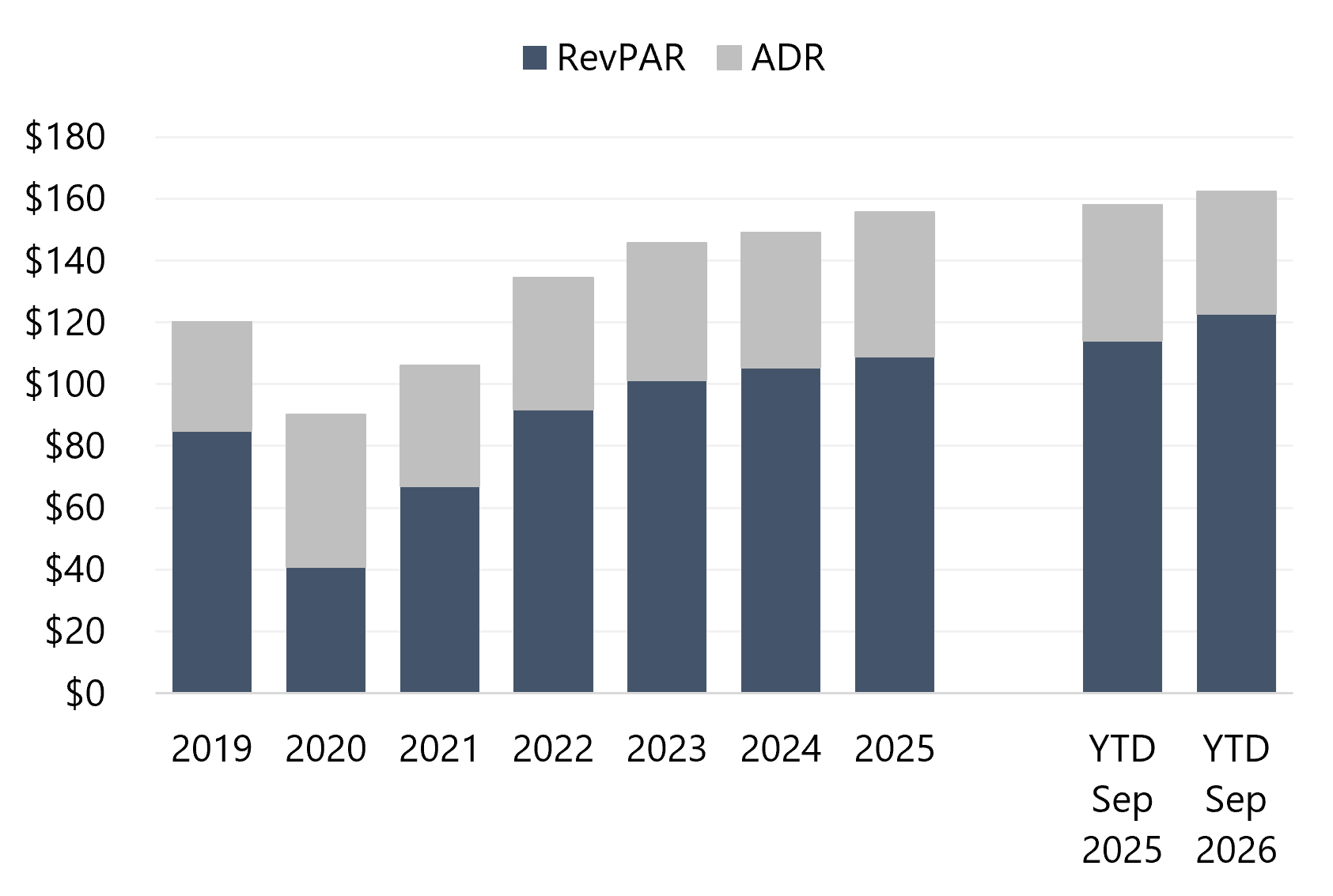
Salt Lake City’s mix of business and leisure travel helped keep occupancy near 70% from 2023 through 2025. Downtown employers and the region’s technology firms provided a base of weekday business, while ski and other outdoor travel helped fill rooms on weekends and during vacation periods. Demand growth for 2026 through September was strongest in February and March, which together accounted for roughly 85% of the year-over-year gain in room nights sold. February benefited from events such as the Silicon Slopes Summit and Winter Roundup, which drew more than 20,000 attendees downtown over four days. Across the full nine months, a 3.1% decline in available room nights amplified a 1.4% increase in demand, helping lift occupancy to 75.7% and giving hotels more room to raise rates.

Air Access Improvements

Salt Lake City International Airport served approximately 28.2 million passengers in 2025, compared with 26.8 million in 2019 and a record 28.4 million in 2024. Four additional gates opened in July 2026, and the final seven gates of the $5.1-billion New SLC redevelopment recently opened on October 27, 2026. The expanded facility, including an increase in domestic and international connections, will support hotel demand generated by corporate meetings, conventions, ski travel, and leisure visitation. However, passenger totals include connecting travelers and should not be treated as a direct measure of local hotel demand. Nonetheless, the expanded air service should stimulate additional demand growth over the next several years.

Sports, Entertainment, Culture and Convention District Investment

Downtown investment related to the Sports, Entertainment, Culture and Convention (SECC) District is expected to support hotel demand through an expanded event calendar and improvements to the city’s convention facilities. The SECC District revitalization project is intended to better connect the Delta Center and Salt Palace Convention Center with nearby hotels, restaurants, cultural venues, and public spaces.

A renovation of the Delta Center was completed from April 2025 through September 2026 to establish a permanent dual-sport home for the Utah Jazz (NBA) and Utah Mammoth (NHL). NHL hockey adds dozens of event nights each season, complementing existing convention and leisure business. Amateur tournaments also bring participants and families to the greater Salt Lake area, benefiting hotels beyond the downtown core.

The Salt Palace reconstruction is another major component of the SECC investment. The facility is expected to close for roughly three years beginning in the fall of 2027, with completion targeted for January 2031. Plans include adding a second full-service ballroom and improving circulation, which will allow the center to accommodate major events concurrently while retaining a similar overall amount of space. These changes should improve Salt Lake City’s ability to attract larger conventions and host overlapping events.

The closure will temporarily reduce convention-related hotel demand, particularly weekday group business downtown. Sports and leisure travel should offset some losses but may not replace convention room nights during the same periods. Hotels that rely heavily on citywide events will face the greatest adjustment until the improved facility reopens.

Temple Square’s Reemergence as a Visitor Draw

Temple Square has historically been one of downtown’s principal visitor attractions. Its new Visitors’ Center opened in May 2026, marking another step toward restoring visitation after years of construction. The renovated Salt Lake Temple is scheduled to open to the public from April 5 through October 1, 2027. Because access is generally restricted following dedication, the extended open house offers a rare opportunity to tour the historic building and should draw visitors during that period.

The hotel impact will depend on attendance, length of stay, and the share of visitors traveling from outside the region. The broader reopening should restore pedestrian activity near downtown hotels, restaurants, and shops. Although this visitation will provide additional demand during 2027, the open house is scheduled to end around the start of the Salt Palace closure and will not offset the displaced convention business.

Near-Term Outlook and Beyond

Salt Lake City’s long-term hotel outlook remains favorable, supported by improved air access, a broader sports calendar, and investment in its major visitor facilities. Near-term performance will vary by location and demand mix. Downtown hotels that rely heavily on convention business will face the greatest pressure during the Salt Palace closure. Owners and developers will need to account for this transition when evaluating operating expectations and project timing.

Preparations for the 2034 Olympic and Paralympic Winter Games should provide additional demand through planning meetings, test events, and related travel. Together with the completed downtown improvements, the Games should strengthen the market’s longer-term appeal, although the convention center’s reopening will be a more immediate boon for downtown hotels.

HVS combines rigorous data analysis with local market expertise to deliver insights that move decisions forward. Our approach incorporates primary, in-market interviews to capture real-time perspectives from the communities in which we work, ensuring our conclusions reflect current conditions and evolving trends. To explore the Salt Lake City hotel market further or discuss investment opportunities tailored to your goals, please contact Ryan Mark and Jack Burke, your HVS hospitality experts.
Market Report

Salt Lake City Hotels Prepare for a Transformative Decade

November 23, 2026
Salt Lake City is heading into one of its busiest development periods in recent years. The airport expansion is nearing completion, major changes are underway downtown, Temple Square is reopening, and plans are advancing for the Salt Palace. Further ahead, the 2034 Winter Games will be an important long-term driver.
Salt Lake City’s hotel market is entering a pivotal period shaped by expanding air access, major downtown investment, renewed visitor attractions, and preparations for the 2034 Winter Games. These catalysts point to stronger long-term demand, even as the planned Salt Palace closure creates a significant near-term challenge for convention-dependent hotels.
 

The planned projects should strengthen the city’s long-term appeal while creating temporary disruptions along the way. As a result, the outlook is favorable, although the timing will not be seamless. For hotel owners and developers, the more important question is not whether the city will attract additional visitation, but how quickly that demand will develop and which submarkets are best positioned to capture it.

Salt Lake City Hotel Metrics Illustrate Strength with Modest Growth in Recent Years
Source: CoStar
Source: CoStar
 
Salt Lake City’s mix of business and leisure travel helped keep occupancy near 70% from 2023 through 2025. Downtown employers and the region’s technology firms provided a base of weekday business, while ski and other outdoor travel helped fill rooms on weekends and during vacation periods. Demand growth for 2026 through September was strongest in February and March, which together accounted for roughly 85% of the year-over-year gain in room nights sold. February benefited from events such as the Silicon Slopes Summit and Winter Roundup, which drew more than 20,000 attendees downtown over four days. Across the full nine months, a 3.1% decline in available room nights amplified a 1.4% increase in demand, helping lift occupancy to 75.7% and giving hotels more room to raise rates.

Air Access Improvements

Salt Lake City International Airport served approximately 28.2 million passengers in 2025, compared with 26.8 million in 2019 and a record 28.4 million in 2024. Four additional gates opened in July 2026, and the final seven gates of the $5.1-billion New SLC redevelopment recently opened on October 27, 2026. The expanded facility, including an increase in domestic and international connections, will support hotel demand generated by corporate meetings, conventions, ski travel, and leisure visitation. However, passenger totals include connecting travelers and should not be treated as a direct measure of local hotel demand. Nonetheless, the expanded air service should stimulate additional demand growth over the next several years.

Sports, Entertainment, Culture and Convention District Investment

Downtown investment related to the Sports, Entertainment, Culture and Convention (SECC) District is expected to support hotel demand through an expanded event calendar and improvements to the city’s convention facilities. The SECC District revitalization project is intended to better connect the Delta Center and Salt Palace Convention Center with nearby hotels, restaurants, cultural venues, and public spaces.

A renovation of the Delta Center was completed from April 2025 through September 2026 to establish a permanent dual-sport home for the Utah Jazz (NBA) and Utah Mammoth (NHL). NHL hockey adds dozens of event nights each season, complementing existing convention and leisure business. Amateur tournaments also bring participants and families to the greater Salt Lake area, benefiting hotels beyond the downtown core.

The Salt Palace reconstruction is another major component of the SECC investment. The facility is expected to close for roughly three years beginning in the fall of 2027, with completion targeted for January 2031. Plans include adding a second full-service ballroom and improving circulation, which will allow the center to accommodate major events concurrently while retaining a similar overall amount of space. These changes should improve Salt Lake City’s ability to attract larger conventions and host overlapping events.

The closure will temporarily reduce convention-related hotel demand, particularly weekday group business downtown. Sports and leisure travel should offset some losses but may not replace convention room nights during the same periods. Hotels that rely heavily on citywide events will face the greatest adjustment until the improved facility reopens.

Temple Square’s Reemergence as a Visitor Draw

Temple Square has historically been one of downtown’s principal visitor attractions. Its new Visitors’ Center opened in May 2026, marking another step toward restoring visitation after years of construction. The renovated Salt Lake Temple is scheduled to open to the public from April 5 through October 1, 2027. Because access is generally restricted following dedication, the extended open house offers a rare opportunity to tour the historic building and should draw visitors during that period.

The hotel impact will depend on attendance, length of stay, and the share of visitors traveling from outside the region. The broader reopening should restore pedestrian activity near downtown hotels, restaurants, and shops. Although this visitation will provide additional demand during 2027, the open house is scheduled to end around the start of the Salt Palace closure and will not offset the displaced convention business.

Near-Term Outlook and Beyond

Salt Lake City’s long-term hotel outlook remains favorable, supported by improved air access, a broader sports calendar, and investment in its major visitor facilities. Near-term performance will vary by location and demand mix. Downtown hotels that rely heavily on convention business will face the greatest pressure during the Salt Palace closure. Owners and developers will need to account for this transition when evaluating operating expectations and project timing.

Preparations for the 2034 Olympic and Paralympic Winter Games should provide additional demand through planning meetings, test events, and related travel. Together with the completed downtown improvements, the Games should strengthen the market’s longer-term appeal, although the convention center’s reopening will be a more immediate boon for downtown hotels.

HVS combines rigorous data analysis with local market expertise to deliver insights that move decisions forward. Our approach incorporates primary, in-market interviews to capture real-time perspectives from the communities in which we work, ensuring our conclusions reflect current conditions and evolving trends. To explore the Salt Lake City hotel market further or discuss investment opportunities tailored to your goals, please contact Ryan Mark and Jack Burke, your HVS hospitality experts.