
Market Report

FIFA Lodging Results: Houston Hotels Found More Rate Than Room Nights

September 22, 2026
Houston is no stranger to major sporting events, having hosted Super Bowls, Final Fours, and College Football Playoff games. FIFA 2026 added another chapter, drawing an estimated 500,000 out-of-town visitors to Houston, according to the Harris County–Houston Sports Authority. While Houston hotels did not see a broad occupancy surge, they found meaningful pricing power around the matches.

High Visitor Activity, Modest Hotel Occupancy Gains

Houston hosted seven FIFA World Cup matches between June 14 and July 4, stretching tournament activity across nearly three weeks. Combined, the matches drew more than 480,000 spectators to Houston Stadium (typically known as Reliant Stadium), averaging roughly 68,600 attendees per match, based on reports from the FIFA World Cup 2026 Houston Host Committee. World Cup-related activity was particularly evident in the urban core. According to the Houston Host Committee, the Downtown submarket recorded 933,000 event attendees through June 30, while East Downtown, one of the main centers of World Cup activity, drew more than one million spectators to events held during the tournament period.

Despite the scale of visitor activity, occupancy changed little. By the end of June, occupancy for Houston hotels stood at 61.6%, essentially flat from the prior year, per CoStar. Houston’s large hotel inventory and the extended tournament schedule helped spread demand across the market, with some regular demand likely displaced along the way. This contrast between the level of citywide activity and the relatively modest occupancy response was one of the more distinctive features of Houston’s World Cup experience.

Match Nights Drove Rate Premiums

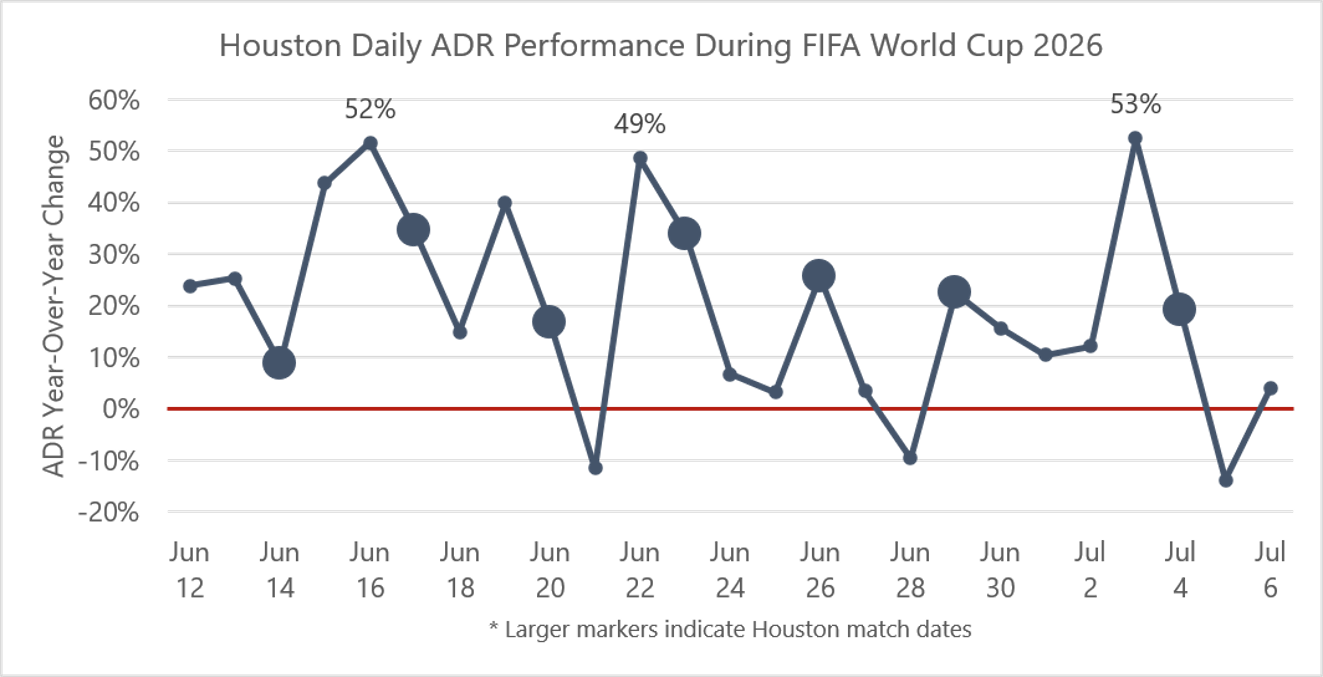
The more visible growth from the World Cup was reflected in hotel average daily rate (ADR), with market-wide ADR increasing 5.8% over the prior year to $131.67. Rate gains tended to cluster around the match dates, often beginning the night before. However, the growth pattern did not hold steady throughout the city’s hosting schedule. ADR increased approximately 52% (compared to the same time last year) ahead of the June 17 match and roughly 49% before the June 23 match. The night before Houston’s July 4 knockout match produced a year-over-year increase of approximately 53%. Between those peaks, rate growth fluctuated but remained mostly positive.

The CoStar data below illustrate that the strongest match-related periods supported substantial rate premiums, even without sustained compression across the broader market.

The Most Significant ADR Increases Occurred the Day Before Matches
Source: CoStar

Submarket Breakdown: Where Rates Rose the Most

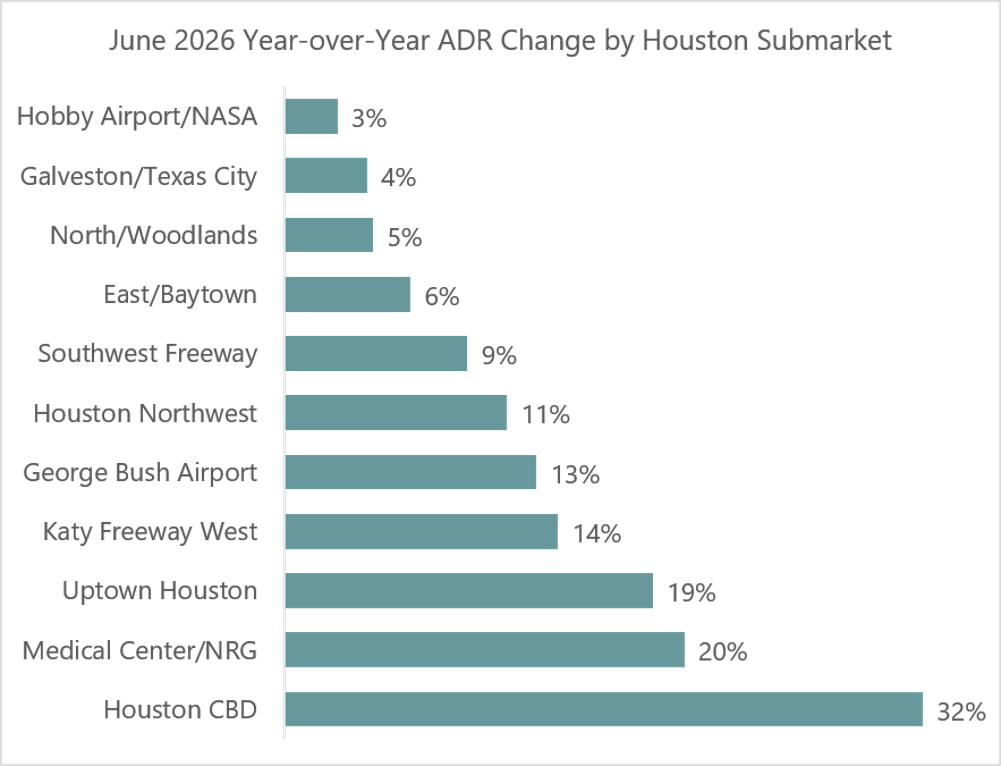
The Downtown Submarket recorded some of the strongest rate growth, with NRG and Uptown also posting notable gains. Katy Freeway and Northwest Houston also achieved double-digit ADR growth, even with little corresponding change in occupancy. Rate growth was still present but more limited across the airport, suburban, and industrial-oriented submarkets.

Greatest Increases Achieved in Houston CBD, NRG, and Uptown Submarkets
Source: CoStar

Bottom Line

For Houston’s lodging market, the immediate World Cup win came through room rate growth, despite the significant visitor levels. But beyond the numbers, the event boosted Houston’s visibility worldwide, creating exposure and momentum that could extend well beyond the final match.

HVS combines current market data with local expertise to help clients understand the forces shaping Houston’s lodging market and how those dynamics influence performance, positioning, and investment decisions. Our perspective reflects both market-wide trends and the differences that can emerge across Houston’s diverse submarkets. To discuss Houston hotel market performance, development projects, or investment strategies, connect with Bunmi Oyinloye, your HVS Houston hospitality expert.

Market Report

FIFA Lodging Results: Houston Hotels Found More Rate Than Room Nights

September 22, 2026
Houston is no stranger to major sporting events, having hosted Super Bowls, Final Fours, and College Football Playoff games. FIFA 2026 added another chapter, drawing an estimated 500,000 out-of-town visitors to Houston, according to the Harris County–Houston Sports Authority. While Houston hotels did not see a broad occupancy surge, they found meaningful pricing power around the matches.

High Visitor Activity, Modest Hotel Occupancy Gains

Houston hosted seven FIFA World Cup matches between June 14 and July 4, stretching tournament activity across nearly three weeks. Combined, the matches drew more than 480,000 spectators to Houston Stadium (typically known as Reliant Stadium), averaging roughly 68,600 attendees per match, based on reports from the FIFA World Cup 2026 Houston Host Committee. World Cup-related activity was particularly evident in the urban core. According to the Houston Host Committee, the Downtown submarket recorded 933,000 event attendees through June 30, while East Downtown, one of the main centers of World Cup activity, drew more than one million spectators to events held during the tournament period.

Despite the scale of visitor activity, occupancy changed little. By the end of June, occupancy for Houston hotels stood at 61.6%, essentially flat from the prior year, per CoStar. Houston’s large hotel inventory and the extended tournament schedule helped spread demand across the market, with some regular demand likely displaced along the way. This contrast between the level of citywide activity and the relatively modest occupancy response was one of the more distinctive features of Houston’s World Cup experience.

Match Nights Drove Rate Premiums

The more visible growth from the World Cup was reflected in hotel average daily rate (ADR), with market-wide ADR increasing 5.8% over the prior year to $131.67. Rate gains tended to cluster around the match dates, often beginning the night before. However, the growth pattern did not hold steady throughout the city’s hosting schedule. ADR increased approximately 52% (compared to the same time last year) ahead of the June 17 match and roughly 49% before the June 23 match. The night before Houston’s July 4 knockout match produced a year-over-year increase of approximately 53%. Between those peaks, rate growth fluctuated but remained mostly positive.

The CoStar data below illustrate that the strongest match-related periods supported substantial rate premiums, even without sustained compression across the broader market.

The Most Significant ADR Increases Occurred the Day Before Matches

Source: CoStar

Submarket Breakdown: Where Rates Rose the Most

The Downtown Submarket recorded some of the strongest rate growth, with NRG and Uptown also posting notable gains. Katy Freeway and Northwest Houston also achieved double-digit ADR growth, even with little corresponding change in occupancy. Rate growth was still present but more limited across the airport, suburban, and industrial-oriented submarkets.

Greatest Increases Achieved in Houston CBD, NRG, and Uptown Submarkets

Source: CoStar

Bottom Line

For Houston’s lodging market, the immediate World Cup win came through room rate growth, despite the significant visitor levels. But beyond the numbers, the event boosted Houston’s visibility worldwide, creating exposure and momentum that could extend well beyond the final match.

HVS combines current market data with local expertise to help clients understand the forces shaping Houston’s lodging market and how those dynamics influence performance, positioning, and investment decisions. Our perspective reflects both market-wide trends and the differences that can emerge across Houston’s diverse submarkets. To discuss Houston hotel market performance, development projects, or investment strategies, connect with Bunmi Oyinloye, your HVS Houston hospitality expert.