

After the impact of the COVID-19 pandemic, the St. Louis market entered a period of strong recovery in 2021 and 2022. That momentum slowed in 2023 and stalled completely in 2024, as post-pandemic leisure travel subsided, office vacancy remained elevated, and the America’s Center Convention Complex underwent renovations. The renovation and expansion of the convention center was completed in late 2024, paving the way for a strong rebound of convention demand in 2025. In May 2025, a major tornado struck portions of the St. Louis area, resulting in temporary lodging demand from displaced residents, emergency responders, contractors, and recovery personnel.
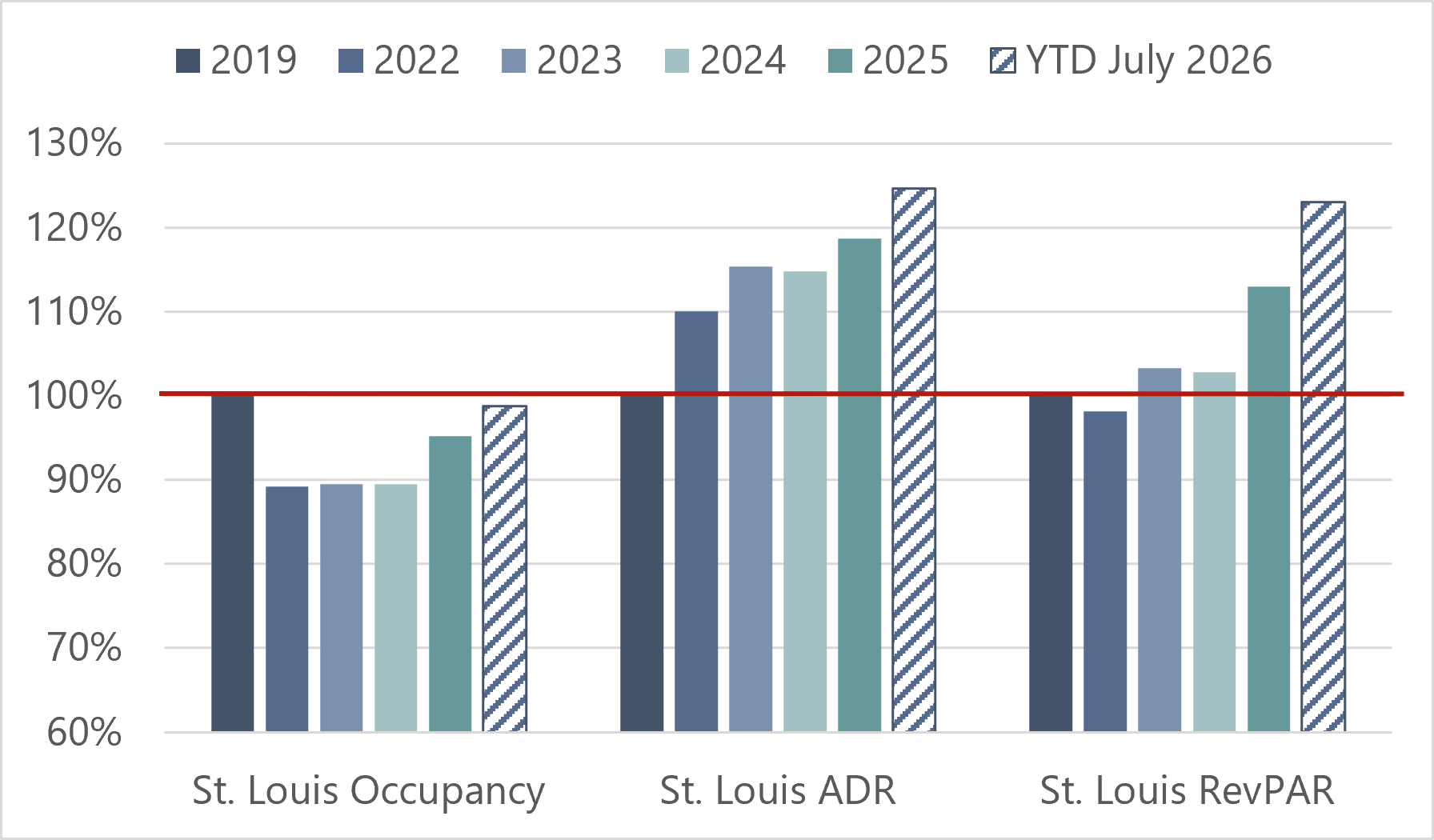
The convention center project and the tornado together resulted in a strong boost to demand in 2025, driving market-wide occupancy back into the low 60s for the first time since 2019. The strong demand base revived pricing power, pushing market-wide ADR beyond $125 and driving RevPAR well above the 2019 level for that year.
Source: CoStar
As of early 2026, it was unclear if the positive momentum could be maintained, as the temporary tornado-related demand was no longer present and the 2026 convention calendar appeared slightly weaker. However, as illustrated in the chart above, occupancy, ADR, and RevPAR have continued to strengthen through July, and this trend is anticipated to continue into 2027.
Although conventions and major events are expected to produce a lower overall number of room nights in 2026 than 2025, hotel market participants have reported that the seasonality of the events is more favorable this year, with similar booking patterns expected for 2027. This is due to higher activity in the shoulder and off-peak travel periods supporting increased occupancy and pricing power during months with typically weaker demand. For example, the 2026 U.S. Figure Skating Championships provided a strong start to the year in January. Similarly, the PGA Tour’s BMW Championship was held in late August, boosting a month that is typically the softest of the summer and early fall.
Going forward, healthy lodging demand should continue to be bolstered by a number of major developments in Downtown St. Louis, within the market’s defense industry, and at area infrastructure and attractions, as detailed below.
- Downtown Development and Events: In July 2026, Missouri passed legislation to establish incentive programs that are expected to support the revitalization of multiple vacant office buildings, as well as a planned $600-million development along the Mississippi River. This follows an initiative from the City of St. Louis that was rolled out in May 2026 to invest $55 million in downtown revitalization. Additionally, in 2025, Missouri created a new entertainment district designation for Downtown St. Louis that will provide increased security and additional marketing to attract and promote new major events.
- In late 2025, a new headquarters campus for the National Geospatial-Intelligence Agency was completed in north St. Louis. The $1.7-billion, 97-acre campus is expected to support additional research and business partnerships with private companies and local institutions.
- Boeing's Defense, Space, & Security campus is currently undergoing a $1.8-billion expansion. When complete in 2030, the project will nearly double the size of company’s local manufacturing facilities, supporting the production of next-generation military aircraft.
- Officials with the Lambert-St. Louis International Airport have begun planning a major reconfiguration of the airport that will include combining the two terminals into a single facility, estimated to cost nearly $3 billion. An initial $1 billion in funding has been approved for design work and preliminary projects, with construction anticipated to begin in 2027.
- A $230-million, 425-acre expansion of the St. Louis Zoo is underway. Upon completion in 2027, the new WildCare Park will offer visitors a one-of-a kind immersive safari experience featuring a variety of big-game species in a natural park-like habitat.
Collectively, these developments and initiatives should broaden St. Louis’s demand base, strengthening lodging performance in the years ahead.
HVS pairs rigorous data analysis with local market expertise to provide insights that support informed decision-making. Our approach draws on primary, in-market interviews to capture timely perspectives directly from local communities, ensuring our conclusions reflect both current conditions and emerging trends. To learn more about the St. Louis market or to discuss investment opportunities aligned with your goals, please contact Dan McCoy, your HVS Midwest hospitality expert.