
Warsaw’s greatest strength as a hotel market is its diversity of demand. Unlike many European capitals that rely heavily on either leisure or corporate travel, Warsaw benefits from a broad mix of domestic visitors, government activity, corporate travel, conferences and a steadily expanding international tourism market. Long defined by its role as Poland’s political and commercial centre, the city has spent the past decade broadening its appeal without losing the business-travel backbone that underpins year-round performance. By 2025, that balance was delivering tangible results: airport traffic reached a new high, visitor volumes remained well above pre-pandemic levels and hotel performance ranked among the strongest in the CEE-6. Having navigated the pandemic, regional geopolitical disruption and a higher interest-rate environment with remarkable resilience, Warsaw has entered the second half of the decade with some of the strongest fundamentals in Central and Eastern Europe.
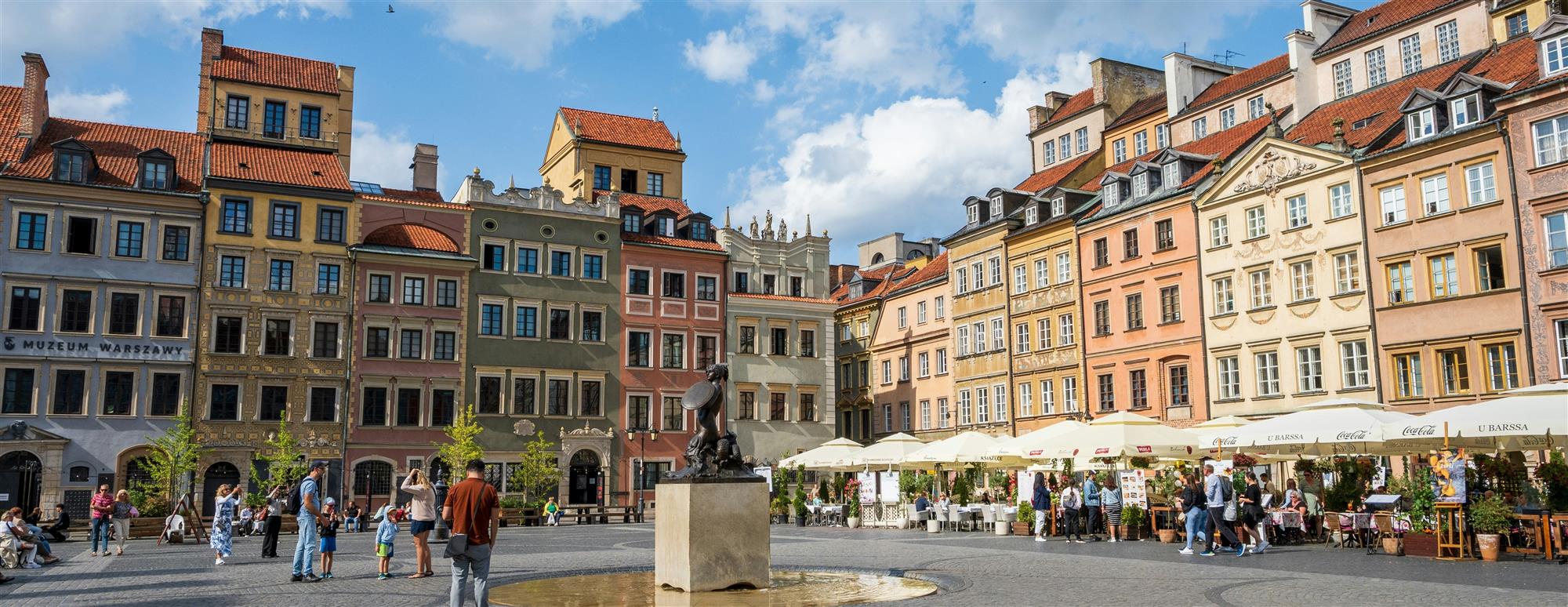

Image: Tomasz Zielonka on Unsplash
Sources: Warsaw Tourism Organization; GUS (Statistics Poland); Eurostat; ICCA; HVS Research
Economic Indicators – Poland
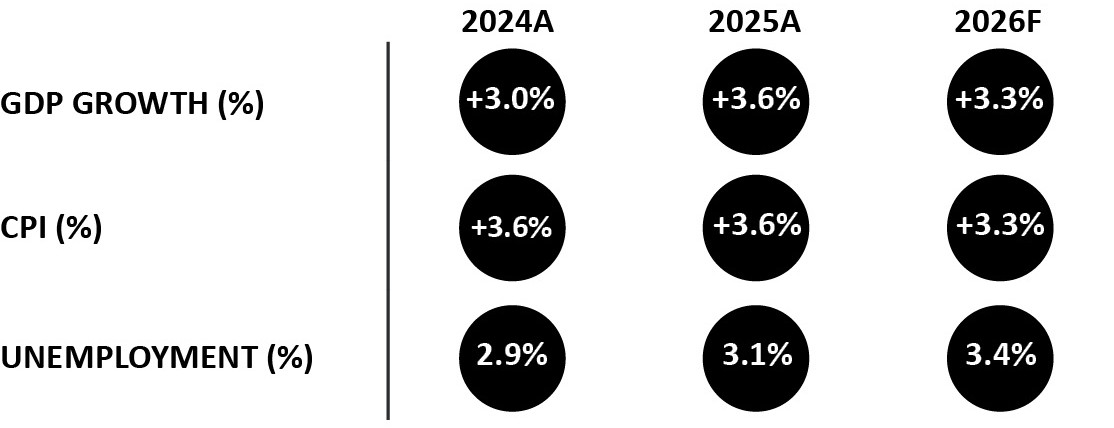
Source: IMF
Tourism Demand
Visitor numbers into Warsaw stabilised in 2025 following a strong rebound the previous year. The city welcomed approximately 12.1 million visitors, a marginal 0.9% decline from the peak 12.2 million recorded in 2024, but still some 20.0% above 2019 levels, underlining how durable the post-pandemic recovery has proven. Domestic travellers continued to anchor demand, accounting for around 70.0% of visitors, while the international share has edged higher over time, from roughly 28.0% in 2016 to 30.0% in 2025, reflecting both improved air connectivity and Warsaw’s growing prominence as a regional business and administrative hub. Ukraine has contributed to that trend, with Warsaw increasingly serving as a gateway for humanitarian, diplomatic and reconstruction-related activity. The city has become a key meeting point for organisations involved in Ukraine’s recovery, exemplified by ReBuild Ukraine 2025, which brought together more than 6,000 participants and 762 companies from 33 countries.
Airport traffic continued to surge in 2025, with Warsaw’s airports handling approximately 24.1 million passengers, up 13.3% on 2024 and around 28.0% above 2019 volumes. Further route expansion by both Ryanair and LOT Polish Airlines, including new destinations such as Porto, Almaty and San Francisco, points to continued gains in connectivity and international reach. Importantly for hotels, that growth is translating into overnight demand rather than simply passenger throughput. Total bednights reached 8.7 million in 2025, up 8.8% year on year and 33.0% above 2019, with international bednights (+12.7%) growing faster than domestic (+6.8%), suggesting that overseas visitors are arriving in greater numbers and spending more time in the city. The conference and meetings segment provided a further layer of support to the market’s growth. According to ICCA, Warsaw hosted 75 internationally ranked association meetings in 2025, up 21.0% on 2024 and modestly above the 71 recorded in 2016, though still short of the 2017 peak of 89 events. As in other European capitals, the recovery in large-scale corporate and association gatherings has trailed that of leisure travel, but the trajectory through 2025 was consistently positive.
Growing Visitor Demand for Warsaw (000s)
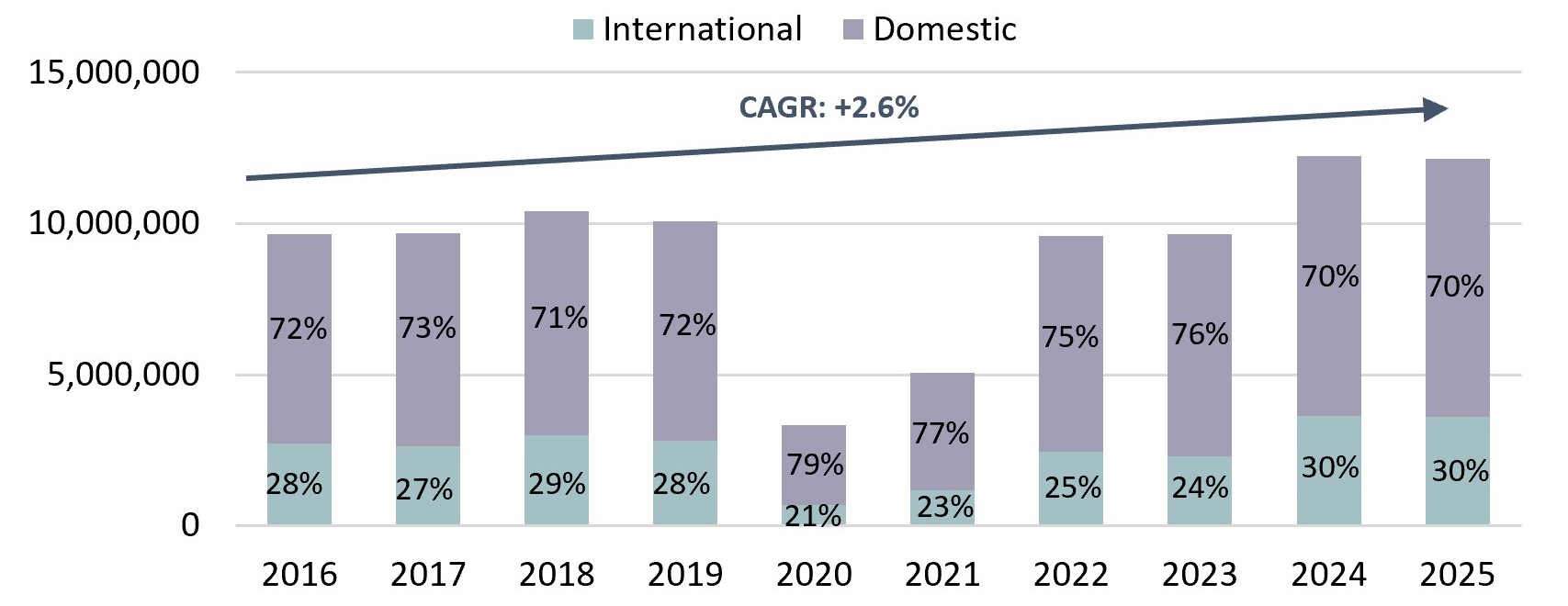
Source: Warsaw Tourism Organization
Hotel Performance
Warsaw's hotel performance in 2025 delivered one of the strongest years of the past decade. Occupancy climbed to close to 80%, up roughly three percentage points on 2024 and back above the 2019 level. The 2016 occupancy peak remained just out of reach, but the shortfall reflects a supply growing by roughly 17% between 2016 and 2019, diluting even the 2019 occupancy as demand kept growing. More notably, Warsaw stands out as the only capital among its CEE-6 peers whose 2025 occupancy climbed back above 2019 levels (albeit lower than 2016), a distinction that underscores the growth in demand relative to Prague, Budapest, Bucharest, Bratislava and Sofia.
Rate performance tells a related story, though the longer-term view is less kind to Warsaw. Over the past decade, RevPAR has grown by well over a third in nominal terms, but cumulative inflation over the same period has run higher still, meaning RevPAR has actually fallen behind its 2016 level in real terms, a shortfall of roughly 15% both in euro and złoty terms. Of the CEE-6, only Prague shows a similar real-terms shortfall, while Budapest, Bratislava and Sofia have already surpassed their 2016 real RevPAR, with Bucharest having done so on a local currency basis only. This nuance tempers the headline nominal record without undermining the broader trajectory: demand has strengthened, and pricing power, while not yet fully outpacing the cost environment, is moving firmly in the right direction.
Set against the more recent past, the picture looks brighter. Warsaw's 2025 average rate reached złoty in the high 400s, up a couple of points on 2024, while RevPAR rose close to 6% year-on-year to złoty in the high 300s, a nominal high and comfortably ahead of 2019. In euro terms, this RevPAR growth was the second strongest in the CEE-6, behind only Bucharest (ahead of Bratislava, Prague, Budapest and Sofia). Meanwhile, Warsaw’s modest room supply growth led the group outright, a combination that speaks to a market absorbing growth without sacrificing pricing discipline. Measured in local currency, however, its ranking slips to level with Budapest and behind Bucharest and Bratislava, largely because the złoty's approximately 1.5% appreciation flattered the euro figures while the Romanian leu's similar depreciation understated Bucharest's local performance. Average rates (in euro) point to the same mixed picture: Warsaw's 2025 ADR sits mid-pack in the CEE-6, ahead of Bucharest, Bratislava and Sofia but still behind Prague and Budapest.
The implication for Warsaw is clear. With the supply increase now absorbed and occupancy back to historical norms, closing the remaining real-terms gap will rely on rate growth rather than volume. Meaningful headroom should remain for ADR appreciation as the market continues to mature.
Tracking Inflation, Still Trailing – Average Rate and RevPAR Index
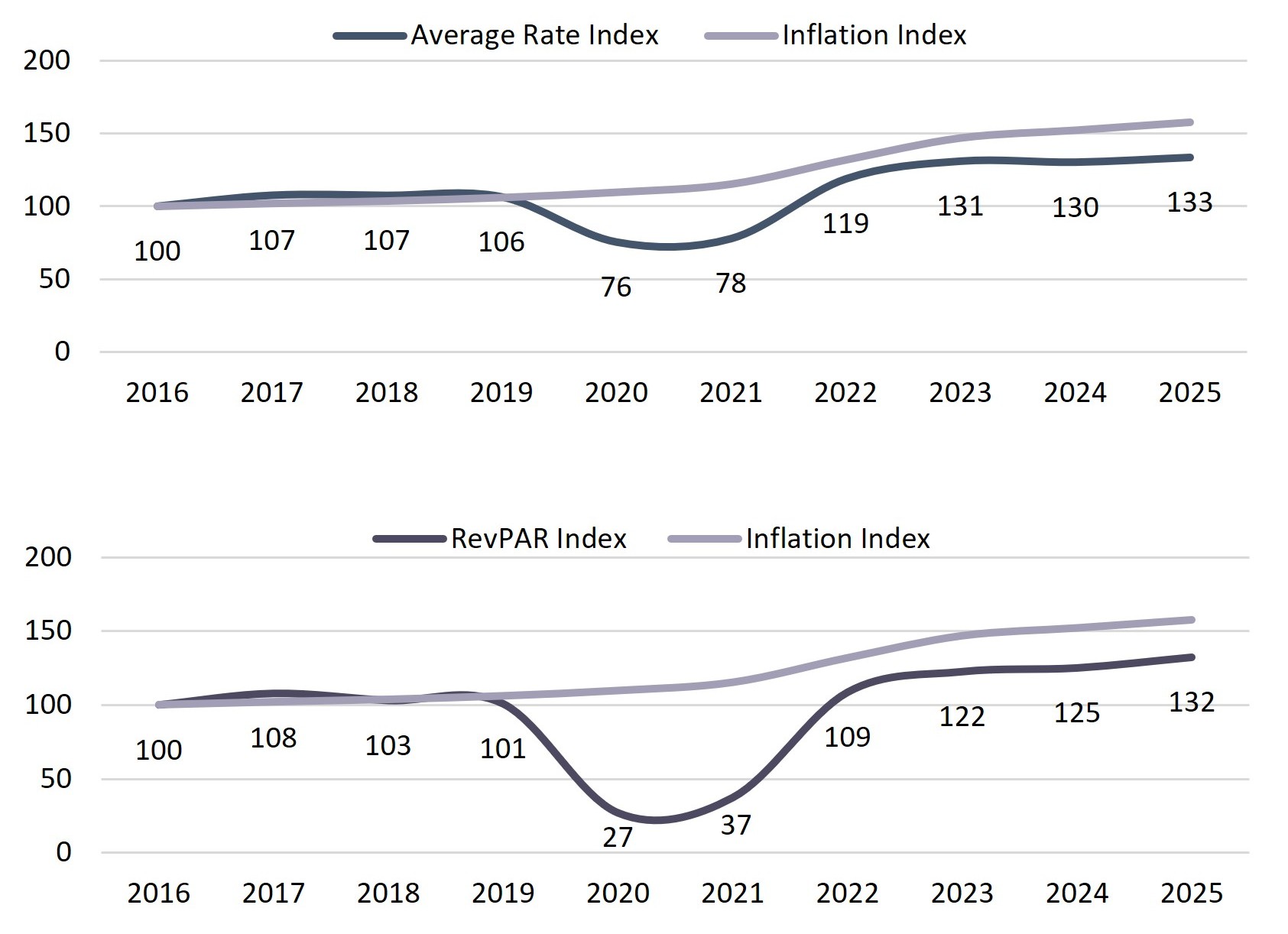
Source: HVS Research
Hotel Supply
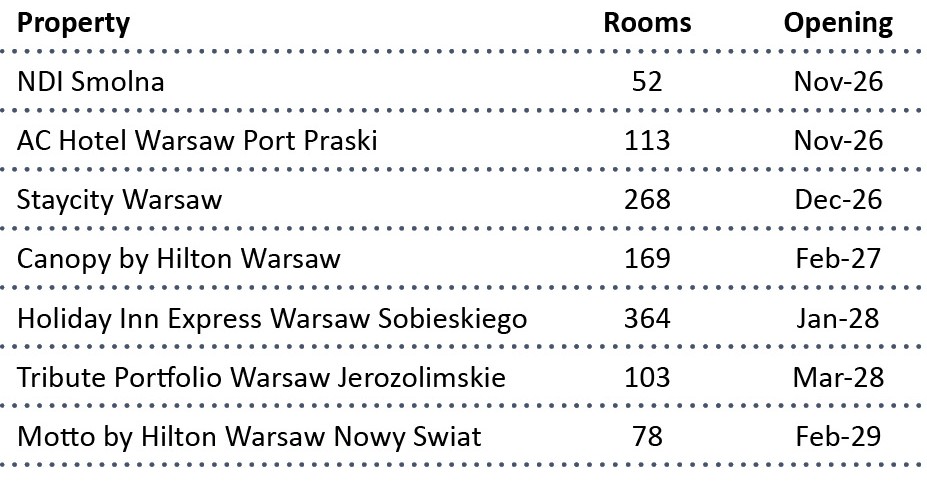
Warsaw ended 2025 with approximately 22,400 rooms across some 160 hotels, a supply base that has grown by 33% since 2016, or a CAGR of 2.6% over the decade. Compared to its CEE-6 peers, Warsaw’s room stock has expanded by far the most since 2016, at more than double the pace of the next-fastest-growing capital, Budapest, while Prague’s inventory has been essentially flat and both Bratislava’s and Sofia’s have contracted over the same period. Despite adding more rooms than any other CEE-6 capital in 2025, Warsaw still recorded some of the region’s strongest RevPAR growth, a combination that highlights the depth of demand underpinning the market. The confirmed forward pipeline comprises seven projects totalling approximately 1,150 rooms through early 2029, equivalent to around 5% of existing supply, a modest increment that points to continued but measured expansion. The composition is notably brand diverse: the NDI Smolna and the AC Hotel Warsaw Port Praski are both due to open in November 2026, followed by the Canopy by Hilton Warsaw (the brand’s Polish debut) in early 2027 and Staycity Warsaw (Staycity’s first Polish aparthotel) in October 2027. The Holiday Inn Express Warsaw Sobieskiego and the Tribute Portfolio Warsaw Jerozolimskie are to follow in 2028, with the Motto by Hilton Warsaw Nowy Świat, another Polish brand debut, expected in 2029.
Beyond this confirmed pipeline, a number of larger schemes remain in earlier stages, including a third Puro hotel on Mariańska Street and Arche’s redevelopment of the historic Fort Szczęśliwice into a hotel and congress complex of over 1,000 rooms, underscoring continued long-term development appetite.
Hotel Pipeline
Source: HVS Research
Investment Market
Transaction and financing activity across Warsaw’s hotel market picked up through 2025 and into 2026, spanning both outright sales and a wave of refinancing that points to improving credit conditions. Deal volume remains modest by European standards with only around a dozen hotel transactions having closed in Warsaw over the past decade, but the transactions that have occurred point to sustained, if selective, institutional appetite.
A notable transaction is the Warsaw HUB portfolio, comprising the 212-room Crowne Plaza and the 218-room Holiday Inn Express, in December 2023 for zł699,000 per room (zł148.1 million and zł152.3 million for each hotel, respectively) at a 6.8% cap rate as Ghelamco sold the assets to Corum, demonstrating that large, full-service branded portfolios can still draw institutional capital even in a thin market.
At the more accessible end of the market, the B&B Warszawa changed hands again in January 2025, this time for zł45.9 million (approximately zł298,000 per room) at a 7.0% cap rate, as part of a wider four-property Covivio Hotels portfolio; the same asset traded in 2019 for zł36.1 million, implying roughly 27% value appreciation over six years despite the pandemic disruption during this holding period.
Supported by robust economic growth and improving investor sentiment toward the hospitality sector, Warsaw remains well positioned to attract further hotel capital through 2026, though transaction volume is likely to stay limited by the small pool of assets that change hands in any given year.
Outlook
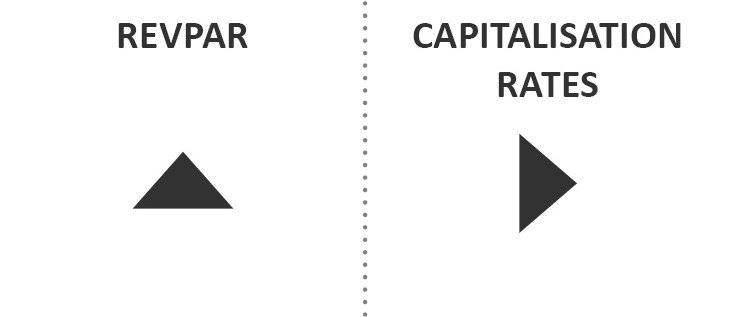
Warsaw's hotel market enters the second half of 2026 from a position of genuine strength. Occupancy is at an almost decade high, RevPAR has reached a new nominal record and visitor arrivals and bednights remain well above pre-pandemic levels. More importantly, the market continues to absorb one of the most active development pipelines in the CEE-6 while still delivering some of the region's strongest operating performance. Average rates, meanwhile, remain below most regional peers, leaving scope for further rate convergence as the market continues to mature. The macroeconomic backdrop remains broadly supportive. Poland's GDP growth is forecast at 3.3% for 2026, among the strongest in the European Union, albeit down modestly from 3.6% recorded in 2025. At a national level, tourism remains a comparatively small share of the Polish economy at around 5.0% of GDP, according to the Ministry of Sport and Tourism, which has ambitions to raise that level to 9.0% by 2030, a target that, if achieved, would give the sector a meaningful boost.
Longer term, the Centralny Port Komunikacyjny (CPK) project, which entered the delivery phase in 2026 with completion targeted for the early 2030s, points to a further step change in Warsaw's aviation capacity and long-haul connectivity, though its benefits remain some years from being realised. On balance, the structural pillars behind Warsaw's performance, resilient demand, ability to absorb supply and a broadening investor base, remain firmly in place heading into 2027.
Value Trends 2025 vs 2024
Sources: HVS Research