
Sacramento’s growth has moderated in the post-pandemic period, but the city’s long-term expansion drivers remain in place. Several major developments, most notably the Sacramento Railyards, have experienced delays and revised timelines amid elevated construction and financing costs. However, these projects continue to represent meaningful future sources of visitation, employment, and economic activity. Sacramento has also remained a relative bright spot within California in terms of recent population gains in the region, as contrasted with weaker trends elsewhere in the state. For lodging investors, the implication is that demand tied to area projects appears delayed rather than displaced.
The Railyards Anchor
The Sacramento Railyards remains one of the nation’s largest urban infill developments and one of the most consequential projects in the city’s core. The district is entitled for a broad mix of uses, including residential, retail, entertainment, healthcare, and sports facilities. One of the most important anchors is Kaiser Permanente’s new medical center. Kaiser’s Railyards Medical Center is under construction and scheduled to open in 2029. The hospital will replace Kaiser’s existing Sacramento facility, which faces safety concerns related to California’s 2030 seismic-compliance requirements for acute-care hospitals.
Another important anchor for the Railyards is the new soccer stadium for the Sacramento Republic FC, which has begun development after several delays. In March 2026, Wilton Rancheria and Sacramento Republic FC announced plans to move forward with the Republic Stadium at the Railyards, a privately financed, soccer-first venue with more than 19,600 seats. When completed, the stadium will complement Golden 1 Center, which opened in 2016, and the renovated SAFE Credit Union Convention Center, which reopened in 2021 with more than 240,000 square feet of programmable space. Together, these assets will enhance Sacramento’s ability to attract regional, national, and international events, supporting future lodging demand.
Natomas Rebounds from Moratorium
North Sacramento’s Natomas is another key growth area, having experienced significant expansion in the past decade. Development in the Natomas Basin was constrained for years following FEMA floodplain determinations in 2008, which limited new construction because of levee-related flood-risk concerns. After FEMA approved a revised flood-zone designation, the City of Sacramento resumed accepting building-permit applications in 2015. Since then, Natomas has reemerged as a strategic development corridor, benefiting from proximity to Interstate 5, State Highway 99, Interstate 80, and Sacramento International Airport.
Several major investments are reinforcing Natomas’s long-term potential. Sacramento International Airport is advancing SMForward, a $1.4-billion, multi-phase modernization and expansion program planned for completion in 2028. Nearby Metro Air Park comprises approximately 1,320 fully entitled developable acres east of the airport, with zoning for industrial, manufacturing, distribution, and high-tech commercial uses that has attracted major tenants, including Amazon and Walmart.
In addition, California Northstate University (CNU) has proposed Innovation Park at the former Sleep Train Arena site, anchored by a planned 350-bed teaching hospital and supporting commercial and public uses. According to the Sacramento Business Journal, the hospital could break ground as early as 2026, with opening targeted for 2029. Based on estimates provided by CNU, the campus is expected to generate $3.5 billion to $5.5 billion in annual economic impact. If realized, the redevelopment could become a significant long-term demand generator for Natomas hotels.
Sacramento’s Lodging Market Shows Resilience
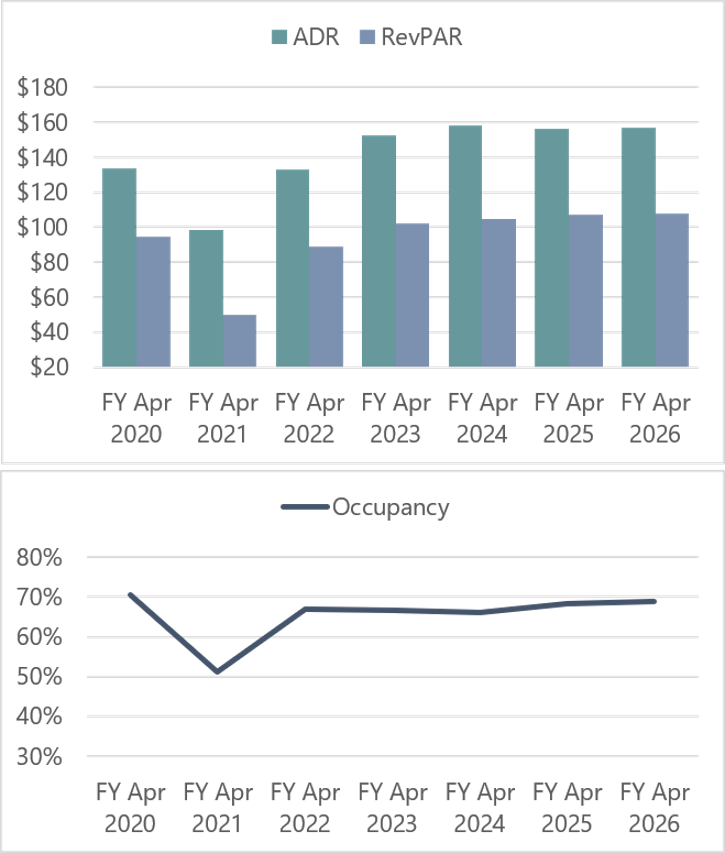
Fiscal-year data for 72 hotels, as shown in the charts below, indicate that occupancy has not yet returned to pre-pandemic levels. However, ADR has more than offset the shortfall, increasing by more than $20 over the pre-pandemic levels. This trend has resulted in RevPAR growth in recent years.
Rate Growth Driving RevPAR Gains in Sacramento Despite Occupancy Stabilization
Source: CoStar
According to Sacramento city officials, one of the primary hurdles the city faces as it seeks to expand its convention and major-event business is the limited availability of guestrooms. City leaders have therefore identified hospitality development as a key priority, focusing on support for projects that help Sacramento attract larger conventions, sporting events, festivals, and national crowds. In 2023, then-Mayor Darrell Steinberg and city staff promoted a 330-room convention-center hotel development adjacent to the recently renovated and expanded SAFE Credit Union Convention Center. In November 2024, the City Council renewed support for the project as part of a broader tourism-investment package. The council approved a motion of intent to support the use of future project-generated Transient Occupancy Tax revenue, subject to further financial review, design approval, and a final council-approved agreement. While this project has not yet begun construction, it illustrates the local government’s focus on hotel development in the market.
In fact, the greater Sacramento area has approximately 36 hotels in some stage of development as of mid-year 2026. While high construction costs are expected to delay or prevent some proposed hotel projects, those that move forward should benefit from Sacramento’s expanding base of healthcare, transportation, mixed-use, and event-driven demand.
For hospitality investors, Sacramento’s near-term recovery remains uneven, but its long-term fundamentals continue to strengthen.
At HVS, we translate market data into actionable intelligence that supports confident decision‑making. Our teams operate within the markets they serve, allowing us to engage directly with owners, operators, and other key stakeholders through primary research. This local presence ensures access to timely insights and current market data, helping you stay ahead of the curve. To learn more about the Sacramento market or to discuss investment strategies aligned with your objectives and risk tolerance, please contact Brandon Conner and John Berean, your local HVS Northern California hospitality experts.