
Market Report

Eugene, Oregon Hotel Market: Growth Supported by Investment

June 4, 2026
Eugene’s hotel market has experienced strong growth in recent years and continues to benefit from significant investment in the city. Eugene has emerged as a leading Pacific Northwest travel destination, and hotel demand benefits from its mix of demand generators that have resulted in increased commercial demand and a strong tourism industry.

Growth Drivers Behind Eugene’s Rising Visitation

Eugene has become one of Oregon’s fastest growing travel destinations through a mix of university development and events, popular Willamette Valley outdoor recreation, and a growing technology sector.

Home to the historic University of Oregon, the city attracts visitors year-round for collegiate sports, cultural events, and academic conferences. In recent years, investments have provided a significant boost to Eugene’s economy and provided hotels and other services with strong levels of demand. The largest recent development is the construction of the $1-billion Phil and Penny Knight Campus for Accelerating Scientific Impact, which has helped fuel new business travel and economic growth. Other investments include the university’s startup program and its research expenditures, which totaled approximately $125 million in 2024/25.

A growing cluster of technology companies has further diversified the local economy, supporting steady hotel demand and year-round visitation. The area is currently home to many technology companies, including Pipeworks Studios, Zynga, and IDX Broker, as well as specialized medical facilities, such as the Slocum Center for Orthopedics & Sports Medicine. In total, over 70 tech companies have moved to Eugene in the past decade. Additional key technology companies have announced plans to establish or expand facilities in Eugene in the near term, such as Amazon, Penderia Technologies, and Ksana Health. Other major technology developments include new micro-LED manufacturing initiatives, growth in various robotics companies, and specialized programs at the University of Oregon that focus on high-performance computing, software development, and hardware manufacturing.

This technology growth in the market has resulted in significant improvements for Eugene hotel metrics in recent years. According to Travel Lane County representatives, hotel room-night revenue in the market has increased by roughly 40% since 2016 as a result of strong occupancy levels and rising guestroom rates. A large portion of this growth, particularly in the shoulder seasons and at the market’s extended-stay hotels, is attributed to the technology industry.

Travel Growth and Rising Visitor Spending in Lane County

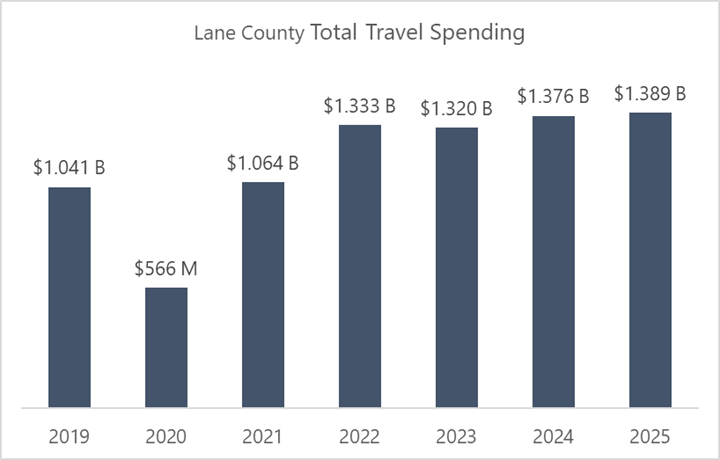
Tourism to Eugene is especially popular during the summer and fall months, when warm weather and outdoor activities draw visitors to the Willamette Valley. Recent reporting shows that the Lane County region, including Eugene, recorded more than 3.5 million overnight stays in 2025. This growth is particularly notable in the visitor spending reported by Travel Oregon, as shown in the chart below.

Travel Spending in Lane County Showed Growth in 2024 and 2025
Source: Travel Oregon
 
Roughly 80% of the travel spending within the county occurs in the Eugene-Springfield market, with visitors staying in hotels, motels, and short-term rentals accounting for 65% of overnight visitor spending in the county. Furthermore, of the nearly $1.4 billion spent by travelers in the region in 2025, roughly $253 million was spent on accommodations.
Year-Round Demand: Sports Tourism and Airport Access

Major events, University of Oregon athletics, and shoulder-season travel have helped extend demand beyond the traditional summer peak. The city’s identity as “Track Town USA” elevates its international profile, particularly through global events held at Hayward Field, such as the 2022 World Athletics Championships. The stadium also hosts major National Collegiate Athletic Association (NCAA) and Olympic qualifying events. Furthermore, a significant amount of demand for the market stems from the University of Oregon’s status as a member of the Big Ten Conference in the NCAA. University football games, graduation ceremonies, basketball tournaments, and youth sporting events frequently sell out hotels across the region, making sports tourism one of Eugene’s strongest hotel demand generators.

Eugene’s accessibility also supports the market’s economic growth and strong levels of hotel demand within the region. In 2025, Eugene Airport recorded more than 1.7 million total passengers, which represents an increase of approximately 6% over 2019 levels and reflects sustained traveler demand in recent years. In order to accommodate the higher passenger levels, the airport has undergone significant upgrades in recent years, including terminal renovations, expanded parking, and new car-rental facilities. Additional expansion plans are underway to support future passenger growth and increased flight service. According to airport officials, passenger levels through the airport are expected to reach 3.2 million annually by 2042. This trend is anticipated to have a significant impact on Eugene, resulting in nearly 10,000 additional direct and indirect jobs in the market, as well as an increase of room nights at hotels throughout the market.

The Road Ahead

Although the hospitality industry faced challenges during the pandemic, Eugene’s travel market has rebounded steadily since 2021. Continued investment in education, athletics, and technology supports an optimistic outlook, and the city remains well positioned as a year-round destination for outdoor recreation, collegiate sports, meetings, and regional events. While growth is normalizing from its rapid post-pandemic pace, Eugene remains one of Oregon’s fastest growing markets. The city’s resilient tourism industry and ongoing development activity should continue to support strong hotel demand from both commercial and leisure travel.

At HVS, data is only the starting point. Our local market presence enables direct interviews with key industry players, providing real‑time insight and current data specific to each market. The result is analysis grounded in today’s realities, not outdated assumptions. For more information on the Eugene hotel market or for guidance on investment decisions aligned with your strategy and risk tolerance, contact Hannah Homack, your local HVS Pacific Northwest hospitality expert.
Market Report

Eugene, Oregon Hotel Market: Growth Supported by Investment

June 4, 2026
Eugene’s hotel market has experienced strong growth in recent years and continues to benefit from significant investment in the city. Eugene has emerged as a leading Pacific Northwest travel destination, and hotel demand benefits from its mix of demand generators that have resulted in increased commercial demand and a strong tourism industry.

Growth Drivers Behind Eugene’s Rising Visitation

Eugene has become one of Oregon’s fastest growing travel destinations through a mix of university development and events, popular Willamette Valley outdoor recreation, and a growing technology sector.

Home to the historic University of Oregon, the city attracts visitors year-round for collegiate sports, cultural events, and academic conferences. In recent years, investments have provided a significant boost to Eugene’s economy and provided hotels and other services with strong levels of demand. The largest recent development is the construction of the $1-billion Phil and Penny Knight Campus for Accelerating Scientific Impact, which has helped fuel new business travel and economic growth. Other investments include the university’s startup program and its research expenditures, which totaled approximately $125 million in 2024/25.

A growing cluster of technology companies has further diversified the local economy, supporting steady hotel demand and year-round visitation. The area is currently home to many technology companies, including Pipeworks Studios, Zynga, and IDX Broker, as well as specialized medical facilities, such as the Slocum Center for Orthopedics & Sports Medicine. In total, over 70 tech companies have moved to Eugene in the past decade. Additional key technology companies have announced plans to establish or expand facilities in Eugene in the near term, such as Amazon, Penderia Technologies, and Ksana Health. Other major technology developments include new micro-LED manufacturing initiatives, growth in various robotics companies, and specialized programs at the University of Oregon that focus on high-performance computing, software development, and hardware manufacturing.

This technology growth in the market has resulted in significant improvements for Eugene hotel metrics in recent years. According to Travel Lane County representatives, hotel room-night revenue in the market has increased by roughly 40% since 2016 as a result of strong occupancy levels and rising guestroom rates. A large portion of this growth, particularly in the shoulder seasons and at the market’s extended-stay hotels, is attributed to the technology industry.

Travel Growth and Rising Visitor Spending in Lane County

Tourism to Eugene is especially popular during the summer and fall months, when warm weather and outdoor activities draw visitors to the Willamette Valley. Recent reporting shows that the Lane County region, including Eugene, recorded more than 3.5 million overnight stays in 2025. This growth is particularly notable in the visitor spending reported by Travel Oregon, as shown in the chart below.

Travel Spending in Lane County Showed Growth in 2024 and 2025
Source: Travel Oregon
 
Roughly 80% of the travel spending within the county occurs in the Eugene-Springfield market, with visitors staying in hotels, motels, and short-term rentals accounting for 65% of overnight visitor spending in the county. Furthermore, of the nearly $1.4 billion spent by travelers in the region in 2025, roughly $253 million was spent on accommodations.

Year-Round Demand: Sports Tourism and Airport Access

Major events, University of Oregon athletics, and shoulder-season travel have helped extend demand beyond the traditional summer peak. The city’s identity as “Track Town USA” elevates its international profile, particularly through global events held at Hayward Field, such as the 2022 World Athletics Championships. The stadium also hosts major National Collegiate Athletic Association (NCAA) and Olympic qualifying events. Furthermore, a significant amount of demand for the market stems from the University of Oregon’s status as a member of the Big Ten Conference in the NCAA. University football games, graduation ceremonies, basketball tournaments, and youth sporting events frequently sell out hotels across the region, making sports tourism one of Eugene’s strongest hotel demand generators.

Eugene’s accessibility also supports the market’s economic growth and strong levels of hotel demand within the region. In 2025, Eugene Airport recorded more than 1.7 million total passengers, which represents an increase of approximately 6% over 2019 levels and reflects sustained traveler demand in recent years. In order to accommodate the higher passenger levels, the airport has undergone significant upgrades in recent years, including terminal renovations, expanded parking, and new car-rental facilities. Additional expansion plans are underway to support future passenger growth and increased flight service. According to airport officials, passenger levels through the airport are expected to reach 3.2 million annually by 2042. This trend is anticipated to have a significant impact on Eugene, resulting in nearly 10,000 additional direct and indirect jobs in the market, as well as an increase of room nights at hotels throughout the market.

The Road Ahead

Although the hospitality industry faced challenges during the pandemic, Eugene’s travel market has rebounded steadily since 2021. Continued investment in education, athletics, and technology supports an optimistic outlook, and the city remains well positioned as a year-round destination for outdoor recreation, collegiate sports, meetings, and regional events. While growth is normalizing from its rapid post-pandemic pace, Eugene remains one of Oregon’s fastest growing markets. The city’s resilient tourism industry and ongoing development activity should continue to support strong hotel demand from both commercial and leisure travel.

At HVS, data is only the starting point. Our local market presence enables direct interviews with key industry players, providing real‑time insight and current data specific to each market. The result is analysis grounded in today’s realities, not outdated assumptions. For more information on the Eugene hotel market or for guidance on investment decisions aligned with your strategy and risk tolerance, contact Hannah Homack, your local HVS Pacific Northwest hospitality expert.