
Market Report

Upward Trajectory: Continued Recovery of the Manhattan Hotel Market

May 29, 2026
The Manhattan market has continued to achieve strong ADR growth in recent years. Occupancy, however, still lags the historical peak. Although legislative and supply changes should bolster this recovery, recent geopolitical factors, tariffs, and federal policy changes are expected to affect short-term hotel market trends. Our forecast shows full recovery beyond 2019 levels for all hotel metrics by 2027/28.
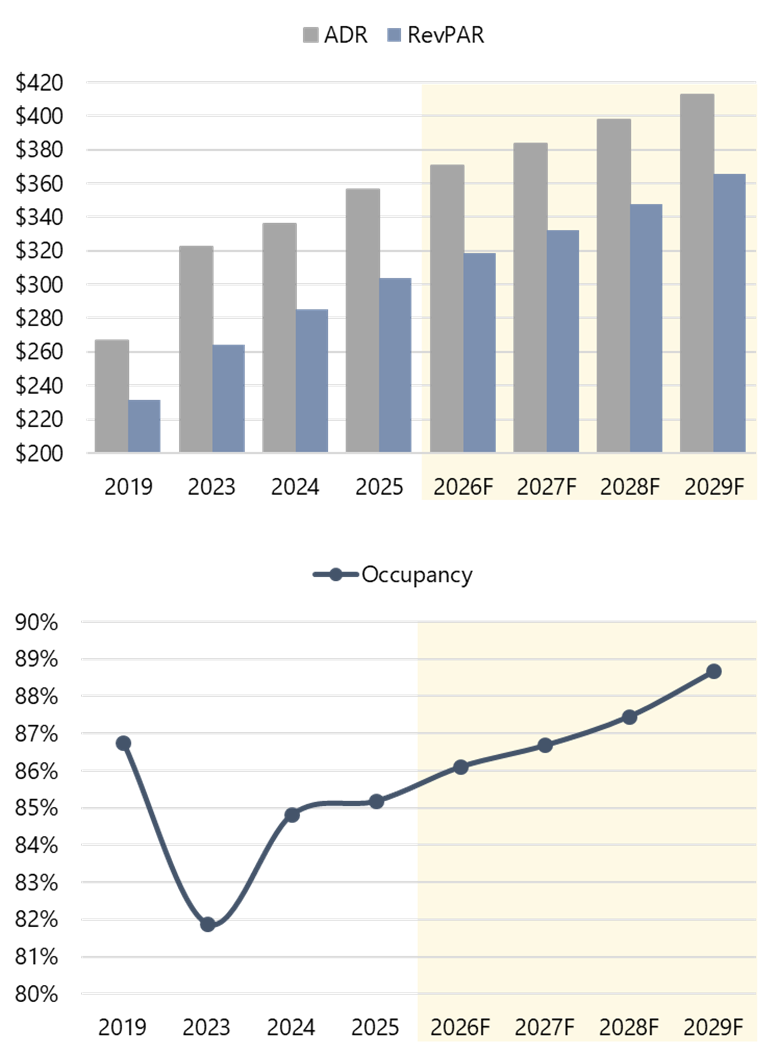
The Manhattan market has been recovering favorably during the post-pandemic period. The last four years have been a period of continued recovery for Manhattan hotels, attributed to strong average rate gains. ADR peaked in 2025, exceeding the 2019 level by roughly 34%. Occupancy remained relatively stable year-over-year in 2025, ending in the mid-80s; however, the substantial ADR growth helped push the market’s 2025 RevPAR approximately 31% above the 2019 level. The strong 2025 market performance exceeded expectations amid the reduction of some international room-night demand.
 
The full market recovery will require the complete return of international travel, meeting and group business, and commercial demand. In 2025, geopolitical factors and federal policy changes contributed to a reduction of some international visitation to the United States. Relatively strong domestic travel, however, offset a portion of that reduction. New York City Tourism + Conventions has projected visitation to reach 66.3 million travelers in 2026, attributed to the anticipated FIFA World Cup 2026 matches to be held in the greater area, including the World Cup Final, as well as the America 250 celebration events and the return of some international leisure demand. The current geopolitical factors and federal policy changes may have a continued short-term impact on international room-night demand. Inflationary levels resulting from the imposed tariffs may indirectly boost domestic travel. Some consumers may consider more cost-effective stateside trips to manage discretionary income.

Safe Hotels Act (Bill Int. 991-C) – Effective May 3, 2025

In July 2024, the New York City Council introduced the proposed bill Int. 991-2024, known as the “Safe Hotels Act.” A final version of the proposed bill was approved by the City Council on October 23, 2024, following review and discussions between the City Council, Hotel and Gaming Trades Council (HTC), and Protect NYC Tourism Coalition. Former Mayor Eric Adams signed the final revised bill into law on November 4, 2024, and the Safe Hotels Act went into effect on May 3, 2025. Hotel ownership entities and hotel operators have reported that the hotel license application process is relatively straightforward.
 
The Safe Hotels Act comprises numerous service and safety requirements, which many hotels already have as part of their standard operating procedures. The following are the main new regulations:
  • All hotels in New York City are required to obtain a hotel license, which will be valid for a two-year term, for the operation of the hotel. The hotel operator must obtain a hotel license renewal every two years thereafter.
  •  All hotels in New York City (regardless of guestroom count) must maintain continuous front desk coverage during operational hours. As such, at least one staff member must provide front desk services during overnight periods.
  •  All hotels in New York City with 100 or more guestrooms cannot subcontract “core hotel” positions and must directly employ these staff members. “Core hotel” positions are defined as front desk, housekeeping, and front service (e.g., house person, bell person, and door person).
    • This requirement does not apply to hotels with less than 100 guestrooms.
    • Subcontractor staffing contracts that were executed prior to the law’s May 3, 2025, effective date may remain in effect if the contracts provide for termination by a certain date.
    • A hotel owner need not directly employ core employees if the owner retains a single hotel operator to manage all hotel operations involving core employees, in which case the hotel operator must be the direct employer of the core employees. 
  • All hotels in New York City with more than 400 guestrooms (categorized as “large hotels”) must have at least one security guard onsite during all operational hours. 
  • No hotels in New York City, with the exception of airport hotels, may offer guestroom bookings for less than four hours.

NYC Citywide Hotels Text Amendment

In December 2018, the City Council adopted a text amendment to the M1 zoning district regulations, creating a requirement for a special-use permit for new hotel developments in M1 zoning districts. On December 9, 2021, the City Council adopted the Citywide Hotels Text Amendment, which extends the special-use permit requirement to all new hotel construction projects in all five boroughs. This essentially eliminated as-of-right hotel development in Manhattan.

The Citywide Hotels Text Amendment also requires that hotel construction commencing after December 9, 2021, use unionized construction workforces. Hotel owners and operators must then adhere to collective bargaining agreements for hourly staff in the operational departments (rooms, food and beverage, and engineering/maintenance). Thus, hotel owners and operators must consider the higher costs associated with these labor requirements. We note that food and beverage operations leased to external operators are exempt from the unionized workforce requirement.

Although the development of limited- and select-service lodging facilities is expected to be stifled by the NYC Citywide Hotels Text Amendment, the potential remains for the development of upper-upscale and luxury products where revenue generation could offset the higher construction and operational costs. Four new hotel building permits, representing luxury and ultra-luxury hotel projects, have been submitted since the enactment of this text amendment.

Expiration of Local Law 50 and New Housing Laws

Local Law 50 was enacted in 2015 to prohibit the conversion of hotels with more than 150 guestrooms to alternate uses. Under Local Law 50, owners of large hotels could convert only 20% of the guestroom inventory to another use, such as micro apartments and student housing. At least 80% of the property’s guestroom inventory was required to be retained for hotel use. Local Law 50 expired in June 2019; thus, some hotels may operate with a reduced guestroom count in an effort to increase operational efficiencies. The former 492-key Holiday Inn Manhattan-Financial District is being converted to a 650-bed FOUND Study student-housing facility. Phase I opened in November 2025, and Phase II is slated for completion in 2026.
 

Additionally, the Housing Our Neighbors with Dignity Act, or HONDA (S5257C/A6593B), that was signed into New York State law in June 2021 enables financially distressed hotels and office buildings to be permanently converted to affordable housing. Moreover, the Hotel Conversion Bill (S4937C/A6262B) was enacted in June 2022, allowing residential hotels with different building regulations (Class B hotels) located within residential zoning districts or within 400 feet of such districts to be converted to permanent residential units with their existing certificates of occupancy.

Collective Bargaining Agreement – Effective July 1, 2026, through June 30, 2034

The current Industry-Wide Agreement (IWA) for the Hotel and Gaming Trades Council (HTC) ends on June 30, 2026. The Hotel Association of New York City (HANYC) and HTC reached a deal for the new IWA on May 18, 2026, and HTC members ratified the new contract on May 21, 2026. This contract will take effect on July 1, 2026, and end on June 30, 2034. The following are some key items in the contract:
  • Wages for non-tipped workers will increase by $21.20 over the life of the contract, which averages to over 5.0% each year.
  • Completely free healthcare for members and their families will continue during the contract, and employer contributions to the Health Benefits Fund will increase by 3.0%.
  • Employer contributions to the Pension Fund will increase by 0.5% starting January 1, 2027.
  • New Housing and Childcare Funds will be established, funded by employers to help offset financial burdens for workers.
  • Additional paid time off will be provided, including fully paid family leave for new parents and four paid hours to vote in local, state, and federal elections.
Non-union hotel operators would want to consider the market hourly wage increase to maintain worker satisfaction.

Hotels as Temporary Shelter Facilities

Most hotels that closed temporarily in 2020 have reopened in the years since. However, some have permanently closed, others are operating as temporary shelters for unhoused individuals, and still others have been or may be converted to alternate uses. Prior to the pandemic, some of the outer-borough hotels were already contracting guestrooms with the New York City Department of Homeless Services (NYC DHS) to provide temporary shelter facilities for residents experiencing homelessness. Additional lodging facilities were temporarily utilized as shelters during 2020 and 2021 to meet social-distance requirements during the height of the pandemic. In March 2026, the DHS and HANYC agreed on a new three-year contract for the use of New York City hotels to provide emergency shelter to unhoused residents (with a focus on families).
 
An influx of migrants/asylum seekers (many of whom were transported directly from other states) began to arrive in New York City in the second quarter of 2022 and continued through mid-year 2024. More than 210,000 migrants/asylum seekers arrived in NYC during this period. Several dozen hotels within the five boroughs were utilized as temporary shelters for homeless residents and newly arrived migrants/asylum seekers. Given the significant reduction of migrants/asylum-seeker arrivals from 2024 through the year-to-date 2026 period, city officials have been closing the temporary shelters in waves since mid-year 2024.
 
Numerous hotels have reopened to the public following the shelter closures, such as the 1,331-key Row NYC in Midtown Manhattan that reopened on May 1, 2026, following renovations. In June 2025, The Roosevelt Hotel (1,015 keys) in Midtown Manhattan ended its role as the main Humanitarian Emergency Response and Relief Center for migrants/asylum seekers. Although recent February 2026 news indicates the possible renovation and revival of The Roosevelt Hotel, uncertainty remains regarding the future use of the historic building. A portion of the few remaining hotels currently operating as temporary shelters for migrants/asylum seekers and those that have remained closed with uncertain reopening dates are older assets that are in fair to good condition, and many have significant obsolescence drawbacks. As such, we anticipate that over 30% of those remaining hotels have a high probability of either closing permanently or being converted to another use over the next several years. In some cases, the use of hotels to house New York City’s homeless population could become a permanent solution to the city’s affordable housing crisis.

Local Law 18

Local Law 18, known as the Short-Term Rental Registration Law, was adopted on January 9, 2022, requiring all short-term-rental hosts to register with the Mayor’s Office of Special Enforcement (OSE). Local Law 18 prohibits booking platforms (such as Airbnb, Vrbo, and Hotels.com) from processing transactions for short-term rentals that are not registered with the OSE. The OSE remains a strong regulator to ensure that short-term-rental hosts are using the city’s verification system consistently and correctly. Given the tight restrictions, a large portion of the short-term rentals in New York City are not permitted to operate. Hotels have reportedly been absorbing a portion of this room-night demand.

There is continued opposition to Local Law 18 from NYC residents who report that the short-term rental restrictions have had negative financial consequences for homeowners who rely on short-term rentals for additional income. On November 13, 2024, a few City Council members introduced Intro. 1107 that would grant some flexibility for owners of one- and two-family homes. The proposed Intro. 1107 has full support from the Restore Homeowners Autonomy & Rights (RHOAR) group, which comprises several hundred homeowners who have been pushing for changes to Local Law 18. An amended Intro 1107-A was issued on February 3, 2025. Tenant advocates, the hotel industry, and HTC oppose both the proposed Intro. 1107 and the amended Intro 1107-A. A final decision has not yet been made regarding the amended Intro 1107-A.

Local Law 97

Local Law 97 was passed in April 2019 as part of the Climate Mobilization Act, which requires that most buildings greater than 25,000 gross square feet must meet new energy-efficiency and greenhouse gas-emissions standards as of 2024, reduce emissions by 40% as of 2030, and reduce emissions by 100% as of 2050. Many property owners and operators have reported that their hotel buildings meet the 2024 and 2030 requirements.
 

Starting on July 1, 2025, penalties will be issued for either non-compliance with the requirements or for non-reporting. Thus, owners of older hotels must consider the cost of either making the required upgrades or remitting penalty fines. Local Law 97 does not directly affect Manhattan lodging guestroom inventory. However, these potential costs, along with the associated higher development costs and general expenses (e.g., higher property and liability insurance costs), must be considered by hotel developers, hotel ownership entities, and hotel operators.

Manhattan Market Forecast 2026–2029

Based on our analysis of the historical data, a review of the net new supply pipeline, the potential short-term impact of the current geopolitical factors and federal policy changes, and the long-term outlook for demand growth, we have prepared the following forecasts for the Manhattan lodging market through 2029.
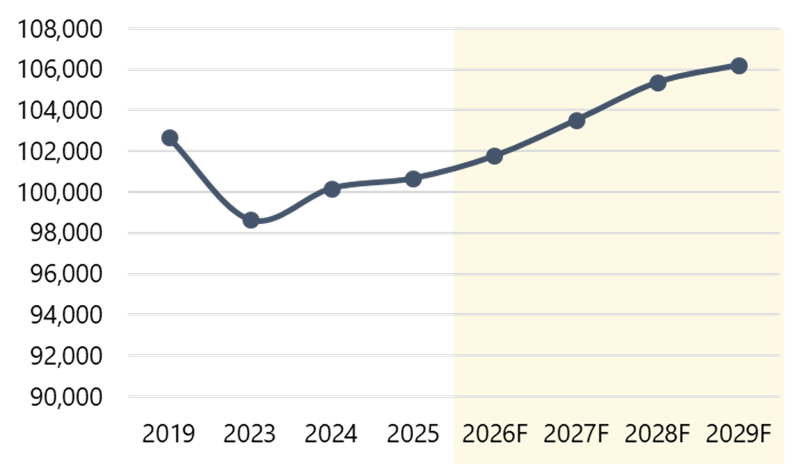
 
New Supply Pipeline Anticipated to be Nominal After 2028
Source: CoStar/STR (Historical), HVS (Forecast)

Manhattan Occupancy, ADR & RevPAR Forecast to Stabilize in 2029
Source: CoStar/STR (Historical), HVS (Forecast)

New York City and New Jersey are jointly hosting eight FIFA World Cup 2026 matches, including the World Cup Final, at MetLife Stadium in East Rutherford, New Jersey. Manhattan is expected to benefit from the associated visitation given the borough’s direct access to/from northern New Jersey. Room-night demand has been relatively soft due to several factors, including ticket pricing, visa processing wait times, and geopolitical influences. However, the FIFA World Cup 2026 period coincides with the peak summer season and the America 250 celebration events. Therefore, the softer World Cup visitation is anticipated to be offset by traditional summer leisure demand.
 
Continued strengthening demand and a constrained supply pipeline are expected to support continued ADR growth. It is important to note that the remaining new supply comprises predominantly upscale to luxury hotel products, which should boost ADR growth to some degree. Moreover, the increase in operational costs also has an impact on ADR growth. Contributors to the anticipated demand growth include the sustained return of international leisure travelers, continued gradual return of business travel, and continuous growth of meeting and group activity. We forecast occupancy to stabilize at 88.7% in 2029, modestly higher than the 2019 peak, given the restricted supply pipeline.

Conclusion

The Manhattan lodging market experienced extraordinary growth in the decade prior to 2020. Demand growth was approximately 57%, which outpaced the 52% increase in supply during that time. Occupancy levels were firmly established in the upper 80s during this period. However, the introduction of new guestroom inventory contributed to a decline in ADR from 2015 to 2017 and again in 2019.
 
The market has been experiencing an accelerating recovery for the last four years, primarily due to strong average rate gains. The current geopolitical factors, the imposed tariffs, and new federal policies, however, may affect room-night demand to some degree in the short term. ADR growth is anticipated to continue but at more moderate levels. The restricted supply pipeline, comprising largely upscale to luxury hotel products, as well as the increase in operational costs, are anticipated to contribute to overall ADR growth.
 
The market is well positioned for continued economic success over the longer term, supported by a diverse base of employers, a robust tourism industry, and an expanded convention center, as well as multiple new and planned larger-scale, mixed-use developments. Occupancy levels should return to historical norms as global travel continues to strengthen and as New York City remains a premier gateway destination. As the net new supply is absorbed through 2028 and the new supply pipeline contracts considerably, ADR increases are expected to remain strong, supporting the forecasted RevPAR growth.
 
At HVS, we turn data into powerful insights that drive your success. Our unique approach leverages primary, in-market interviews to capture real-time insights straight from local communities. If you are seeking to better understand the trajectory of the Manhattan lodging market, contact Roland de Milleret, MAI, at (516) 209-7305 or Patricia Shih at (404) 791-5509 for additional insights and discussion. And to stay ahead of the evolving dynamics of any major market on a quarterly basis, consider HVS MarketCast as a valuable forecasting tool. This tailored, five-year forecast provides annual projections for occupancy, ADR, and RevPAR and is designed to equip teams with the market-specific data and forward-looking insights needed to support planning, optimize performance, and maximize profitability in major markets like New York City.
Market Report

Upward Trajectory: Continued Recovery of the Manhattan Hotel Market

May 29, 2026
The Manhattan market has continued to achieve strong ADR growth in recent years. Occupancy, however, still lags the historical peak. Although legislative and supply changes should bolster this recovery, recent geopolitical factors, tariffs, and federal policy changes are expected to affect short-term hotel market trends. Our forecast shows full recovery beyond 2019 levels for all hotel metrics by 2027/28.
The Manhattan market has been recovering favorably during the post-pandemic period. The last four years have been a period of continued recovery for Manhattan hotels, attributed to strong average rate gains. ADR peaked in 2025, exceeding the 2019 level by roughly 34%. Occupancy remained relatively stable year-over-year in 2025, ending in the mid-80s; however, the substantial ADR growth helped push the market’s 2025 RevPAR approximately 31% above the 2019 level. The strong 2025 market performance exceeded expectations amid the reduction of some international room-night demand.
 
The full market recovery will require the complete return of international travel, meeting and group business, and commercial demand. In 2025, geopolitical factors and federal policy changes contributed to a reduction of some international visitation to the United States. Relatively strong domestic travel, however, offset a portion of that reduction. New York City Tourism + Conventions has projected visitation to reach 66.3 million travelers in 2026, attributed to the anticipated FIFA World Cup 2026 matches to be held in the greater area, including the World Cup Final, as well as the America 250 celebration events and the return of some international leisure demand. The current geopolitical factors and federal policy changes may have a continued short-term impact on international room-night demand. Inflationary levels resulting from the imposed tariffs may indirectly boost domestic travel. Some consumers may consider more cost-effective stateside trips to manage discretionary income.

Safe Hotels Act (Bill Int. 991-C) – Effective May 3, 2025

In July 2024, the New York City Council introduced the proposed bill Int. 991-2024, known as the “Safe Hotels Act.” A final version of the proposed bill was approved by the City Council on October 23, 2024, following review and discussions between the City Council, Hotel and Gaming Trades Council (HTC), and Protect NYC Tourism Coalition. Former Mayor Eric Adams signed the final revised bill into law on November 4, 2024, and the Safe Hotels Act went into effect on May 3, 2025. Hotel ownership entities and hotel operators have reported that the hotel license application process is relatively straightforward.
 
The Safe Hotels Act comprises numerous service and safety requirements, which many hotels already have as part of their standard operating procedures. The following are the main new regulations:
  • All hotels in New York City are required to obtain a hotel license, which will be valid for a two-year term, for the operation of the hotel. The hotel operator must obtain a hotel license renewal every two years thereafter.
  •  All hotels in New York City (regardless of guestroom count) must maintain continuous front desk coverage during operational hours. As such, at least one staff member must provide front desk services during overnight periods.
  •  All hotels in New York City with 100 or more guestrooms cannot subcontract “core hotel” positions and must directly employ these staff members. “Core hotel” positions are defined as front desk, housekeeping, and front service (e.g., house person, bell person, and door person).
    • This requirement does not apply to hotels with less than 100 guestrooms.
    • Subcontractor staffing contracts that were executed prior to the law’s May 3, 2025, effective date may remain in effect if the contracts provide for termination by a certain date.
    • A hotel owner need not directly employ core employees if the owner retains a single hotel operator to manage all hotel operations involving core employees, in which case the hotel operator must be the direct employer of the core employees. 
  • All hotels in New York City with more than 400 guestrooms (categorized as “large hotels”) must have at least one security guard onsite during all operational hours. 
  • No hotels in New York City, with the exception of airport hotels, may offer guestroom bookings for less than four hours.

NYC Citywide Hotels Text Amendment

In December 2018, the City Council adopted a text amendment to the M1 zoning district regulations, creating a requirement for a special-use permit for new hotel developments in M1 zoning districts. On December 9, 2021, the City Council adopted the Citywide Hotels Text Amendment, which extends the special-use permit requirement to all new hotel construction projects in all five boroughs. This essentially eliminated as-of-right hotel development in Manhattan.

The Citywide Hotels Text Amendment also requires that hotel construction commencing after December 9, 2021, use unionized construction workforces. Hotel owners and operators must then adhere to collective bargaining agreements for hourly staff in the operational departments (rooms, food and beverage, and engineering/maintenance). Thus, hotel owners and operators must consider the higher costs associated with these labor requirements. We note that food and beverage operations leased to external operators are exempt from the unionized workforce requirement.

Although the development of limited- and select-service lodging facilities is expected to be stifled by the NYC Citywide Hotels Text Amendment, the potential remains for the development of upper-upscale and luxury products where revenue generation could offset the higher construction and operational costs. Four new hotel building permits, representing luxury and ultra-luxury hotel projects, have been submitted since the enactment of this text amendment.

Expiration of Local Law 50 and New Housing Laws

Local Law 50 was enacted in 2015 to prohibit the conversion of hotels with more than 150 guestrooms to alternate uses. Under Local Law 50, owners of large hotels could convert only 20% of the guestroom inventory to another use, such as micro apartments and student housing. At least 80% of the property’s guestroom inventory was required to be retained for hotel use. Local Law 50 expired in June 2019; thus, some hotels may operate with a reduced guestroom count in an effort to increase operational efficiencies. The former 492-key Holiday Inn Manhattan-Financial District is being converted to a 650-bed FOUND Study student-housing facility. Phase I opened in November 2025, and Phase II is slated for completion in 2026.
 

Additionally, the Housing Our Neighbors with Dignity Act, or HONDA (S5257C/A6593B), that was signed into New York State law in June 2021 enables financially distressed hotels and office buildings to be permanently converted to affordable housing. Moreover, the Hotel Conversion Bill (S4937C/A6262B) was enacted in June 2022, allowing residential hotels with different building regulations (Class B hotels) located within residential zoning districts or within 400 feet of such districts to be converted to permanent residential units with their existing certificates of occupancy.

Collective Bargaining Agreement – Effective July 1, 2026, through June 30, 2034

The current Industry-Wide Agreement (IWA) for the Hotel and Gaming Trades Council (HTC) ends on June 30, 2026. The Hotel Association of New York City (HANYC) and HTC reached a deal for the new IWA on May 18, 2026, and HTC members ratified the new contract on May 21, 2026. This contract will take effect on July 1, 2026, and end on June 30, 2034. The following are some key items in the contract:
  • Wages for non-tipped workers will increase by $21.20 over the life of the contract, which averages to over 5.0% each year.
  • Completely free healthcare for members and their families will continue during the contract, and employer contributions to the Health Benefits Fund will increase by 3.0%.
  • Employer contributions to the Pension Fund will increase by 0.5% starting January 1, 2027.
  • New Housing and Childcare Funds will be established, funded by employers to help offset financial burdens for workers.
  • Additional paid time off will be provided, including fully paid family leave for new parents and four paid hours to vote in local, state, and federal elections.
Non-union hotel operators would want to consider the market hourly wage increase to maintain worker satisfaction.

Hotels as Temporary Shelter Facilities

Most hotels that closed temporarily in 2020 have reopened in the years since. However, some have permanently closed, others are operating as temporary shelters for unhoused individuals, and still others have been or may be converted to alternate uses. Prior to the pandemic, some of the outer-borough hotels were already contracting guestrooms with the New York City Department of Homeless Services (NYC DHS) to provide temporary shelter facilities for residents experiencing homelessness. Additional lodging facilities were temporarily utilized as shelters during 2020 and 2021 to meet social-distance requirements during the height of the pandemic. In March 2026, the DHS and HANYC agreed on a new three-year contract for the use of New York City hotels to provide emergency shelter to unhoused residents (with a focus on families).
 
An influx of migrants/asylum seekers (many of whom were transported directly from other states) began to arrive in New York City in the second quarter of 2022 and continued through mid-year 2024. More than 210,000 migrants/asylum seekers arrived in NYC during this period. Several dozen hotels within the five boroughs were utilized as temporary shelters for homeless residents and newly arrived migrants/asylum seekers. Given the significant reduction of migrants/asylum-seeker arrivals from 2024 through the year-to-date 2026 period, city officials have been closing the temporary shelters in waves since mid-year 2024.
 
Numerous hotels have reopened to the public following the shelter closures, such as the 1,331-key Row NYC in Midtown Manhattan that reopened on May 1, 2026, following renovations. In June 2025, The Roosevelt Hotel (1,015 keys) in Midtown Manhattan ended its role as the main Humanitarian Emergency Response and Relief Center for migrants/asylum seekers. Although recent February 2026 news indicates the possible renovation and revival of The Roosevelt Hotel, uncertainty remains regarding the future use of the historic building. A portion of the few remaining hotels currently operating as temporary shelters for migrants/asylum seekers and those that have remained closed with uncertain reopening dates are older assets that are in fair to good condition, and many have significant obsolescence drawbacks. As such, we anticipate that over 30% of those remaining hotels have a high probability of either closing permanently or being converted to another use over the next several years. In some cases, the use of hotels to house New York City’s homeless population could become a permanent solution to the city’s affordable housing crisis.

Local Law 18

Local Law 18, known as the Short-Term Rental Registration Law, was adopted on January 9, 2022, requiring all short-term-rental hosts to register with the Mayor’s Office of Special Enforcement (OSE). Local Law 18 prohibits booking platforms (such as Airbnb, Vrbo, and Hotels.com) from processing transactions for short-term rentals that are not registered with the OSE. The OSE remains a strong regulator to ensure that short-term-rental hosts are using the city’s verification system consistently and correctly. Given the tight restrictions, a large portion of the short-term rentals in New York City are not permitted to operate. Hotels have reportedly been absorbing a portion of this room-night demand.

There is continued opposition to Local Law 18 from NYC residents who report that the short-term rental restrictions have had negative financial consequences for homeowners who rely on short-term rentals for additional income. On November 13, 2024, a few City Council members introduced Intro. 1107 that would grant some flexibility for owners of one- and two-family homes. The proposed Intro. 1107 has full support from the Restore Homeowners Autonomy & Rights (RHOAR) group, which comprises several hundred homeowners who have been pushing for changes to Local Law 18. An amended Intro 1107-A was issued on February 3, 2025. Tenant advocates, the hotel industry, and HTC oppose both the proposed Intro. 1107 and the amended Intro 1107-A. A final decision has not yet been made regarding the amended Intro 1107-A.

Local Law 97

Local Law 97 was passed in April 2019 as part of the Climate Mobilization Act, which requires that most buildings greater than 25,000 gross square feet must meet new energy-efficiency and greenhouse gas-emissions standards as of 2024, reduce emissions by 40% as of 2030, and reduce emissions by 100% as of 2050. Many property owners and operators have reported that their hotel buildings meet the 2024 and 2030 requirements.
 

Starting on July 1, 2025, penalties will be issued for either non-compliance with the requirements or for non-reporting. Thus, owners of older hotels must consider the cost of either making the required upgrades or remitting penalty fines. Local Law 97 does not directly affect Manhattan lodging guestroom inventory. However, these potential costs, along with the associated higher development costs and general expenses (e.g., higher property and liability insurance costs), must be considered by hotel developers, hotel ownership entities, and hotel operators.

Manhattan Market Forecast 2026–2029

Based on our analysis of the historical data, a review of the net new supply pipeline, the potential short-term impact of the current geopolitical factors and federal policy changes, and the long-term outlook for demand growth, we have prepared the following forecasts for the Manhattan lodging market through 2029.
 
New Supply Pipeline Anticipated to be Nominal After 2028
Source: CoStar/STR (Historical), HVS (Forecast)

Manhattan Occupancy, ADR & RevPAR Forecast to Stabilize in 2029

Source: CoStar/STR (Historical), HVS (Forecast)

New York City and New Jersey are jointly hosting eight FIFA World Cup 2026 matches, including the World Cup Final, at MetLife Stadium in East Rutherford, New Jersey. Manhattan is expected to benefit from the associated visitation given the borough’s direct access to/from northern New Jersey. Room-night demand has been relatively soft due to several factors, including ticket pricing, visa processing wait times, and geopolitical influences. However, the FIFA World Cup 2026 period coincides with the peak summer season and the America 250 celebration events. Therefore, the softer World Cup visitation is anticipated to be offset by traditional summer leisure demand.
 
Continued strengthening demand and a constrained supply pipeline are expected to support continued ADR growth. It is important to note that the remaining new supply comprises predominantly upscale to luxury hotel products, which should boost ADR growth to some degree. Moreover, the increase in operational costs also has an impact on ADR growth. Contributors to the anticipated demand growth include the sustained return of international leisure travelers, continued gradual return of business travel, and continuous growth of meeting and group activity. We forecast occupancy to stabilize at 88.7% in 2029, modestly higher than the 2019 peak, given the restricted supply pipeline.

Conclusion

The Manhattan lodging market experienced extraordinary growth in the decade prior to 2020. Demand growth was approximately 57%, which outpaced the 52% increase in supply during that time. Occupancy levels were firmly established in the upper 80s during this period. However, the introduction of new guestroom inventory contributed to a decline in ADR from 2015 to 2017 and again in 2019.
 
The market has been experiencing an accelerating recovery for the last four years, primarily due to strong average rate gains. The current geopolitical factors, the imposed tariffs, and new federal policies, however, may affect room-night demand to some degree in the short term. ADR growth is anticipated to continue but at more moderate levels. The restricted supply pipeline, comprising largely upscale to luxury hotel products, as well as the increase in operational costs, are anticipated to contribute to overall ADR growth.
 
The market is well positioned for continued economic success over the longer term, supported by a diverse base of employers, a robust tourism industry, and an expanded convention center, as well as multiple new and planned larger-scale, mixed-use developments. Occupancy levels should return to historical norms as global travel continues to strengthen and as New York City remains a premier gateway destination. As the net new supply is absorbed through 2028 and the new supply pipeline contracts considerably, ADR increases are expected to remain strong, supporting the forecasted RevPAR growth.
 
At HVS, we turn data into powerful insights that drive your success. Our unique approach leverages primary, in-market interviews to capture real-time insights straight from local communities. If you are seeking to better understand the trajectory of the Manhattan lodging market, contact Roland de Milleret, MAI, at (516) 209-7305 or Patricia Shih at (404) 791-5509 for additional insights and discussion. And to stay ahead of the evolving dynamics of any major market on a quarterly basis, consider HVS MarketCast as a valuable forecasting tool. This tailored, five-year forecast provides annual projections for occupancy, ADR, and RevPAR and is designed to equip teams with the market-specific data and forward-looking insights needed to support planning, optimize performance, and maximize profitability in major markets like New York City.