
Market Report

Looking Toward the Normalization of the New Orleans Hotel Market

April 14, 2026
Although a slow COVID recovery and negative news cycles previously cast doubt on New Orleans’ viability as a vacation destination, the popularity of the city is supporting strong leisure travel rebound and an optimistic convention schedule.

While New Orleans remains one of the most popular cities to visit in the United States, a prolonged recovery after the COVID-19 pandemic left some doubtful about the city’s viability as a top hotel market. Looking forward, there is cause for optimism.

The Post-Pandemic Uphill Climb

The city did not fully reopen from the COVID-19 shutdown until 2021, after festivals and major conventions were cancelled; Hurricane Ida further exacerbated demand disruptions. For a CoStar set of more than 211 hotels with 4,800 rooms located throughout New Orleans, occupancy registered in the low 70s from 2014 through 2019, settled in the 60s after the pandemic, and declined to the high 50s in 2025.
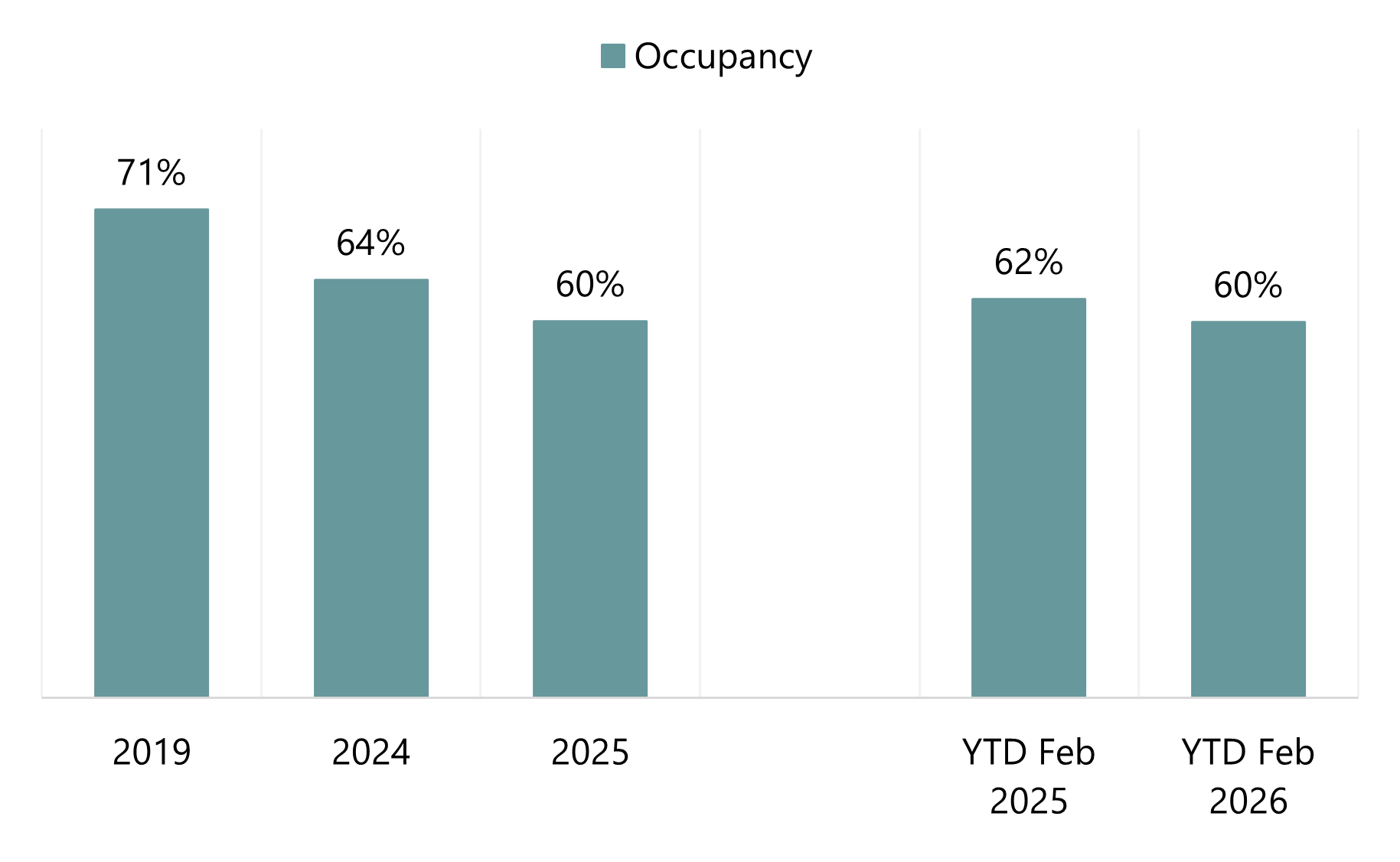
Latest Data for New Orleans Show Occupancy Declines

Source: CoStar

Key events in recent years have influenced occupancy. After the reported $500-million economic impact of Taylor Swift concerts in October 2024, an attack on New Year’s Eve 2025 increased wariness about safety in the city, tempering leisure demand early in the year. However, in February 2025, Super Bowl LIX reportedly had an approximately $1.25-billion economic impact.

Despite fluctuating occupancy trends, operators have maintained higher ADR levels to keep RevPAR more stable. The effects of inflation led to a nearly $50 ADR increase in 2022 but only a $10 correction afterwards. Because of the effects of the Super Bowl in February 2025, ADR and RevPAR show a correction in the year-to-date 2026 period, though the ADR is slightly above the year-end 2024 level.
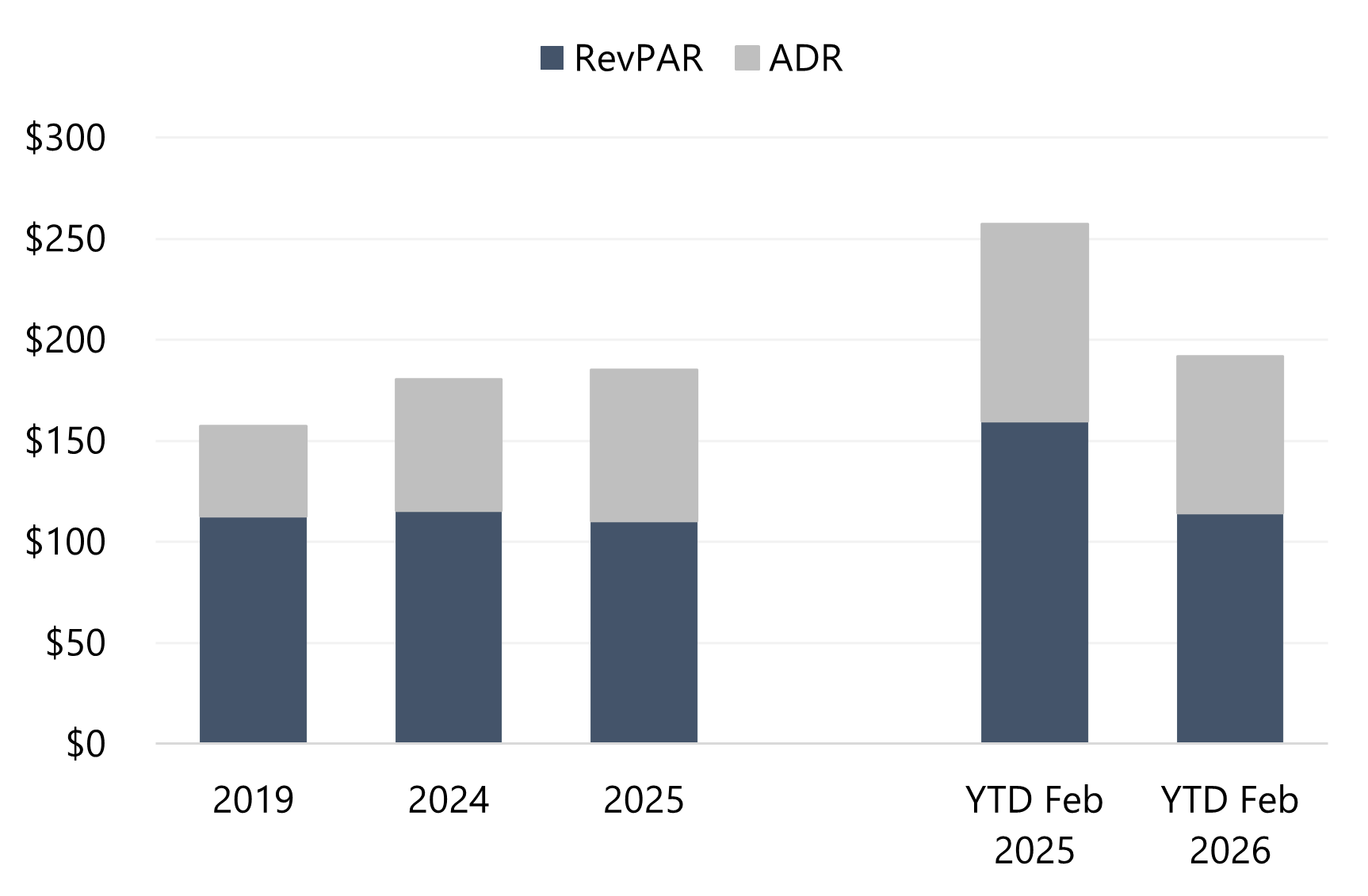
RevPAR and ADR Have Been More Stable Despite Recent Correction
Source: CoStar

Hotel Pipeline and Shifting Development Patterns

Because the market was home to many undercapitalized and independent hotels, a wave of hotel upgrades and new brand affiliations swept through the market between 2014 and 2018. Since that time, many additional hotels have undergone major renovations, particularly as construction costs and a lack of vacant sites have made it difficult to develop brand-new properties. While independent or more dated properties were converted to soft brands before the pandemic, some of the most dramatic renovations occurred at upscale and luxury hotels leading up to the city hosting the Super Bowl. Additionally, well-known properties in the city, like Hotel Monteleone, Windsor Court, and Le Pavillon, have undergone multimillion-dollar transformations in recent years.

Many hotel projects proposed before 2020 were cancelled due to escalating costs, but a trend toward short-term rental developments has endured. For instance, vacant buildings in the Warehouse District have been turned into multi-suite properties like the Hotel Perle, which is sold on both the property’s proprietary booking site and Airbnb.

New neighborhoods represent areas of opportunity; another ground-up hotel is being built in the Garden District. However, most hotels proposed for the Marigny and Bywater neighborhoods face opposition from residents concerned about the impact of new buildings on the character of these districts.

Looking Ahead: Near-Term Outlook

In 2024, the city hosted more than 19 million visitors for the first time since the pandemic, and visitor spending was near $10.4 million—8.3% higher than the previous year, according to MMGY Global. However, some indicators are still a cause for concern; the “summer slump” results in year-over-year RevPAR declines in most of the off-season months, and political uncertainty has led to a drop in international visitation.

More favorably, the city was ranked as the second-best travel destination in the United States for 2025 by Travel + Leisure. Also in 2025, the Michelin Guide awarded stars to three restaurants in New Orleans. The New Orleans Jazz & Heritage Festival in 2026 will host headliners such as the Eagles, Stevie Nicks, and Rod Stewart.

A strong convention schedule should support hotel demand in the coming years. Two events are scheduled for the slow summer season of 2026 and 2028, with over 7,000 definite bookings. Events like the American Heart Association’s International Stroke Conference in February registered demand levels similar to the previous year’s Super Bowl month; two more medical-industry events will bring more than 10,000 attendees in 2026. Thereafter, four events in 2028 are expected to bring more than 10,000 peak room nights.

The Path Forward: 2030 and Beyond

A convention center hotel has long been planned as part of New Orleans’ bid to compete with other major markets. Because the site has now been purchased, officials expect to open the $600-million Omni by 2030. Reportedly, this will help the city stay in the running to host another Super Bowl. Furthermore, New Orleans has not been able to accommodate conventions that require a host hotel attached to the event facility. With the new Omni adjoining the New Orleans Ernest N. Morial Convention Center, the inconvenience of inclement weather and mobility issues should be mitigated for meeting and event planners.

Our Perspective

As major events remind potential visitors about the unique amenities and attractions of New Orleans, the city’s popularity as a leisure and group destination is expected to support demand going forward. Though the impact of new supply may result in occupancy levels in the mid-60s going forward, opportunities for ADR growth should lead to RevPAR increases in the coming years.

When you partner with HVS, you gain access to the most current data, unlocking the nuances of local dynamics and empowering you to make confident, strategic decisions. Connect with Lauren Hock, your Gulf Coast hospitality expert, to evaluate market potential, refine your development strategy, and position your investment for success as New Orleans regains its status as a premier destination in the United States.

Market Report

Looking Toward the Normalization of the New Orleans Hotel Market

April 14, 2026
Although a slow COVID recovery and negative news cycles previously cast doubt on New Orleans’ viability as a vacation destination, the popularity of the city is supporting strong leisure travel rebound and an optimistic convention schedule.

While New Orleans remains one of the most popular cities to visit in the United States, a prolonged recovery after the COVID-19 pandemic left some doubtful about the city’s viability as a top hotel market. Looking forward, there is cause for optimism.

The Post-Pandemic Uphill Climb

The city did not fully reopen from the COVID-19 shutdown until 2021, after festivals and major conventions were cancelled; Hurricane Ida further exacerbated demand disruptions. For a CoStar set of more than 211 hotels with 4,800 rooms located throughout New Orleans, occupancy registered in the low 70s from 2014 through 2019, settled in the 60s after the pandemic, and declined to the high 50s in 2025.

Latest Data for New Orleans Show Occupancy Declines

Source: CoStar

Key events in recent years have influenced occupancy. After the reported $500-million economic impact of Taylor Swift concerts in October 2024, an attack on New Year’s Eve 2025 increased wariness about safety in the city, tempering leisure demand early in the year. However, in February 2025, Super Bowl LIX reportedly had an approximately $1.25-billion economic impact.

Despite fluctuating occupancy trends, operators have maintained higher ADR levels to keep RevPAR more stable. The effects of inflation led to a nearly $50 ADR increase in 2022 but only a $10 correction afterwards. Because of the effects of the Super Bowl in February 2025, ADR and RevPAR show a correction in the year-to-date 2026 period, though the ADR is slightly above the year-end 2024 level.

RevPAR and ADR Have Been More Stable Despite Recent Correction
Source: CoStar

Hotel Pipeline and Shifting Development Patterns

Because the market was home to many undercapitalized and independent hotels, a wave of hotel upgrades and new brand affiliations swept through the market between 2014 and 2018. Since that time, many additional hotels have undergone major renovations, particularly as construction costs and a lack of vacant sites have made it difficult to develop brand-new properties. While independent or more dated properties were converted to soft brands before the pandemic, some of the most dramatic renovations occurred at upscale and luxury hotels leading up to the city hosting the Super Bowl. Additionally, well-known properties in the city, like Hotel Monteleone, Windsor Court, and Le Pavillon, have undergone multimillion-dollar transformations in recent years.

Many hotel projects proposed before 2020 were cancelled due to escalating costs, but a trend toward short-term rental developments has endured. For instance, vacant buildings in the Warehouse District have been turned into multi-suite properties like the Hotel Perle, which is sold on both the property’s proprietary booking site and Airbnb.

New neighborhoods represent areas of opportunity; another ground-up hotel is being built in the Garden District. However, most hotels proposed for the Marigny and Bywater neighborhoods face opposition from residents concerned about the impact of new buildings on the character of these districts.

Looking Ahead: Near-Term Outlook

In 2024, the city hosted more than 19 million visitors for the first time since the pandemic, and visitor spending was near $10.4 million—8.3% higher than the previous year, according to MMGY Global. However, some indicators are still a cause for concern; the “summer slump” results in year-over-year RevPAR declines in most of the off-season months, and political uncertainty has led to a drop in international visitation.

More favorably, the city was ranked as the second-best travel destination in the United States for 2025 by Travel + Leisure. Also in 2025, the Michelin Guide awarded stars to three restaurants in New Orleans. The New Orleans Jazz & Heritage Festival in 2026 will host headliners such as the Eagles, Stevie Nicks, and Rod Stewart.

A strong convention schedule should support hotel demand in the coming years. Two events are scheduled for the slow summer season of 2026 and 2028, with over 7,000 definite bookings. Events like the American Heart Association’s International Stroke Conference in February registered demand levels similar to the previous year’s Super Bowl month; two more medical-industry events will bring more than 10,000 attendees in 2026. Thereafter, four events in 2028 are expected to bring more than 10,000 peak room nights.

The Path Forward: 2030 and Beyond

A convention center hotel has long been planned as part of New Orleans’ bid to compete with other major markets. Because the site has now been purchased, officials expect to open the $600-million Omni by 2030. Reportedly, this will help the city stay in the running to host another Super Bowl. Furthermore, New Orleans has not been able to accommodate conventions that require a host hotel attached to the event facility. With the new Omni adjoining the New Orleans Ernest N. Morial Convention Center, the inconvenience of inclement weather and mobility issues should be mitigated for meeting and event planners.

Our Perspective

As major events remind potential visitors about the unique amenities and attractions of New Orleans, the city’s popularity as a leisure and group destination is expected to support demand going forward. Though the impact of new supply may result in occupancy levels in the mid-60s going forward, opportunities for ADR growth should lead to RevPAR increases in the coming years.

When you partner with HVS, you gain access to the most current data, unlocking the nuances of local dynamics and empowering you to make confident, strategic decisions. Connect with Lauren Hock, your Gulf Coast hospitality expert, to evaluate market potential, refine your development strategy, and position your investment for success as New Orleans regains its status as a premier destination in the United States.