

Summary of Hotel Product Types

Understanding Full-Service Hotels
Full-service hotels are typically upscale, upper-upscale, or luxury chain scales that provide amenities such as food and beverage outlets, banquet space, and valet parking. These hotels achieve the strongest RevPAR levels, primarily through maximizing ADR.The largest demand generators for full-service hotels in Kansas City include corporate and government travelers, professional sporting events, concerts, Country Club Plaza, social groups, and events at the convention center.
Full-service hotels also require the highest level of capital investment and operating expenses due to their extensive amenities and service offerings, which must be considered alongside their strong RevPAR performance.
Understanding Select- & Limited-Service Hotels
Select- and limited-service hotels range more broadly from economy to upscale chain scales. Given the variety within this segment, management teams must consider the characteristics of each property and submarket when determining how to maximize RevPAR.For example, select- and limited-service hotels with a strong brand affiliation located in Downtown Kansas City or near Country Club Plaza may draw a significant portion of their demand from corporate and government segments or from high-rated leisure travelers. Meanwhile, similar properties located in suburbs are likely to capture a majority of their demand from more price-sensitive segments, such as construction and railroad crews, transient highway travelers, and youth sports teams.
Select- and limited-service hotels typically have more efficient operating models and lower development costs than full-service properties, supporting more moderate but stable profitability.
Understanding Extended-Stay Hotels
Extended-stay hotels range from economy to upscale chain scales. These hotels typically include kitchenettes in each guestroom and offer discounted rates for extended length of stays.The demand generators differ between the chain scales of extended-stay hotels as follows:
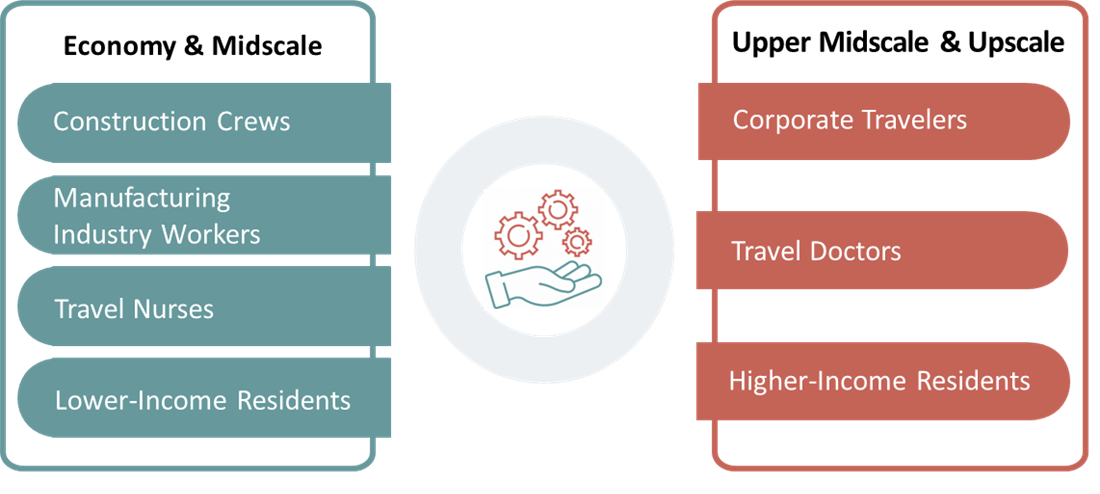
Extended-stay hotels generally benefit from lower operating costs due to longer lengths of stay and reduced housekeeping requirements, as well as lower development costs compared to full-service properties.
Historical Hotel Performance in Kansas City by Product Type
The distinct periods that have emerged since 2009 illustrate nuanced performance trends for the three product types.Pre-Pandemic: 2009–2019
From 2009 through 2019, the Kansas City economy and hotel market recovered from the Great Recession and entered a period of economic expansion. The market experienced steady economic and population growth, which supported increasing hotel demand. Downtown revitalization played a meaningful role, with expanded entertainment options and new development driving more activity and visitation in the urban core. Occupancy and ADR grew during these years, and RevPAR stabilized near the end of the decade given the opening of new supply throughout the market.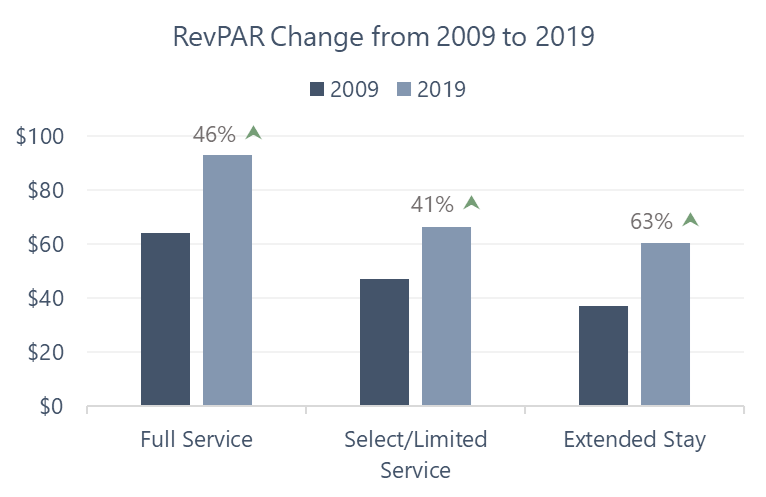
COVID-19 Pandemic: 2020
In 2020, hotel performance was influenced by the effects of the COVID-19 pandemic, as shown in the following table. While a significant decrease in demand was the primary reason for the decline in RevPAR, the impact on full-service hotels was further exacerbated by new supply entering the market in 2020, including the Loews Hotel.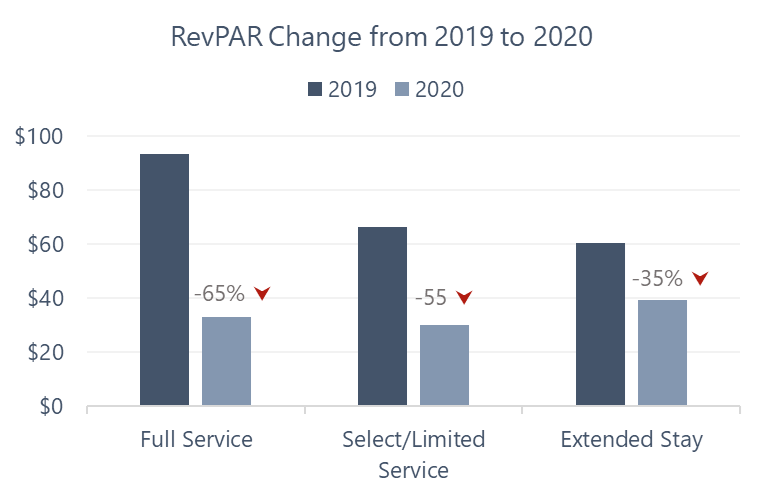
Extended-stay hotels experienced a less severe downturn in 2020, as a higher percentage of their demand was essential, including medical professionals, construction workers, or residents.
Post-Pandemic: 2021–2025
Beginning in 2021, hotel revenue began to recover from the pandemic and stabilized in 2025, as shown in the following chart.
Post-Pandemic Recovery Pace Differed for Each Product Type
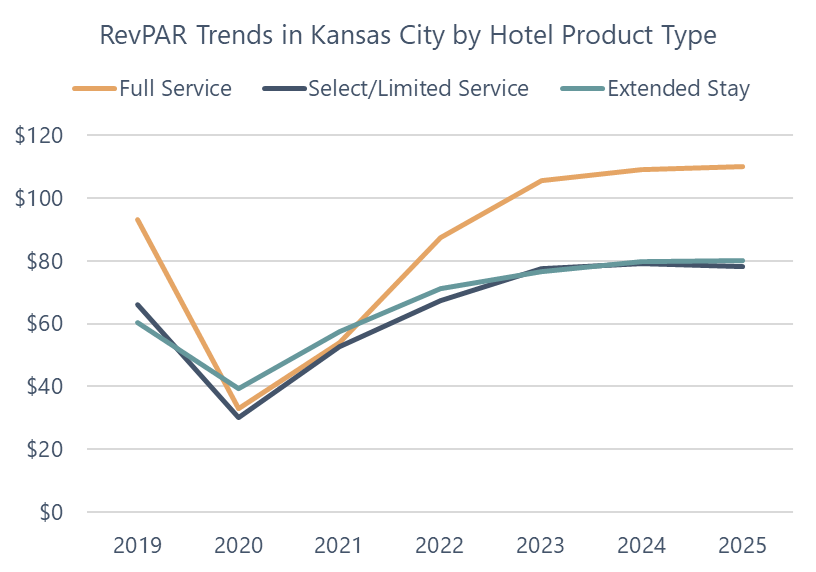
Extended-stay hotels had the quickest recovery from the pandemic, nearly returning to pre-pandemic RevPAR level by 2021, followed by select- and limited-service hotels, which surpassed pre-pandemic RevPAR in 2022, and then full-service hotels, which fully recovered in 2023.
Looking Forward
The forecast for the Kansas City economy is optimistic. In the summer of 2026, the market will host several matches for the FIFA World Cup, which is expected to drive a significant amount of demand to local hotels.
Furthermore, major developments in the area are indicative of a growing economy. The largest recently completed, ongoing, and planned developments in the Kansas City metro area include the following:
- Panasonic electric-vehicle battery plant – Opened July 2025
- Country Club Plaza revitalization – Ongoing
- Data centers, including Project Mica – Expected completion by year-end 2026
- New American Royal campus – Expected completion late 2027/early 2028
- KCI 29 Logistics Park – Ongoing
- New sports stadiums and entertainment districts
- CPKC Stadium – Opened March 2024
- New Kansas City Chiefs stadium – Speculative with potential completion by August 2031
- New Kansas City Royals stadium – Speculative with potential completion by March 2031
These factors support a favorable outlook for the Kansas City economy and hotel market.
Implications for Development and Investment
The data suggest different strategic considerations by product type in the Kansas City market.
Full-service hotels are expected to achieve record RevPAR levels in the near term, supported by strong ADR growth and limited new supply. However, the high barriers to entry and significant development costs make new construction in this segment relatively uncommon, limiting near-term development opportunities.
Select- and limited-service hotels offer a more balanced risk-return profile. These properties benefit from a diverse demand base, which supports relatively stable performance across all market conditions. While they are exposed to some risk of oversupply, the impact is generally less pronounced than in the extended-stay segment given shorter average length of stay. As such, select- and limited-service hotels may present attractive development opportunities in submarkets where demand fundamentals remain strong and new supply is limited.
Extended-stay hotels present the most compelling development opportunity from a cycle-resilience perspective, as they have demonstrated consistent performance across both expansionary and contractionary periods. However, the relatively low barriers to entry introduces the risk of oversupply; as such, extended-stay development should be evaluated carefully at the submarket level.
At HVS, we turn data into powerful insights that drive your success. Our work within local markets empowers us to conduct primary interviews with key market participants. This approach ensures we obtain real-time insights and current data for each market we operate in. For more information about the Kansas City market or for help making informed investment decisions that align with your goals and risk tolerance, please contact Benjamin Giebler, your local HVS Midwest hospitality expert.