

Market Report

Sedona’s Lodging Market: Resilience and Pricing Power

March 20, 2026
Nestled among the iconic red rock formations of northern Arizona, Sedona is one of the most distinctive leisure destinations in the American Southwest. Over the past decade, Sedona’s hotel market has demonstrated remarkable resilience, supported by strong leisure demand, constrained hotel supply, and a reputation as a premium outdoor and wellness destination.
Following the surge in high-rated leisure travel during the pandemic, the Sedona lodging market entered a period of ADR normalization in 2023. Recent performance indicators and operator sentiment suggest that the market has stabilized and is poised for renewed growth as visitation trends strengthen and international travel returns.

Tourism Demand and Visitation Trends

Tourism demand remains the fundamental driver of Sedona’s lodging performance. The market benefits from a diverse mix of regional drive-in visitors, national leisure travelers, and international tourists drawn to northern Arizona’s natural landscapes.

According to the Arizona Office of Tourism and National Park Service, visitation to the American Southwest’s national parks and recreation areas, as well as Arizona State Parks, remains robust, with continued strong visitation at attractions such as Grand Canyon National Park, Slide Rock State Park (in Sedona), Glen Canyon National Recreation Area, and other northern Arizona destinations. These destinations serve as key anchors for the region’s tourism economy and drive significant overnight visitation across northern Arizona. However, we note that the 2025 data illustrate visitation declines of 5% to 10% at each of these destinations due to national economic and political uncertainty and reduced international demand.

Nevertheless, Sedona continues to benefit from its role as both a gateway market within northern Arizona’s broader tourism ecosystem, as well as a standalone destination for its outdoor recreation, spiritual and wellness retreats, art galleries, and shopping.

Recent Hotel Performance

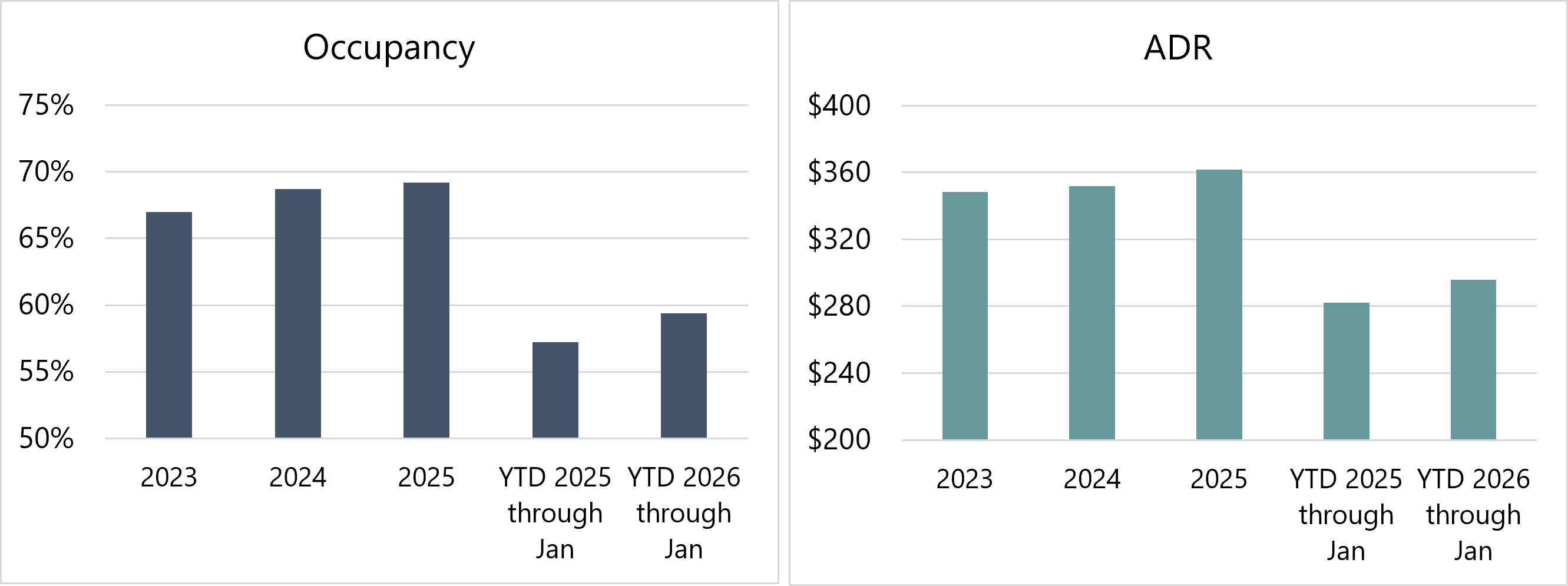
Sedona’s lodging market historically demonstrated strong pricing power and relatively stable occupancy levels until experiencing significant disruption during the COVID-19 pandemic, followed by a period of rapid ADR growth. Data from 2023 through 2025 indicate that Sedona’s hotel market has largely stabilized with modest growth following the volatility of the pandemic period. Occupancy increased within the high 60% range, reflecting sustained demand driven primarily by leisure travel and outdoor recreation.

Despite the opening of Ambiente Sedona and continued rate growth at the luxury hotels in the market, overall ADR moderated in 2023 as pricing normalized from the extraordinary levels reached during the pandemic recovery period. However, rates remained elevated above historical levels, and modest growth has continued, underscoring the market’s pricing strength.

Sedona Occupancy and ADR Show Modest Growth in Recent Years *
Source: CoStar
* Note: This data includes all properties in Sedona, including those with near or over $1,000 ADRs (Ambiente Sedona, Enchantment Resort, and L’Auberge de Sedona).

The improvements in recent months appear to be driven by both reduced competitive supply following the closure of Outbound Sedona and strengthening leisure and tour-related demand in the market.

Preliminary data from early 2026 show strengthening performance across several properties. According to local operators and CoStar data, RevPAR has improved year-over-year during the first months of the year. These early-year indicators suggest that demand in Sedona remains resilient despite broader economic uncertainty and rising travel costs.

Evolving Demand Patterns

Historically, Sedona has relied heavily on leisure travel, but the composition of demand continues to evolve. One notable trend is the gradual return of international visitation. Prior to the pandemic, Sedona hotels regularly hosted international travelers from Europe and Asia. According to several local operators, this demand source faced a prolonged absence during the pandemic years, as well as more recently due to U.S. federal policies. Nevertheless, these local hotel operators report that international travelers have begun to return.

At the same time, business travel, while still limited compared with larger metropolitan markets, has begun to stabilize. Remote work trends have reduced the frequency of traditional corporate travel, but Sedona continues to benefit from small corporate retreats, wellness programs, and experiential group travel.

Tour group demand also plays an important role in the market. Operators report that some tour operators continue to book blocks of rooms in advance for Grand Canyon itineraries, though these bookings can occasionally be volatile due to last-minute cancellations.

Investment and Development Considerations

Sedona remains one of Arizona’s most supply-constrained lodging markets due to topography, zoning restrictions, and community development priorities. These constraints have historically supported strong ADR levels and investor interest in existing assets.

In recent years, several properties have undergone repositioning or brand realignment as owners seek to capture higher-rated leisure demand. Notable examples include the conversion of Sky Rock Sedona to Marriott’s Tribute Portfolio, the repositioning of Sedona Real Inn & Suites as Mountain Modern Sedona, and the ongoing redevelopment of Poco Diablo Resort into Outbound Sedona. Most recently, 40 new guestrooms and an indoor event space are planned to be added to Sedona’s Sky Ranch Lodge, adjacent to the existing 94-room property. These investments reflect a broader trend toward lifestyle-oriented and experiential lodging products that align with Sedona’s outdoor recreation and luxury leisure positioning.

For investors, the market offers the opportunity to create value through renovation, repositioning, or lifestyle-oriented branding in a destination where barriers to entry and sustained visitation support long-term asset performance.

Operational Considerations

Like many hospitality markets, Sedona hotels continue to face operational challenges related to labor availability and rising operating costs. Staffing shortages were particularly pronounced during the pandemic recovery period and continue to affect some operators.

Labor costs remain a significant component of operating expenses, particularly for the larger properties that provide extensive guest services. Insurance expenses have also increased significantly in recent years due to broader industry trends, though operators note that these costs have begun to stabilize.

Outlook for the Sedona Lodging Market

Looking ahead, Sedona’s hotel market appears well positioned for continued stability and moderate growth. Factors that support this outlook include continued strong visitation to northern Arizona’s national parks and outdoor recreation destinations, the gradual return of international tourism, limited new hotel supply due to development constraints, and Sedona’s reputation as a premium wellness and outdoor destination.

While the market may not replicate the extraordinary growth experienced during the post-pandemic travel boom, current trends suggest a stable operating environment characterized by strong ADR performance and steady occupancy levels. For investors and operators alike, Sedona remains one of the most unique and resilient lodging markets in the American Southwest.

At HVS, we turn data into powerful insights that drive your success. Our unique methodology, which involves conducting primary interviews within local markets, enables us to gather real-time insights and current data. This approach ensures an in-depth understanding of each market we operate in, giving you a distinct competitive edge. For comprehensive information about the Sedona market or for assistance in making investment decisions that align with your specific goals and risk tolerance, we invite you to reach out to Zabada Abouelhana.
Market Report

Sedona’s Lodging Market: Resilience and Pricing Power

March 20, 2026
Nestled among the iconic red rock formations of northern Arizona, Sedona is one of the most distinctive leisure destinations in the American Southwest. Over the past decade, Sedona’s hotel market has demonstrated remarkable resilience, supported by strong leisure demand, constrained hotel supply, and a reputation as a premium outdoor and wellness destination.
Following the surge in high-rated leisure travel during the pandemic, the Sedona lodging market entered a period of ADR normalization in 2023. Recent performance indicators and operator sentiment suggest that the market has stabilized and is poised for renewed growth as visitation trends strengthen and international travel returns.

Tourism Demand and Visitation Trends

Tourism demand remains the fundamental driver of Sedona’s lodging performance. The market benefits from a diverse mix of regional drive-in visitors, national leisure travelers, and international tourists drawn to northern Arizona’s natural landscapes.

According to the Arizona Office of Tourism and National Park Service, visitation to the American Southwest’s national parks and recreation areas, as well as Arizona State Parks, remains robust, with continued strong visitation at attractions such as Grand Canyon National Park, Slide Rock State Park (in Sedona), Glen Canyon National Recreation Area, and other northern Arizona destinations. These destinations serve as key anchors for the region’s tourism economy and drive significant overnight visitation across northern Arizona. However, we note that the 2025 data illustrate visitation declines of 5% to 10% at each of these destinations due to national economic and political uncertainty and reduced international demand.

Nevertheless, Sedona continues to benefit from its role as both a gateway market within northern Arizona’s broader tourism ecosystem, as well as a standalone destination for its outdoor recreation, spiritual and wellness retreats, art galleries, and shopping.

Recent Hotel Performance

Sedona’s lodging market historically demonstrated strong pricing power and relatively stable occupancy levels until experiencing significant disruption during the COVID-19 pandemic, followed by a period of rapid ADR growth. Data from 2023 through 2025 indicate that Sedona’s hotel market has largely stabilized with modest growth following the volatility of the pandemic period. Occupancy increased within the high 60% range, reflecting sustained demand driven primarily by leisure travel and outdoor recreation.

Despite the opening of Ambiente Sedona and continued rate growth at the luxury hotels in the market, overall ADR moderated in 2023 as pricing normalized from the extraordinary levels reached during the pandemic recovery period. However, rates remained elevated above historical levels, and modest growth has continued, underscoring the market’s pricing strength.

Sedona Occupancy and ADR Show Modest Growth in Recent Years *
Source: CoStar
* Note: This data includes all properties in Sedona, including those with near or over $1,000 ADRs (Ambiente Sedona, Enchantment Resort, and L’Auberge de Sedona).

The improvements in recent months appear to be driven by both reduced competitive supply following the closure of Outbound Sedona and strengthening leisure and tour-related demand in the market.

Preliminary data from early 2026 show strengthening performance across several properties. According to local operators and CoStar data, RevPAR has improved year-over-year during the first months of the year. These early-year indicators suggest that demand in Sedona remains resilient despite broader economic uncertainty and rising travel costs.

Evolving Demand Patterns

Historically, Sedona has relied heavily on leisure travel, but the composition of demand continues to evolve. One notable trend is the gradual return of international visitation. Prior to the pandemic, Sedona hotels regularly hosted international travelers from Europe and Asia. According to several local operators, this demand source faced a prolonged absence during the pandemic years, as well as more recently due to U.S. federal policies. Nevertheless, these local hotel operators report that international travelers have begun to return.

At the same time, business travel, while still limited compared with larger metropolitan markets, has begun to stabilize. Remote work trends have reduced the frequency of traditional corporate travel, but Sedona continues to benefit from small corporate retreats, wellness programs, and experiential group travel.

Tour group demand also plays an important role in the market. Operators report that some tour operators continue to book blocks of rooms in advance for Grand Canyon itineraries, though these bookings can occasionally be volatile due to last-minute cancellations.

Investment and Development Considerations

Sedona remains one of Arizona’s most supply-constrained lodging markets due to topography, zoning restrictions, and community development priorities. These constraints have historically supported strong ADR levels and investor interest in existing assets.

In recent years, several properties have undergone repositioning or brand realignment as owners seek to capture higher-rated leisure demand. Notable examples include the conversion of Sky Rock Sedona to Marriott’s Tribute Portfolio, the repositioning of Sedona Real Inn & Suites as Mountain Modern Sedona, and the ongoing redevelopment of Poco Diablo Resort into Outbound Sedona. Most recently, 40 new guestrooms and an indoor event space are planned to be added to Sedona’s Sky Ranch Lodge, adjacent to the existing 94-room property. These investments reflect a broader trend toward lifestyle-oriented and experiential lodging products that align with Sedona’s outdoor recreation and luxury leisure positioning.

For investors, the market offers the opportunity to create value through renovation, repositioning, or lifestyle-oriented branding in a destination where barriers to entry and sustained visitation support long-term asset performance.

Operational Considerations

Like many hospitality markets, Sedona hotels continue to face operational challenges related to labor availability and rising operating costs. Staffing shortages were particularly pronounced during the pandemic recovery period and continue to affect some operators.

Labor costs remain a significant component of operating expenses, particularly for the larger properties that provide extensive guest services. Insurance expenses have also increased significantly in recent years due to broader industry trends, though operators note that these costs have begun to stabilize.

Outlook for the Sedona Lodging Market

Looking ahead, Sedona’s hotel market appears well positioned for continued stability and moderate growth. Factors that support this outlook include continued strong visitation to northern Arizona’s national parks and outdoor recreation destinations, the gradual return of international tourism, limited new hotel supply due to development constraints, and Sedona’s reputation as a premium wellness and outdoor destination.

While the market may not replicate the extraordinary growth experienced during the post-pandemic travel boom, current trends suggest a stable operating environment characterized by strong ADR performance and steady occupancy levels. For investors and operators alike, Sedona remains one of the most unique and resilient lodging markets in the American Southwest.

At HVS, we turn data into powerful insights that drive your success. Our unique methodology, which involves conducting primary interviews within local markets, enables us to gather real-time insights and current data. This approach ensures an in-depth understanding of each market we operate in, giving you a distinct competitive edge. For comprehensive information about the Sedona market or for assistance in making investment decisions that align with your specific goals and risk tolerance, we invite you to reach out to Zabada Abouelhana.