
Market Report

Hotel Discount Rates and Equity Yields: A Decade of Shifting Investor Expectations

March 5, 2026
Over the past decade, equity yields for hotel investments have declined steadily across all segments, reflecting growing investor confidence in the asset class. Discount rates, by contrast, have remained relatively stable, moving with broader economic conditions. With equity yields approaching a natural floor, stability is the most likely near-term outlook.
HVS continually tracks the discount rates and equity yields for the assets on which we consult. In cases where hotels were sold near the date of our valuation, we were able to derive the equity yield rate and unlevered discount rate by inserting the ten-year projection, total investment (purchase price plus estimated capital expenditure and/or PIP), and debt assumptions into a valuation model and solving for the equity yield.

Equity yield is the rate of return that an equity investor expects over a ten-year holding period. It specifically considers annual inflation-adjusted cash flows, property appreciation, mortgage amortization, and proceeds from a sale at the end of the holding period. Notably in today's environment, the equity yield rate also reflects the effect of debt financing on the cash flow available to the equity investor.

The total property yields (discount rates) presented reflect the "free and clear" internal rate of return to an all-cash purchaser, or a blended rate of debt and equity return requirements. The discount rate takes into consideration the degree of perceived risk, anticipated income growth, market attitudes, and rates of return on other investment alternatives, as well as the availability and cost of financing.

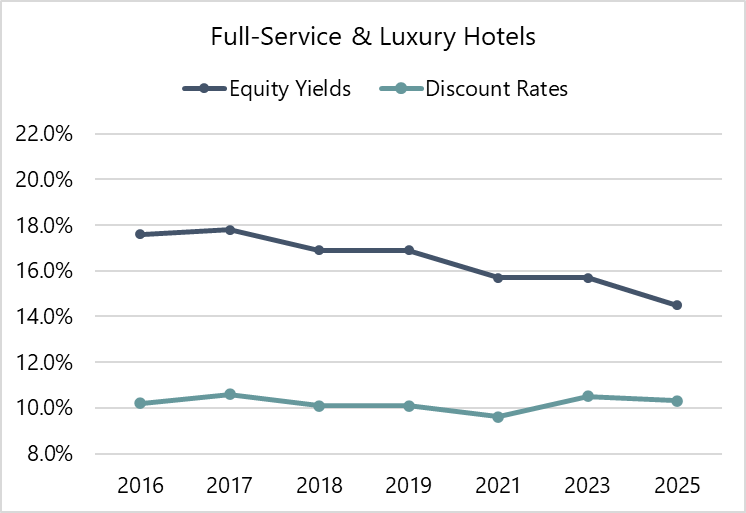
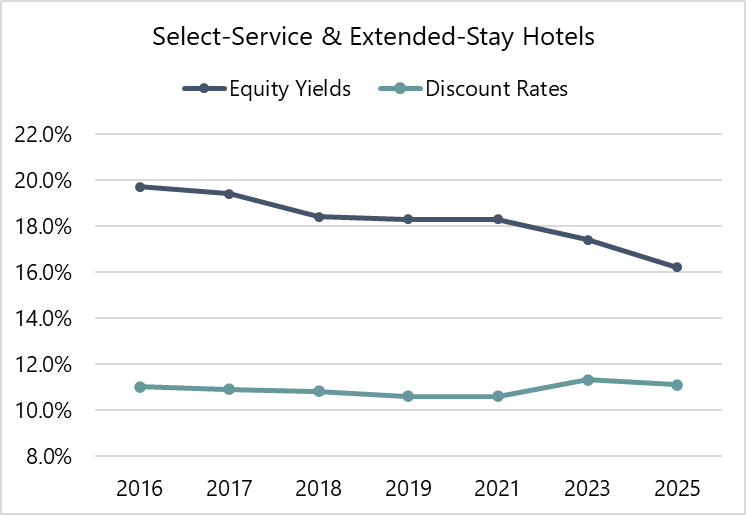
The charts below illustrate historical trends for both equity yields and discount rates for three main hotel segments. We note that there tends to be a lag between the sales data and current market conditions; thus, the full effect of the changes in the economy and capital markets may not yet be reflected.
 
All Segments Show Steady Decline in Equity Yields but Stability in Discount Rates
Source: HVS Data
Source: HVS Data
Source: HVS Data
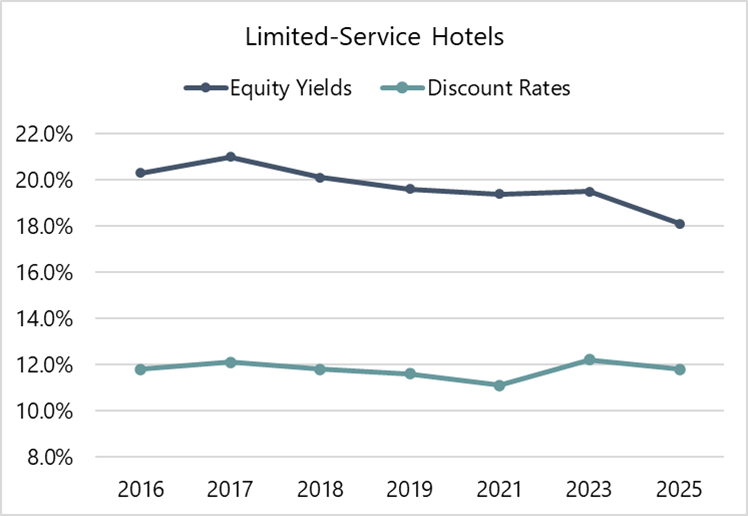
 
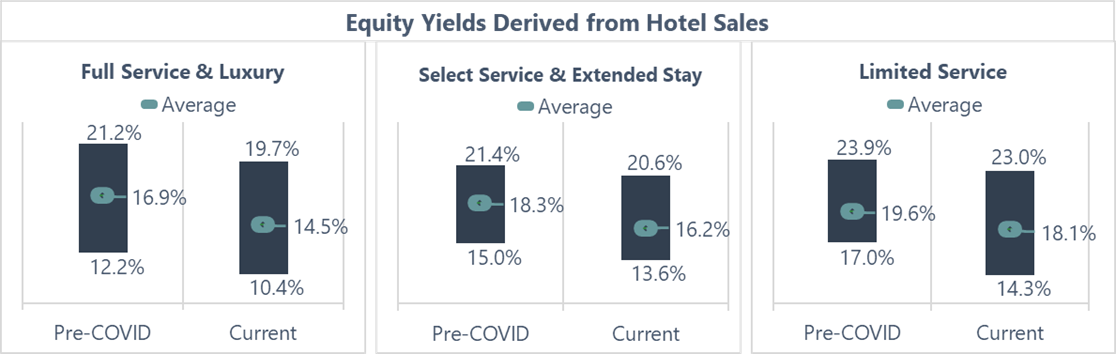
The data illustrates a clear and consistent trend: equity yields have declined steadily across all three hotel segments over the past decade. Full-Service & Luxury hotels saw the most significant compression, with equity yields falling from 17.6% in 2016 to 14.5% in 2025, a decline of 310 basis points. Select-Service & Extended-Stay hotels followed a similar path, with equity yields for this segment declining from 19.7% to 16.2% over the same period. Limited-Service hotels, which have historically achieved the highest equity yields due to their greater perceived risk, declined from 20.3% to 18.1%. Collectively, this trend suggests that investors have grown increasingly comfortable with hotel assets and have been willing to accept lower returns as a result.

Current Equity Yields Show Declines Compared to Pre-COVID Levels
Source: HVS Data
 
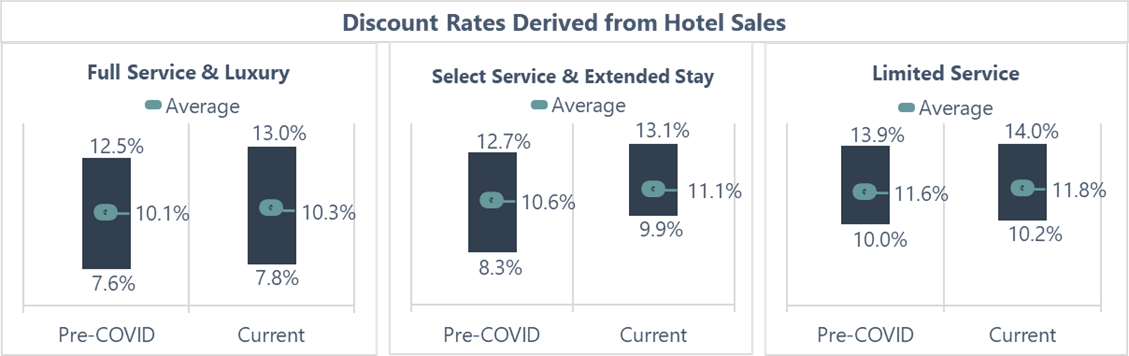
Discount rates tell a different story. Rather than trending in one direction, they have remained relatively stable across all three segments, fluctuating within a narrow range throughout the period. The most notable movement came in 2021, when discount rates reached their lowest levels across all segments, reflecting the broader low-interest-rate environment of that period. By 2023, rates had largely returned to levels consistent with the pre-pandemic period, and they remained near those levels in 2025.

Current Discount Rates Show General Stability Compared to Pre-COVID Levels
Source: HVS Data

The divergence between these two metrics is significant. While discount rates have remained largely tied to broader economic conditions and interest rate cycles, equity yield expectations have shifted in a more structural way.

The steady decline in equity yields, even as discount rates fluctuated with broader economic conditions, points to a lasting increase in investor confidence in the hotel sector. In our view, current equity yield levels are approaching a natural floor. Should interest rates ease further and financing conditions improve, discount rates would likely respond. Equity yields, however, have shown a decade-long resilience to those forces, suggesting the decline is caused by a genuine shift in the way investors value hotels, rather than a response to financing conditions alone.

That said, a meaningful rise in transaction volume could bring more investment alternatives into focus, giving equity investors less reason to accept lower returns. Broader economic uncertainty, the long-term commitment that hotel ownership demands, and the inherent operational complexity of the asset class all reinforce why return requirements are unlikely to fall much further. Balancing these forces, stability is likely the most reasonable expectation for equity yields in the near term.

At HVS, we turn data into powerful insights that drive your success. For help making informed investment decisions that align with your goals and risk tolerance, please contact Katy Black, MAI.
Market Report

Hotel Discount Rates and Equity Yields: A Decade of Shifting Investor Expectations

March 5, 2026
Over the past decade, equity yields for hotel investments have declined steadily across all segments, reflecting growing investor confidence in the asset class. Discount rates, by contrast, have remained relatively stable, moving with broader economic conditions. With equity yields approaching a natural floor, stability is the most likely near-term outlook.
HVS continually tracks the discount rates and equity yields for the assets on which we consult. In cases where hotels were sold near the date of our valuation, we were able to derive the equity yield rate and unlevered discount rate by inserting the ten-year projection, total investment (purchase price plus estimated capital expenditure and/or PIP), and debt assumptions into a valuation model and solving for the equity yield.

Equity yield is the rate of return that an equity investor expects over a ten-year holding period. It specifically considers annual inflation-adjusted cash flows, property appreciation, mortgage amortization, and proceeds from a sale at the end of the holding period. Notably in today's environment, the equity yield rate also reflects the effect of debt financing on the cash flow available to the equity investor.

The total property yields (discount rates) presented reflect the "free and clear" internal rate of return to an all-cash purchaser, or a blended rate of debt and equity return requirements. The discount rate takes into consideration the degree of perceived risk, anticipated income growth, market attitudes, and rates of return on other investment alternatives, as well as the availability and cost of financing.

The charts below illustrate historical trends for both equity yields and discount rates for three main hotel segments. We note that there tends to be a lag between the sales data and current market conditions; thus, the full effect of the changes in the economy and capital markets may not yet be reflected.
 
All Segments Show Steady Decline in Equity Yields but Stability in Discount Rates
Source: HVS Data
Source: HVS Data
Source: HVS Data
 
The data illustrates a clear and consistent trend: equity yields have declined steadily across all three hotel segments over the past decade. Full-Service & Luxury hotels saw the most significant compression, with equity yields falling from 17.6% in 2016 to 14.5% in 2025, a decline of 310 basis points. Select-Service & Extended-Stay hotels followed a similar path, with equity yields for this segment declining from 19.7% to 16.2% over the same period. Limited-Service hotels, which have historically achieved the highest equity yields due to their greater perceived risk, declined from 20.3% to 18.1%. Collectively, this trend suggests that investors have grown increasingly comfortable with hotel assets and have been willing to accept lower returns as a result.

Current Equity Yields Show Declines Compared to Pre-COVID Levels
Source: HVS Data
 
Discount rates tell a different story. Rather than trending in one direction, they have remained relatively stable across all three segments, fluctuating within a narrow range throughout the period. The most notable movement came in 2021, when discount rates reached their lowest levels across all segments, reflecting the broader low-interest-rate environment of that period. By 2023, rates had largely returned to levels consistent with the pre-pandemic period, and they remained near those levels in 2025.

Current Discount Rates Show General Stability Compared to Pre-COVID Levels
Source: HVS Data

The divergence between these two metrics is significant. While discount rates have remained largely tied to broader economic conditions and interest rate cycles, equity yield expectations have shifted in a more structural way.

The steady decline in equity yields, even as discount rates fluctuated with broader economic conditions, points to a lasting increase in investor confidence in the hotel sector. In our view, current equity yield levels are approaching a natural floor. Should interest rates ease further and financing conditions improve, discount rates would likely respond. Equity yields, however, have shown a decade-long resilience to those forces, suggesting the decline is caused by a genuine shift in the way investors value hotels, rather than a response to financing conditions alone.

That said, a meaningful rise in transaction volume could bring more investment alternatives into focus, giving equity investors less reason to accept lower returns. Broader economic uncertainty, the long-term commitment that hotel ownership demands, and the inherent operational complexity of the asset class all reinforce why return requirements are unlikely to fall much further. Balancing these forces, stability is likely the most reasonable expectation for equity yields in the near term.

At HVS, we turn data into powerful insights that drive your success. For help making informed investment decisions that align with your goals and risk tolerance, please contact Katy Black, MAI.