
Market Report

Room Supply Constraints Limiting Convention Growth in Hartford

February 19, 2026
Hartford’s hotel market has demonstrated strong performance, with occupancy and ADR exceeding pre-pandemic levels. However, a significant decline in hotel room supply has hindered the convention center’s ability to attract large-scale events, underscoring the need for additional lodging to support long-term competitiveness.
The Hartford hotel market has undergone notable shifts over the past five years following the onset of the COVID-19 pandemic. The market rebounded relatively quickly, with occupancy levels in 2022 only modestly below 2019 levels and ultimately surpassing pre-pandemic performance in 2024. Average daily rate (ADR) recovered even more strongly, exceeding pre-COVID levels beginning in 2022 given the market’s pricing resilience and strong demand base.

Despite this recovery, one of the most important long-term drivers of Hartford’s transient demand remains the convention center, which plays a critical role in generating corporate and group business for the surrounding lodging market. Since the pandemic, however, hotel room supply constraints have limited Hartford’s ability to attract and accommodate large-scale conventions, creating a structural challenge for sustained growth.
Supply Challenges

The Connecticut Convention Center (CTCC), the largest convention facility between Boston and New York, serves as a premier regional destination for conventions, trade shows, business meetings, and related events. The CTCC comprises approximately 540,000 square feet of total convention space, including 140,000 square feet of exhibit space, a 40,000-square-foot ballroom, and a 2,300-space parking garage. From a demand standpoint, the convention center benefits from a strong locational and economic foundation given its strategic position between New York and New England, as well as near several Fortune 500 companies and large corporate headquarters. Despite these advantages, inadequate hotel room supply has become a limiting factor, making Hartford less attractive for hosting large-scale conventions.

Hotel Supply in Hartford Has Declined Since 2020
Source: STR/CoStar
 
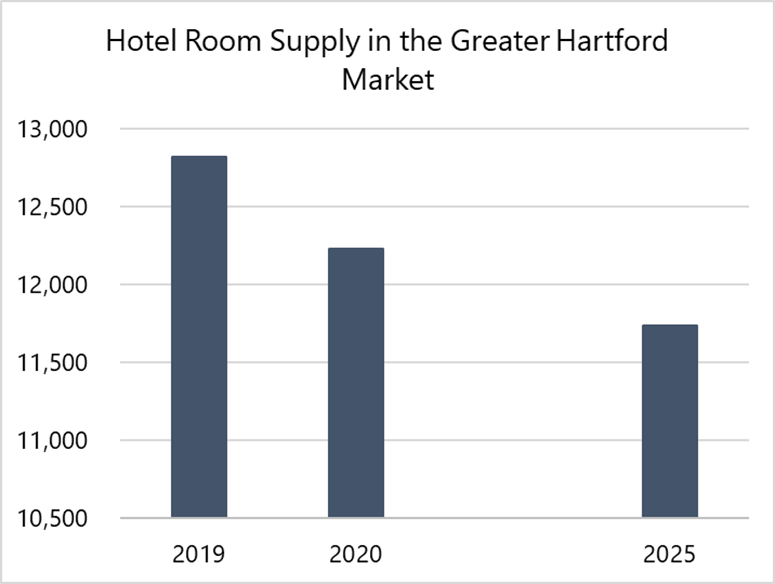
As illustrated above, Hartford has struggled to maintain a stable hotel room supply since the pandemic, losing approximately 1,300 rooms between 2019 and 2024. While hotel closures during the pandemic were a nationwide phenomenon, Hartford was unable to replace the rooms lost during that period. Compounding this decline, several shuttered hotels have been repurposed for residential use rather than reintroduced as lodging supply. Most notably, the 22-story former Downtown Hartford Hilton was converted to dual hotel/residential use, with a DoubleTree by Hilton on the first eleven floors and the 147-unit Revel apartments on the upper floors. This conversion resulted in a loss of 223 hotel rooms. Similarly, the Homewood Suites on Asylum Street and the Red Lion near Dunkin’ Park were fully converted to residential use.
Given the hotel supply decline, the convention center has faced increasing difficulty in attracting and accommodating large-scale conventions. For example, the annual New England Regional Volleyball Association (NERVA) Winterfest tournament, held at the convention center each January, draws more than 30,000 players, families, and spectators to Hartford. In 2024, however, insufficient hotel room supply forced event organizers to relocate two tournament weekends to Providence. Notably, the CTCC was able to recapture almost the full three-week event in 2025, with only one week split between Hartford and Providence, an encouraging sign of improved competitiveness despite ongoing lodging constraints. Nevertheless, Hartford faces not only a limited hotel supply but also increasing competitive pressure from hotels in nearby markets, including Providence and Springfield, as well as the Mohegan Sun casino resort, located approximately 35 miles from Downtown Hartford, all of which compete for a limited pool of regional events.

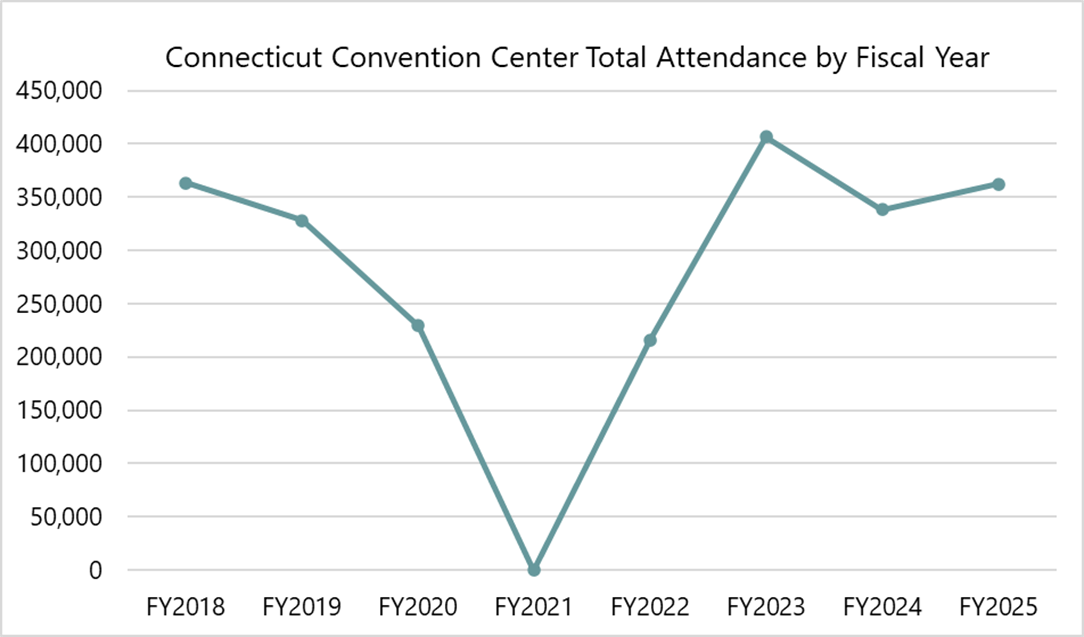
Consequently, the CTCC has shifted focus toward smaller-scale events with a greater local appeal and a more diverse event mix. Despite hosting only 108 events in 2023, compared to 166 in 2018, total attendance exceeded pre-COVID levels that year. A key contributor to this trend has been the increase in visitors attending exhibits for just one day. While this shift has been beneficial for convention-center revenues, it has generated limited spillover demand for Hartford’s lodging market, as day-trippers do not produce overnight demand.

Convention Center Attendance Rebounded After Pandemic Decline
Source: CTCC
 
Prior to the pandemic, managers at the CTCC could rely on approximately 900 to 1,000 hotel rooms within convenient driving distance of the facility. During that period, a study conducted by Johnson Consulting determined that an additional 500 rooms were required to support the convention center’s sustainable growth. Instead, Hartford’s hotel inventory has declined substantially since then. Only an estimated 400 to 600 rooms are now available within driving distance of the CTCC, a level widely considered insufficient.

Looking Ahead

Given the significant undersupply of hotel rooms in Downtown Hartford, expanding lodging inventory is critical to supporting the long-term viability of the convention center. A 2025 study conducted by Econsult Solution Inc. highlights elevated downtown office vacancies, totaling approximately 2.2 million square feet of Class A space. This presents a potential opportunity to repurpose underutilized office space into hotel accommodation. Such conversions align with initiatives outlined by the Capital Region Development Authority (CRDA) and have been identified as a priority strategy to support the CTCC’s financial sustainability and long-term competitiveness.

At HVS, we turn data into powerful insights that drive your success. For more information about the Hartford market or for help making informed investment decisions that align with your goals and risk tolerance, please contact Jimmy Radwan.

Sources

https://static1.squarespace.com/static/65ba5913ca8e9f19928929ea/t/68812db6851b5326427ee889/1753296311512/ESI+-+Hartford+Office+Reinvestment+Strategy+7-9-2025.pdf
https://www.ctinsider.com/business/article/ct-convention-center-rebounds-amid-hotel-shortage-19666482.php
https://www.metrohartford.com/newsroom/three-weekend-nike-new-england-winterfest-volleyball-to-bring-close-to-30000-and-nearly-11-million-to-hartford-area
https://crdact.net/wp-content/uploads/2025/09/CRDA-2025-Annual-Report-DRAFT.pdf
https://ctbythenumbers.news/ctnews/whats-next-for-hartford-new-analysis-looks-at-challenges-opportunities
Market Report

Room Supply Constraints Limiting Convention Growth in Hartford

February 19, 2026
Hartford’s hotel market has demonstrated strong performance, with occupancy and ADR exceeding pre-pandemic levels. However, a significant decline in hotel room supply has hindered the convention center’s ability to attract large-scale events, underscoring the need for additional lodging to support long-term competitiveness.
The Hartford hotel market has undergone notable shifts over the past five years following the onset of the COVID-19 pandemic. The market rebounded relatively quickly, with occupancy levels in 2022 only modestly below 2019 levels and ultimately surpassing pre-pandemic performance in 2024. Average daily rate (ADR) recovered even more strongly, exceeding pre-COVID levels beginning in 2022 given the market’s pricing resilience and strong demand base.

Despite this recovery, one of the most important long-term drivers of Hartford’s transient demand remains the convention center, which plays a critical role in generating corporate and group business for the surrounding lodging market. Since the pandemic, however, hotel room supply constraints have limited Hartford’s ability to attract and accommodate large-scale conventions, creating a structural challenge for sustained growth.

Supply Challenges

The Connecticut Convention Center (CTCC), the largest convention facility between Boston and New York, serves as a premier regional destination for conventions, trade shows, business meetings, and related events. The CTCC comprises approximately 540,000 square feet of total convention space, including 140,000 square feet of exhibit space, a 40,000-square-foot ballroom, and a 2,300-space parking garage. From a demand standpoint, the convention center benefits from a strong locational and economic foundation given its strategic position between New York and New England, as well as near several Fortune 500 companies and large corporate headquarters. Despite these advantages, inadequate hotel room supply has become a limiting factor, making Hartford less attractive for hosting large-scale conventions.

Hotel Supply in Hartford Has Declined Since 2020
Source: STR/CoStar
 
As illustrated above, Hartford has struggled to maintain a stable hotel room supply since the pandemic, losing approximately 1,300 rooms between 2019 and 2024. While hotel closures during the pandemic were a nationwide phenomenon, Hartford was unable to replace the rooms lost during that period. Compounding this decline, several shuttered hotels have been repurposed for residential use rather than reintroduced as lodging supply. Most notably, the 22-story former Downtown Hartford Hilton was converted to dual hotel/residential use, with a DoubleTree by Hilton on the first eleven floors and the 147-unit Revel apartments on the upper floors. This conversion resulted in a loss of 223 hotel rooms. Similarly, the Homewood Suites on Asylum Street and the Red Lion near Dunkin’ Park were fully converted to residential use.

Given the hotel supply decline, the convention center has faced increasing difficulty in attracting and accommodating large-scale conventions. For example, the annual New England Regional Volleyball Association (NERVA) Winterfest tournament, held at the convention center each January, draws more than 30,000 players, families, and spectators to Hartford. In 2024, however, insufficient hotel room supply forced event organizers to relocate two tournament weekends to Providence. Notably, the CTCC was able to recapture almost the full three-week event in 2025, with only one week split between Hartford and Providence, an encouraging sign of improved competitiveness despite ongoing lodging constraints. Nevertheless, Hartford faces not only a limited hotel supply but also increasing competitive pressure from hotels in nearby markets, including Providence and Springfield, as well as the Mohegan Sun casino resort, located approximately 35 miles from Downtown Hartford, all of which compete for a limited pool of regional events.

Consequently, the CTCC has shifted focus toward smaller-scale events with a greater local appeal and a more diverse event mix. Despite hosting only 108 events in 2023, compared to 166 in 2018, total attendance exceeded pre-COVID levels that year. A key contributor to this trend has been the increase in visitors attending exhibits for just one day. While this shift has been beneficial for convention-center revenues, it has generated limited spillover demand for Hartford’s lodging market, as day-trippers do not produce overnight demand.

Convention Center Attendance Rebounded After Pandemic Decline
Source: CTCC
 
Prior to the pandemic, managers at the CTCC could rely on approximately 900 to 1,000 hotel rooms within convenient driving distance of the facility. During that period, a study conducted by Johnson Consulting determined that an additional 500 rooms were required to support the convention center’s sustainable growth. Instead, Hartford’s hotel inventory has declined substantially since then. Only an estimated 400 to 600 rooms are now available within driving distance of the CTCC, a level widely considered insufficient.

Looking Ahead

Given the significant undersupply of hotel rooms in Downtown Hartford, expanding lodging inventory is critical to supporting the long-term viability of the convention center. A 2025 study conducted by Econsult Solution Inc. highlights elevated downtown office vacancies, totaling approximately 2.2 million square feet of Class A space. This presents a potential opportunity to repurpose underutilized office space into hotel accommodation. Such conversions align with initiatives outlined by the Capital Region Development Authority (CRDA) and have been identified as a priority strategy to support the CTCC’s financial sustainability and long-term competitiveness.

At HVS, we turn data into powerful insights that drive your success. For more information about the Hartford market or for help making informed investment decisions that align with your goals and risk tolerance, please contact Jimmy Radwan.

Sources

https://static1.squarespace.com/static/65ba5913ca8e9f19928929ea/t/68812db6851b5326427ee889/1753296311512/ESI+-+Hartford+Office+Reinvestment+Strategy+7-9-2025.pdf
https://www.ctinsider.com/business/article/ct-convention-center-rebounds-amid-hotel-shortage-19666482.php
https://www.metrohartford.com/newsroom/three-weekend-nike-new-england-winterfest-volleyball-to-bring-close-to-30000-and-nearly-11-million-to-hartford-area
https://crdact.net/wp-content/uploads/2025/09/CRDA-2025-Annual-Report-DRAFT.pdf
https://ctbythenumbers.news/ctnews/whats-next-for-hartford-new-analysis-looks-at-challenges-opportunities