
The lack of new bank financing for hotels, and indeed for all real estate sectors, has been well documented. What, however, are the prospects for refinancing a hotel on loans maturing in these credit-starved times?
To gain insight we recently conducted a survey amongst the hotel teams of a number of leading European banks. A number of consistent themes came out of this:
1. Most banks expect to refinance all performing loans.
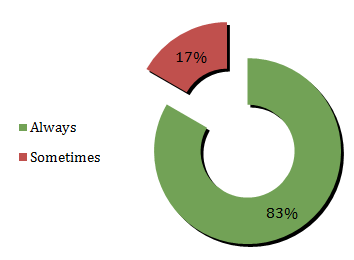
Whilst there is considerable caution with new lending, loans that are maturing, and which have been servicing the debt, can expect to be renewed. Over 80% of banks contacted expect to renew all performing loans. The remainder expect the majority of loans to be renewed.
Banks' Attitude Towards Refinancing
2. But, there is a reluctance to increase the original loan amount.
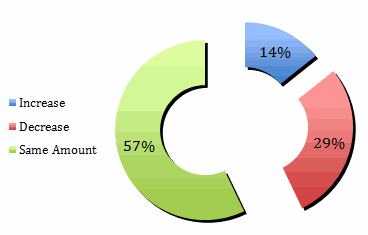
Unlike re-financings of yesteryear where equity could be released through increased leverage, banks are hesitant to increase loan amounts. The key exception is here a loan increase which will be used to fund necessary or value-uplifting refurbishment projects. Our survey showed that banks anticipate around 60% of refinancing to be at the original loan amount. On average, 30% are expected to decrease the loan.
Banks' Attitude Towards Loan Amount
3. And the terms of any new loan are more stringent.
Margins have increased, albeit that with base rates low the all-in cost remains low, and arrangement fees are significantly higher. Amortisation has also become the norm.
The table below presents an indication of the terms offered today versus two years ago.
| Terms | Today | 2 Years Ago |
| Term | 5 years (or less) | 7 to 10 years (or more) |
| Loan to Value | 50 to 55% | 70% or more |
| EBITDA Multiple | 6 to 7 | around 10 |
| Debt Service Coverage Ratio | 1.3 to 1.6 | 1.1 to 1.2 |
| Margin | 250 to 300 | 120 - 150 |
| Amortisation | Likely | None |
| Base Rate | ||
| EU | 1.00% | 3.75% |
| US | 0% - 0.25% | 4.75% |
| UK | 0.50% | 5.75% |
4. There is also closer scrutiny of all key factors.
Loan considerations, both qualitative and quantitative, remain unchanged, but there is more thorough analysis into the performance of the market and hotel, capital expenditure needs, brand performance, the financial health of the sponsor and so forth.
Key Considerations for Loan Renewal | |
| Qualitative | Quantitative |
|
|
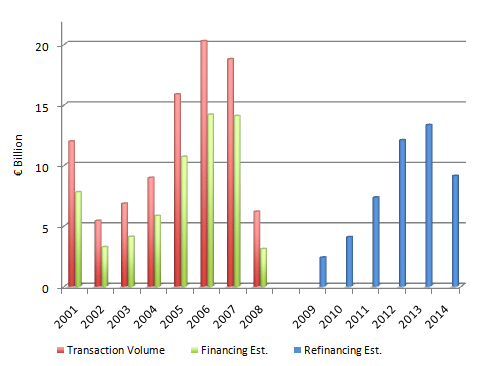
Whilst the climate for refinancing today is not as difficult as many may think, how might this evolve? Our research indicates that the volume of deals with loans maturing is set to increase dramatically. Between 2011 and 2014, we estimate that in excess of €40 billion worth of hotel loans could be maturing over that period. This comes mostly from the peak period in the transaction market in 2005 and 2007, when nearly€55 billion of hotels changed hands, many on a fully leveraged basis with loan terms of 5 to 7 years.
As a consequence, the refinancing environment is unlikely to improve much in the medium term.
Hotel Transaction Volume, Financing and Refinancing Estimates Europe (2001 – 2014)
So, how should hotel owners handle a refinancing?
The ease with which a hotel can be re-financed is highly dependent on the performance of the property, the relationship with the bank, and that bank’s particular view on lending to the hotel sector at present. In general, however, we would advocate the following steps:
- Prepare well in advance of loan maturity. Don’t get boxed into a corner by making contact with your current lender too late.
- Commission a valuation so as to get a realistic feel for the loan amount that could be achievable, given current LTV constraints.
- Prepare a comprehensive information pack, to include the following:
- Fully explain the market demand and supply dynamics. In many markets, the current downturn is due to lower demand rather than issues of increased supply. This means the recovery will be stronger.
- Long term operating history. Relative stability and resilience is the key here. If you have a loan maturity on the horizon, really focus on cost management.
- Renovation needs and benefits. If a hotel would benefit from a renovation, whether defensive or to release latent value, set it out in a business plan. The most realistic way of increasing the loan amount on a re-financing is for a renovation.
- Prepare a detailed forecast, with full supporting data.
- Run Upside and Downside scenarios. The bank will do it anyway, so do it for them.
- Run sensitivities for Debt serviceability.
- Branding. If the hotel is branded, present data which shows the power of the brand in a downturn.
- Uses of proceeds. If you are seeking to re-finance a larger amount that the existing debt, explain where the money is going. If it is to be used for a renovation, it will be much more acceptable.
- Get an early indication of the terms your current lender will offer. They most likely will not be particularly attractive and you will need time to negotiate these.
- Run a parallel process, contacting other lenders. There may be circumstances in which it does not make sense to do anything other than negotiate a one-to-one deal with your current bank, but by and large we would always recommend running a competitive process with other banks.
- Get an advisor on board, to provide specialist expert assistance. We have assisted many clients in the process of refinancing, regularly achieving results that surpass the borrower's expectations.
In conclusion, therefore, the refinancing climate remains challenging, but with the right approach may not be as negative as many envisage. Given the increasing volume of loan maturities on the horizon, the ease with which refinancing can be completed is unlikely to improve. With a thorough and professionally assisted approach, the refinancing process can be navigated to produce better outcomes than many have been anticipated at the outset.